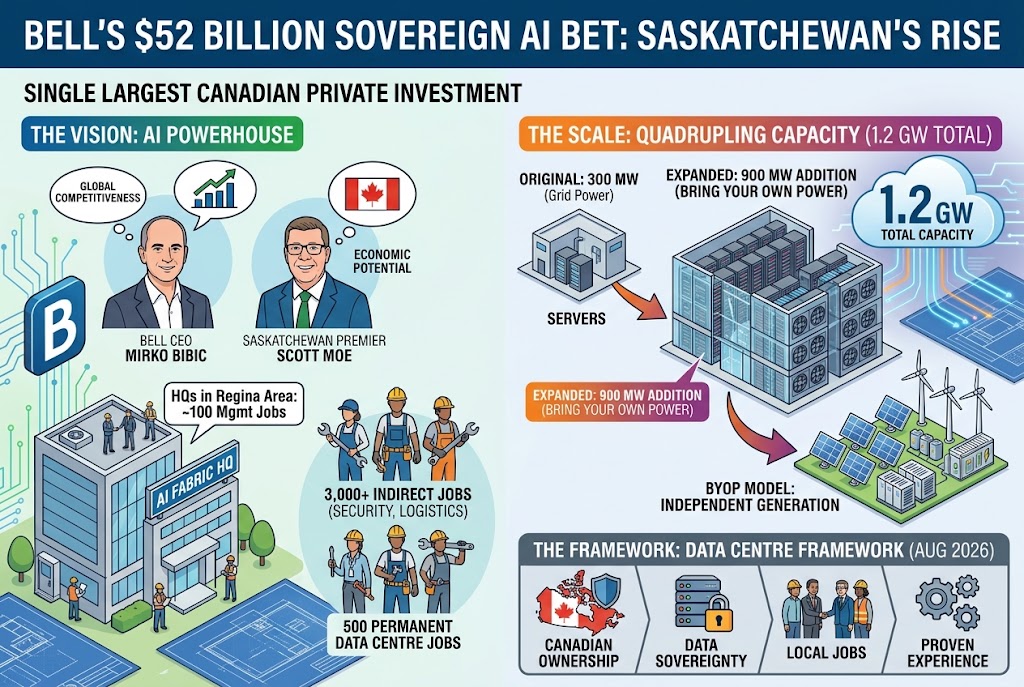
Bell has committed to a $52 billion expansion of its AI data centre near Regina, Saskatchewan — the single largest private-sector capital investment in Canadian history — signaling that the race for AI infrastructure dominance is no longer confined to the usual hyperscaler strongholds in the U.S. and Europe. The move positions Bell as a genuine sovereign AI infrastructure player and gives Canada a real foothold in the global capacity race that has so far been dominated by Microsoft, Google, and Amazon.
The expansion was announced September 14 by Bell CEO Mirko Bibic and Saskatchewan Premier Scott Moe at Canada’s first national investment summit in Toronto, an event aiming to attract $1 trillion in total investment over five years with backing from the Canada Pension Plan Investment Board and the Public Sector Pension Investment Board.
Quadrupling Scale Under a New Power Model
The project originally drew 300 megawatts from Saskatchewan’s provincial grid. Under the new plan, Bell will add up to 900 additional megawatts through a “Bring Your Own Power” model — securing or building its own generation rather than relying solely on public infrastructure — pushing total capacity to 1.2 gigawatts and roughly quadrupling the site’s original footprint. The behind-the-meter approach mirrors a pattern now emerging among hyperscalers globally, who increasingly treat power procurement as a competitive advantage rather than a fixed constraint.
Saskatchewan’s Regulatory Framework Clears the Path
The expansion was approved under Saskatchewan’s Data Centre Framework, released in August 2026, which set six governing principles: Canadian ownership, data sovereignty, local job creation, proven operating experience, and centralized provincial intake for large projects. That framework marks a notably more structured approach than the often-permissive incentive packages U.S. states have used to court data centre investment, and it may become a template other provinces or countries point to as AI infrastructure buildouts strain local grids and housing markets.
Jobs and Economic Stakes for the Prairie Province
Beyond the headline capital figure, the project is expected to create up to 500 permanent jobs in data centre operations and power generation, roughly 3,000 additional positions in security, logistics, and maintenance, and about 100 management roles at Bell’s newly established AI Fabric headquarters in the Regina area. Premier Moe called it a project that “will create thousands of good jobs and new opportunities for Saskatchewan people,” while Minister Jeremy Harrison described it as “a powerful endorsement of our province’s economic potential.”
For Bell, the pivot is strategically significant: as legacy telecom revenue growth slows across the industry, AI infrastructure offers a new growth vector with a scale of capital commitment that rivals — and in dollar terms exceeds — many single projects announced by U.S. hyperscalers this year. It also signals that sovereign AI ambitions, long discussed by governments wary of depending entirely on U.S. cloud providers, are now attracting the kind of private capital needed to make them real. Whether Saskatchewan’s more prescriptive regulatory model slows deployment relative to looser U.S. approvals — or ultimately proves a more durable framework for managing power and community impact — will be a key test case as similar sovereign AI infrastructure bets multiply worldwide.
Leave a Reply