The conversation surrounding Bitcoin mining infrastructure has fundamentally shifted. The key asset is no longer only hash rate. It is power, land, grid access, uptime, and the option to sell compute capacity to whoever values it most: Bitcoin miners, AI labs, cloud tenants, or high-performance computing buyers. This strategic evolution is vividly illustrated by CleanSpark’s massive $6.6 billion AI data center lease, a transaction that serves as a working model for life after the latest Bitcoin halving. If block rewards tighten margins, a miner with large power positions can still build a business around long-duration digital infrastructure. That is a serious shift.
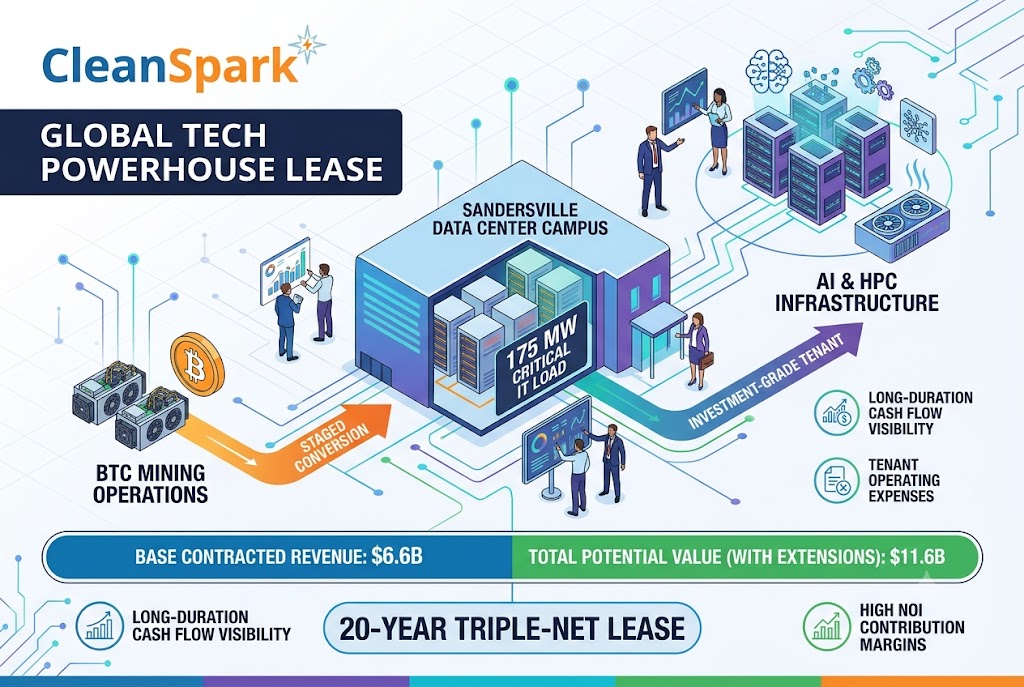
Under the terms of this milestone agreement, CleanSpark signed a 20-year triple-net infrastructure lease with an unnamed investment-grade global technology company for its Sandersville data center campus. The headline number is large: about $6.6 billion in base contracted revenue over the initial term. The agreement also includes two 5-year extension options that could raise total contract value to roughly $11.6 billion. The tenant will deploy production-grade infrastructure for artificial intelligence and high-performance computing workloads at the Sandersville facility, which is expected to provide 175 megawatts of critical IT load. CleanSpark expects the first data hall to be ready in Q4 2027, with the remaining halls ramping in early 2028. Crucially, the company plans to keep mining Bitcoin at the site until that power is transferred. This is not an overnight shutdown of mining. It is a staged conversion of the same energy campus from ASIC mining to AI and HPC infrastructure.
The decision to utilize a triple-net lease structure is a pivotal component of the deal’s financial appeal. In a triple-net lease, the tenant generally carries costs such as operating expenses, property taxes, insurance, and maintenance. This arrangement allows CleanSpark’s role to shift toward owning or controlling the physical infrastructure: land, power access, building shell, and mechanical, electrical, and plumbing systems. Management has projected about $330 million in average annual net operating income once Sandersville is fully ramped, with near-100 percent NOI contribution margins tied to the lease structure. For investors, the difference is simple. A Bitcoin miner’s revenue can swing with BTC price, network difficulty, transaction fees, energy cost, and ASIC efficiency. A long-term lease with an investment-grade tenant gives clearer cash flow visibility. The market noticed the stability of this approach immediately, with reports after the announcement citing share price moves ranging from about 9 percent to more than 20 percent, depending on the source and timing.
Sandersville provides a powerful case study because it shows how Bitcoin mining infrastructure can be repurposed without wasting the original power work. Mining sites are usually built around large electrical capacity, industrial land, utility coordination, transformers, switchgear, and cooling. Those are also the bottlenecks for AI data centers. However, an operational divide remains between the two types of facilities, and an operator cannot simply confuse a Bitcoin mine with an AI data center. The same megawatt is not the same facility.
Bitcoin operations can tolerate environmental conditions that would cause severe issues for advanced computing clusters. ASIC fleets often run with aggressive air cooling, higher intake temperatures, and curtailment windows. In contrast, AI training clusters need tighter uptime planning, denser rack design, fiber diversity, better fire suppression, and cooling that can handle accelerator-heavy racks. One bad network fabric issue can leave expensive GPUs idle while power still burns. That is a very different operating profile. CleanSpark’s deal suggests the company is not simply swapping machines. It is repositioning the campus for a tenant that will bring production-grade AI and HPC infrastructure while CleanSpark monetizes the site as long-term digital real estate.
This dynamic extends far beyond Georgia. Alongside the Sandersville lease, the same tenant signed a letter of intent and exclusivity arrangement covering CleanSpark’s Texas portfolio: 718 acres and up to 885 MW of secured and planned power capacity. That is larger than Sandersville by a wide margin. If it turns into a signed lease, it would reinforce the idea that miners with multi-hundred-megawatt power footprints are becoming strategic suppliers to AI infrastructure buyers. The scarce resource is not only GPUs. It is energized land with a path to utility-scale power. AI companies can buy servers. They cannot instantly create grid interconnections, permitting history, substations, and local operating relationships.
This landmark transaction signals profound changes for the broader Bitcoin mining ecosystem. First, future mining sites will be designed for optionality, meaning they will be planned as dual-use campuses from day one. Operators will incorporate modular data halls, better grid interconnects, stronger cooling plans, and layouts that can support both ASIC fleets and GPU-heavy workloads. When BTC mining economics are attractive, operators can allocate power to miners. When AI tenants offer stronger risk-adjusted returns, power can move toward colocation or lease models. The best operators will design for that choice early because retrofitting is expensive.
Second, hash rate will not be the only valuation metric. For years, public miners were compared by hash rate, fleet efficiency, Bitcoin holdings, and power cost. Those metrics still matter. But CleanSpark’s deal shows that contracted NOI, power capacity, tenant quality, and lease duration may become equally important. A miner with 500 MW of well-located power and credible data center conversion plans may be valued differently from a miner with the same hash rate but weaker site control. That is the real repricing underway.
Third, post-halving pressure will push more miners toward AI and HPC. Bitcoin’s 2024 halving reduced the block subsidy from 6.25 BTC to 3.125 BTC. Miners with high energy costs or older ASICs face tighter margins unless BTC price, transaction fees, or efficiency gains offset the reduction. AI and HPC leases offer another path. They can turn power assets into contracted infrastructure revenue. This does not mean every miner should pivot. Some sites are too remote, too unreliable, or too poorly connected for AI workloads. A low-cost mining site in a weak fiber location may still be better as a mine.
Finally, grid planning will become harder. Sandersville’s 175 MW load is significant. The Texas exclusivity figure of 885 MW is even more striking. At that scale, these campuses become long-term anchors for regional electricity demand. This will naturally invite more scrutiny from utilities, regulators, and local governments. Communities will ask about grid reliability, jobs, water use, tax revenue, and curtailment behavior. Mining operators that want AI tenants will need to speak the language of power planning, not only Bitcoin economics.
Leave a Reply