Contributed Article: By Rohit Gupta, Founder & CEO at Auditoria
Enterprise AI has entered a new phase, in which enterprises are examining what AI should be allowed to do within business workflows. This changes how AI needs to be managed. A system that enforces a policy creates one kind of risk. An AI agent that updates records, initiates workflows, contacts vendors, or reconciles transactions creates another.
This is especially true in finance, where agents resolve vendor inquiries, identify payment issues, reconcile data, or highlight exceptions before they become reporting problems. In my conversations with enterprise leaders, I hear less debate about whether AI can be useful and more discussions about whether organizations are ready to manage AI once it begins doing actual work.
Gartner has predicted that up to 40% of enterprise applications will include integrated task-specific AI agents by 2026, compared with less than 5% in 2025. Deloitte has reported that 74% of respondents expect at least moderate AI-agent use by 2027, while only 21% say they have a mature model for agent governance.
In the US, where finance teams are under pressure to improve productivity while maintaining auditability, compliance, and control, the focus now turns to whether agents can accelerate work within an operating model that the business can defend.
In many companies, agents are orchestrating workflows before the business can establish the governance, oversight, and operating models needed to use them responsibly.
The new digital workforce
For decades, enterprise software was built around people using tools. Employees logged into systems, made decisions, approved transactions, escalated exceptions, and took accountability for the outcome.
AI agents are changing that pattern. These agents can be assigned goals, interpret information, take steps across systems, and complete work with varying levels of independence.
Enterprises, therefore, need to stop thinking about agents only as software features. In many workflows, they increasingly behave like digital workers, with access to systems, data, decisions, and business outcomes.
At that point, governance becomes less abstract. The organization needs to know the agent’s role, the data it can use, the systems it can act in, the decisions it can make, and the points at which it must escalate to a person.
These are familiar control questions, but AI changes the operating conditions. Agents can work continuously, move across workflows, and take action within processes originally designed around human judgment.
Why the old control model does not scale
A common response is to keep a human in every decision loop. That makes sense in early adoption. It builds confidence and gives teams a way to validate outputs before AI has earned trust in a process.
But if every action requires human review, the organization has not really changed the process. It has added AI to the same constraint. The business may get faster analysis or quicker responses, but it still depends on people to move every meaningful step forward.
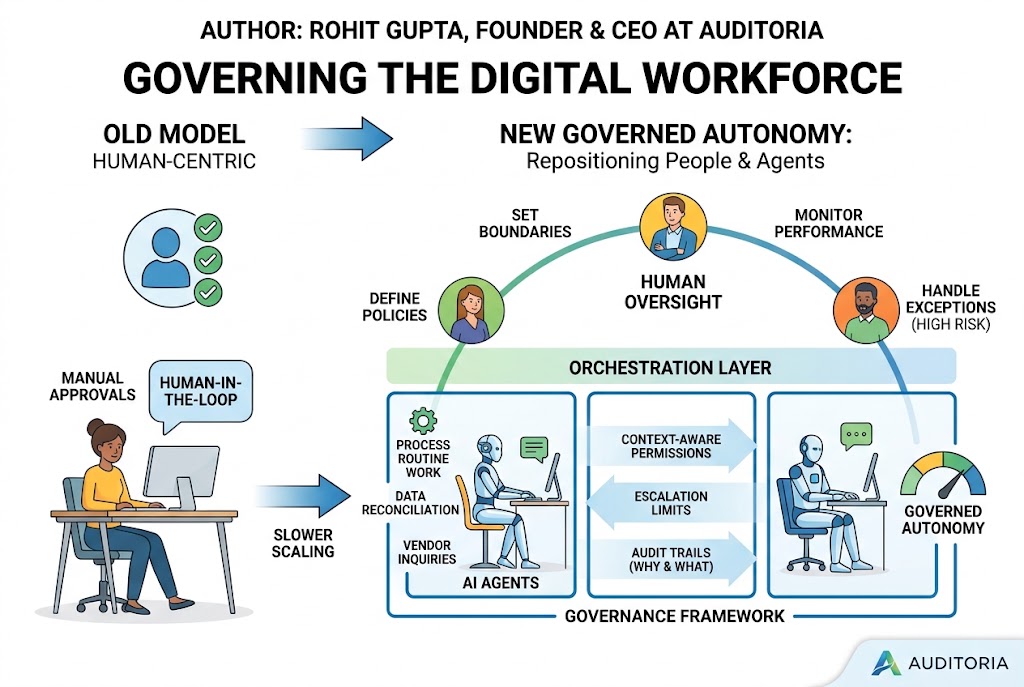
The point is not to remove people from the process, but to reposition them. Humans should define policies, set boundaries, monitor performance, handle exceptions, and make judgment calls where risk is high or review is warranted. They should not have to approve every routine action because the control model has not evolved.
What does governed autonomy really mean?
Governed autonomy is not an excuse for letting AI run loose. It allows AI agents to act independently within defined roles, permissions, policies, and escalation paths.
Enterprises need AI to do more than assist. The technology must complete work and reduce operational friction as well as improve responsiveness without becoming disconnected from accountability, compliance, security, and auditability.
This is especially relevant in finance. An AI agent that helps respond to vendor inquiries, investigate receivables, reconcile data, or identify exceptions cannot be treated like a general-purpose assistant. It is working in an environment where data quality, authorization, timing, and traceability all matter.
A useful agent needs something close to a job description, such as a defined scope, clear permissions, escalation limits, and monitoring that shows what it did, what information it used, and why.
Trust has to move into the design
The early model of trust in AI was based on review. A person checked whether the system’s answer was acceptable. That approach still has a place, but it cannot be the only mechanism. As agents take on more workflow responsibility, trust must be built into the process before the action occurs.
Permissions should be context-aware, controls should reflect the risk of the action, and audit trails should show the outcome, the reasoning behind it, and the data used to produce it. Just as importantly, escalation rules must make clear when the agent should stop and bring in a person.
The best governance models will not treat every AI action the same way. Low-risk and predictable work may be handled autonomously, monitored workflows may need periodic review, and sensitive actions should be escalated immediately.
The next enterprise question
I believe the next phase of enterprise AI will be judged less by how many agents companies deploy and more by how well those agents are managed.
Organizations will need inventories of their agents, just as they maintain inventories of systems, users, and access rights. They will need ownership clarity, behavioral telemetry, and governance that adapts as agents learn, workflows change, and new risks emerge.
AI agents are only going to get better. The hard part is making sure they do not outrun the business. Companies need to be clear about what agents can do on their own, where a person needs to step in, and who carries responsibility when the work is done.
Opinions expressed are the author’s own and do not necessarily reflect those of Biz Tech Journals
Leave a Reply