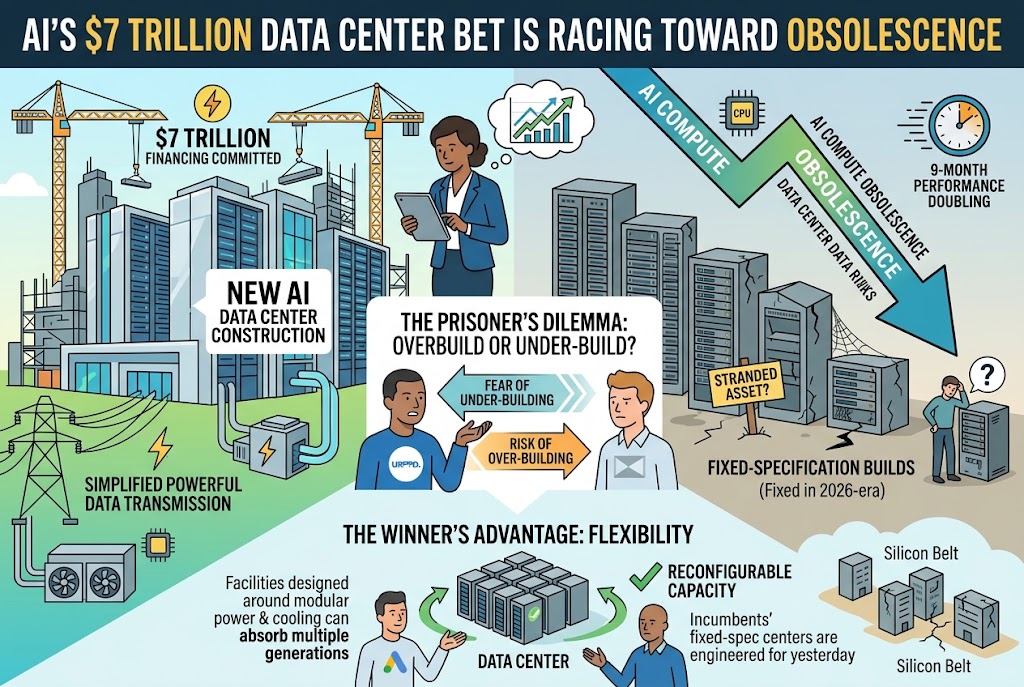
Roughly $7 trillion in financing is now committed to new AI data center construction, even as AI server racks drawing 100-250 kilowatts and compute performance doubling every nine months threaten to strand that infrastructure years before the buildings themselves age out.
The scale of AI infrastructure spending has outrun the physical assets’ useful life, according to Fortune’s reporting on warnings from Ricardo Semler. Data center servers and networking gear last three to six years, cooling and electrical systems seven to fifteen, and buildings thirty to sixty, but AI compute performance is doubling roughly every nine months, meaning the most expensive components go obsolete long before the concrete does. Semler warns the industry risks creating a “Silicon Belt” of abandoned facilities, echoing the Rust Belt’s manufacturing collapse, where regional economies were built around infrastructure that a shift in global production patterns made obsolete almost overnight.
The Capex Figures Behind the $7 Trillion Headline
The $7 trillion in financing represents the cumulative construction pipeline, but the near-term spending is just as telling: Google, Microsoft, Meta, and Amazon collectively guided to roughly $725 billion in 2026 capital expenditure, up 77% from the prior year, most of it flowing directly into the data centers Semler’s warning is about. That spending is compounding, not leveling off, even as the useful-life mismatch he describes becomes harder to ignore, which is itself part of the prisoner’s dilemma: no hyperscaler’s board is going to approve a capex slowdown based on a depreciation argument while competitors keep building at record pace.
Why the Power Numbers Are the Real Warning Sign
Five years ago, a server rack drew 5 to 10 kilowatts. Today’s AI racks draw 100 to 250 kilowatts, a twentyfold increase that has already forced 77% of new data center construction into frontier markets like West Texas, Louisiana, and Ohio, because established hubs are out of power capacity. North America’s data center vacancy rate sits at just 1%. In the first half of 2026 alone, developers contracted 25 gigawatts of electrical capacity, roughly 5% of total annual U.S. power generation, for facilities that current compute trajectories suggest could be functionally outdated within the decade. That power demand is now reshaping regional infrastructure planning far beyond the tech sector itself, pulling grid capacity, water rights, and municipal utility investment into a buildout cycle originally driven entirely by compute economics.
The Mismatch Between Financial and Physical Depreciation Schedules
The core problem isn’t that data centers are expensive, it’s that the financing behind them assumes a useful life the underlying compute hardware won’t come close to matching. Buildings are typically financed and depreciated over multi-decade horizons that made sense for traditional enterprise data centers, where server refresh cycles ran five to seven years. AI infrastructure compresses that refresh cycle toward the eighteen-to-twenty-four-month range for the components that actually drive revenue, the GPUs and accelerators, while the capital stack behind the building itself still assumes a thirty-year asset. That mismatch is what turns a fully-leased, fully-powered facility into a stranded asset: the building survives, the economically relevant compute inside it doesn’t.
No Single Operator Can Afford to Slow Down
This is a textbook prisoner’s dilemma: every hyperscaler knows that overbuilding against an uncertain compute trajectory risks stranding capital, but none can afford to be the one that under-builds and loses the AI infrastructure race to a competitor willing to take the risk. An abandoned AT&T communications facility in Nebraska recently listed for $7.95 million, a preview of what specialized, power-dense infrastructure is worth once the compute generation it was built for is no longer competitive. That kind of markdown, on infrastructure that cost many multiples of its resale value to build, is the exact outcome Semler warns the current $7 trillion buildout is racing toward at scale.
How This Reshapes the Infrastructure Landscape
The winners in this cycle won’t necessarily be whoever builds the most capacity, they’ll be whoever builds the most reconfigurable capacity. Facilities designed around modular power and cooling that can absorb multiple generations of rack density will hold value long after fixed-specification 2026-era builds are stranded. That gives an edge to newer entrants and REITs designing for flexibility today over incumbents whose current-generation data centers were engineered for yesterday’s kilowatt-per-rack assumptions, and it sets up a second-order investment thesis: the next competitive edge in AI infrastructure may belong less to whoever owns the most square footage, and more to whoever can retrofit fastest when the next compute generation arrives on schedule.
Leave a Reply