By news editor
TSMC has responded to a report that it is preparing to manufacture memory chips for Nvidia by restating that its business is contract production of logic chips. The statement mentions neither Nvidia nor DRAM, and the outlets covering it disagree on whether it amounts to a denial.
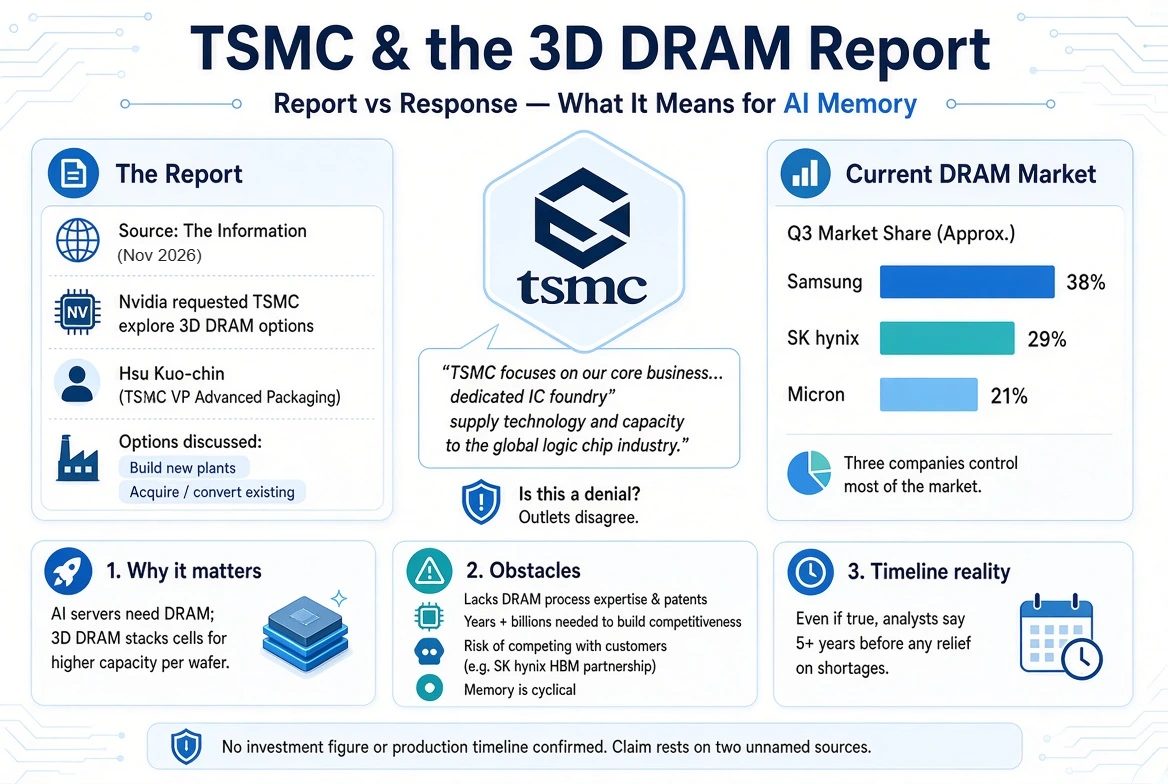
The report originated with The Information. As relayed by Tom’s Hardware, The Information cited two people familiar with the initiative as saying TSMC has begun preparing plans for 3D DRAM manufacturing after a request from Nvidia, its largest customer. The same account names Hsu Kuo-chin, the TSMC vice president responsible for advanced packaging and a former head of Micron’s Taiwanese operations, as overseeing the effort.
Options under consideration include building new plants or acquiring and converting existing ones, according to Seoul Economic Daily, which also summarizes the report. Neither the timing of production nor the way capacity would be secured has been decided, it says.
Asked about the report, TSMC pointed to what it already does. “Please note that TSMC focuses on our core business at all times, which is dedicated IC foundry,” a TSMC spokesperson told Tom’s Hardware. The spokesperson added that the company’s mission is to supply technology and capacity to the global logic chip industry.
How to read that reply is contested. Tom’s Hardware says it essentially means a denial of the report. Technology.org reaches the opposite reading, writing that the answer stopped short of a denial, and reports that Nvidia did not immediately comment.
Memory is the reason the question matters to AI buyers. DRAM is the working memory in every server, and 3D DRAM stacks multiple levels of memory cells vertically to raise the capacity each wafer yields. Tom’s Hardware reports that all three leading DRAM makers, Micron, Samsung and SK hynix, are working on 3D DRAM, and that shortages have turned memory into a component that can decide whether a company ships its products.
Those three companies control most of the market. Samsung, SK hynix and Micron held about 38%, 29% and 21% of DRAM revenue in the third quarter, according to Counterpoint Research figures carried by Technology.org. A TSMC entry would add a fourth supplier, which Tom’s Hardware says could strengthen competition in a market dominated by three manufacturers.
Nothing in the coverage suggests that would happen soon. In its own analysis, Tom’s Hardware says TSMC lacks the expertise and production capacity to make DRAM, and that even buying a small specialty memory maker would leave it needing billions of dollars and years of research to reach a leading-edge DRAM process. It concludes that a 3D DRAM strategy could not ease memory shortages for at least five years.
An executive at a Taiwanese memory company voiced similar doubts. Chao Yu-jun, chairman of Winbond, told reporters that a direct TSMC move into DRAM would be difficult because of process technology and patent issues, in what he described as personal speculation, Seoul Economic Daily reports.
For TSMC, the commercial risks run in two directions. Memory is a cyclical business in which shortages encourage capacity expansions that later depress prices, Tom’s Hardware notes. Producing DRAM could also put TSMC in competition with its own partners, among them SK hynix, which teamed with the foundry in 2024 on logic base dies for high-bandwidth memory. Seoul Economic Daily cites TSMC’s long-standing policy of not competing with its customers as a factor that lowers the odds of an entry.
No investment figure or production timeline has emerged, Technology.org reports, and the central claim rests on two unnamed people cited by a single outlet.
The next development to watch is a statement from either company that addresses DRAM directly. Until TSMC or Nvidia does that, companies budgeting for AI servers have no basis in these reports to expect a new memory supplier.
Leave a Reply