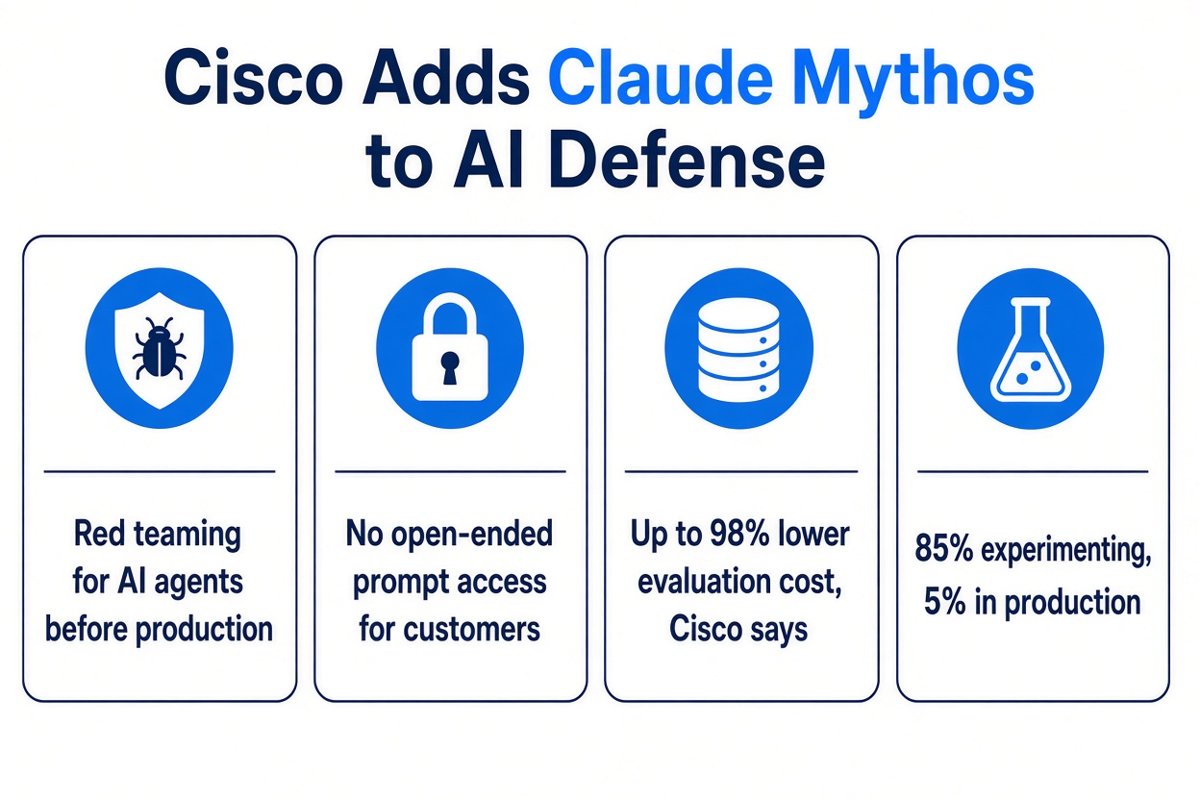
AI-generated infographic: cisco ai defense red teaming with claude mythos. Its figures are taken from this article. Infographic: Grok.
By news editor
Cisco is adding Anthropic's Claude Mythos model to the red-teaming tool in its AI Defense security product, so that enterprise customers can attack their own AI agents with a frontier model before those agents reach production. The company announced the move at its Cisco Live event in Melbourne, together with Splunk features that attach a cost and a quality grade to each agent a company runs.
Red teaming is a simulated attack run to find weaknesses before a real attacker does. In its announcement, Cisco says Claude Mythos will plan tests and generate multi-step attack paths against a customer's AI applications and agents inside AI Defense's existing adaptive red-teaming framework.
Buyers do not get the model itself. According to Cisco, customers work only through AI Defense's structured interface and have no open-ended prompt access. The tool operates only against targets the customer has registered, owns and is authorized to test, and cannot scan arbitrary internet infrastructure. Every engagement requires authentication and is cryptographically tied to a named operator, sessions are time-bound and can be halted on demand, and each testing action is recorded for audit.
What the announcement lacks is a date and a price. Cisco says adaptive red teaming with Claude Mythos is coming soon for select enterprises, and names no customer using it. Network World reports, citing a Cisco blog post, that broader availability is planned for qualified customers on a when-and-if-available basis. Pricing is not disclosed.
AI Defense itself is not new. Since the product launched in January 2025, the company says, it has helped hundreds of customers identify critical flaws in AI models, applications and agents before they reach production.
Spending on agents is the second half of the announcement. A Splunk Agent Observability feature that Cisco calls Tokenomics uses usage data from Amazon Bedrock and Amazon CloudWatch to pair each agent's cost with evaluations that grade the quality and impact of its work. Cisco says Tokenomics will be available in private preview in December, with general availability in AWS Marketplace in early 2027.
Cheaper checking is the pitch behind a related product. Cisco says new Splunk evaluation models, named Eval-G1, are small language models that run evaluations and guardrails at up to 98% lower cost than a commercial LLM and respond 2.5x faster than traditional LLMs. The release does not name the commercial model used for the comparison or describe how the figures were measured, so both numbers stand as vendor claims. The evaluation models and a tuning tool for them are generally available starting this month, according to Cisco.
The company presents the pieces as a single loop for finding risk and measuring value. "You cannot scale what you cannot secure, govern, or observe," said Cisco President and Chief Product Officer Jeetu Patel in the release.
A third piece connects network data to security work. Cisco IQ, which the company says has close to 17,000 customers across more than 22 million devices, will feed vulnerability, lifecycle and configuration data into the Splunk Platform, and new connectors turn exposure findings into ServiceNow problem records.
Agent deployments remain limited, by a Cisco executive's own account. In a Network World analysis of the event's keynote, Oliver Tuszik, Cisco's chief sales officer, is reported to have cited research indicating that 85% of organizations globally are experimenting with agents but only 5% have deployed them to production. The analysis does not identify the research.
The next markers are a date and a price for Mythos-based red teaming, the December private preview of Tokenomics, and any published method behind the 98% figure. Cisco's release carries its own caution: the timeline for some products, features and integrations is subject to change.
Leave a Reply