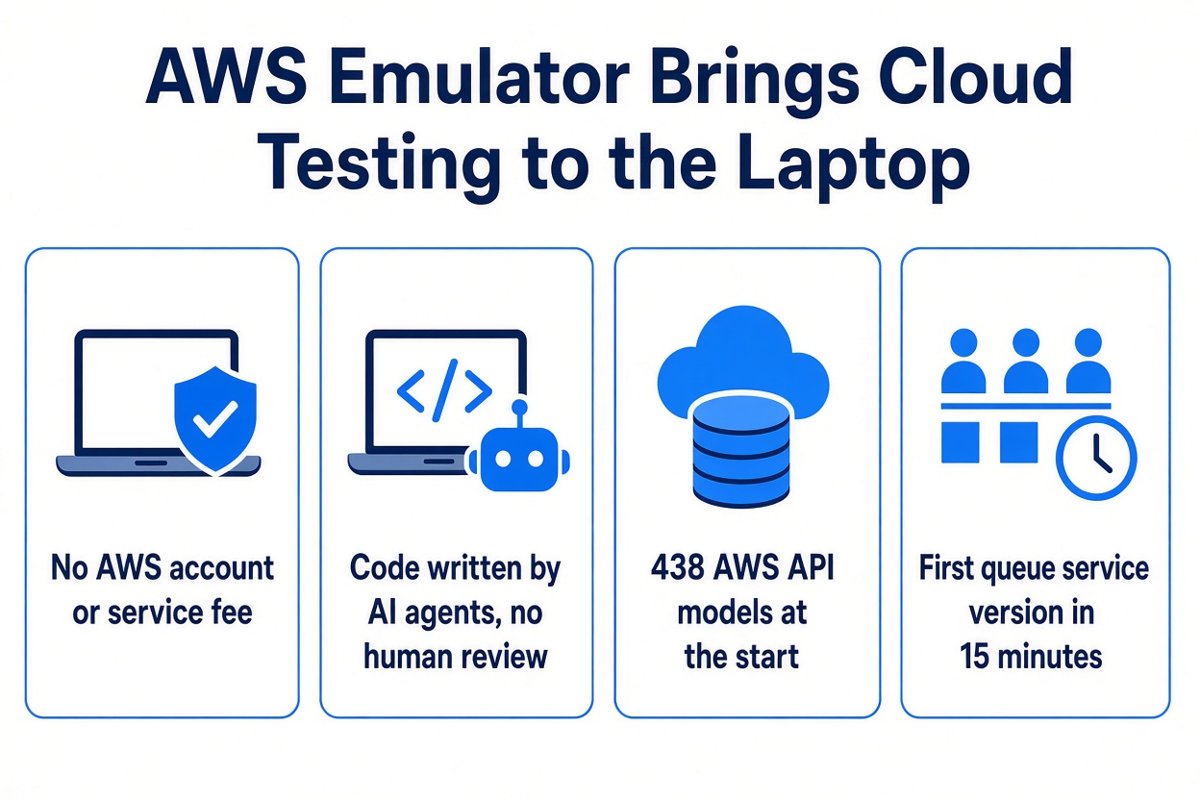
AI-generated infographic: aws emulator local cloud testing tool. Its figures are taken from this article. Infographic: Grok.
By news editor
Amazon Web Services has released AWS Emulator, a free program that imitates the AWS cloud on a developer's own machine so that software can be tested without an AWS account or a cloud bill. The company says autonomous AI agents wrote all of it, and that nobody on the team has written or reviewed the code.
That claim comes from Matthew Goldberg, a senior principal engineer at AWS, in a post on Amazon's news site. Goldberg writes: "The emulator was written entirely by autonomous agents. Our team hasn’t written or reviewed any of the code."
According to the README in AWS's GitHub repository, the emulator is a local program with no graphical interface that serves an AWS API endpoint. Developers point the AWS command line tool or a software development kit at that endpoint by setting environment variables, then run their code as usual. Requests go to emulated resources instead of real ones. The README says the emulator carries no additional service fee and that customers pay only for AWS resources when they deploy on AWS.
The cost argument is about development and testing. InfoWorld reports that AWS is pitching the tool at developers and AI coding agents that would otherwise provision and pay for real infrastructure to test each change. Advait Patel, a senior site reliability engineer at Broadcom, told the outlet that moving an agent's write, run and fix cycle to a laptop cuts each cycle from minutes to seconds and shrinks development account bills.
Goldberg's post describes how the software was produced. One team of agents maintains tens of thousands of fidelity tests, each verified against the real AWS cloud. A second team replays those tests against the emulator and files issues for the failures. A third fixes the issues one at a time, and every change must pass a gate that checks coding standards, security and whether fidelity has regressed.
The project began as a weekend experiment, Goldberg writes, in which AWS's Kiro coding agent returned a passable first version of the Simple Queue Service after 15 minutes. The repository started as an empty web server able to accept requests for 438 AWS API models. Hundreds of agents work on the code concurrently and fix thousands of issues a day, by his account. Of the gate, he writes:"Without this merge gate, we wouldn’t trust what our agents are building."
Limits are spelled out in AWS's own documentation. The README states: "AWS Emulator is for building and testing. Don’t use it for production workloads or to test security." Behaviors that do not yet match AWS are tracked in a public directory of known issues, and AWS says it publishes fidelity scores for each service with every release. Those scores are AWS's measurements; no independent test of the emulator's accuracy is cited by any of the sources.
Analysts quoted by InfoWorld name the gaps that matter to operations teams. "At launch, the emulator does not simulate throttling or outages, snapshot and restore, or per-Region availability, which matter most for resilience," said Devin Pratt, research director at IDC. Patel's warning was about what such tests leave unproven: "If your tests never see a 429 or a timeout, your retry and backoff logic never gets tested." Pratt also told InfoWorld that the emulator does not sandbox the code it runs, so a function tested locally with real production credentials could still reach real AWS resources.
The README carries two operational details. Telemetry is on by default: the emulator reports usage data to AWS, which says the records never include request or response contents, code, credentials or personal data, and documents how to switch reporting off. The repository also does not accept outside code contributions, only bug reports. The code is released under a Creative Commons CC0 public-domain dedication, apart from a vendor directory under the Apache License 2.0.
Missing from both AWS pages are a named customer and any usage figures. Goldberg says the post is the first in a series that will cover how the agent workflow is built, how fidelity is measured and how the team sets its quality and security bar. The fidelity scores attached to coming releases are the number to watch: they are AWS's published measure of how closely the copy tracks the real cloud.
Leave a Reply