By news editor
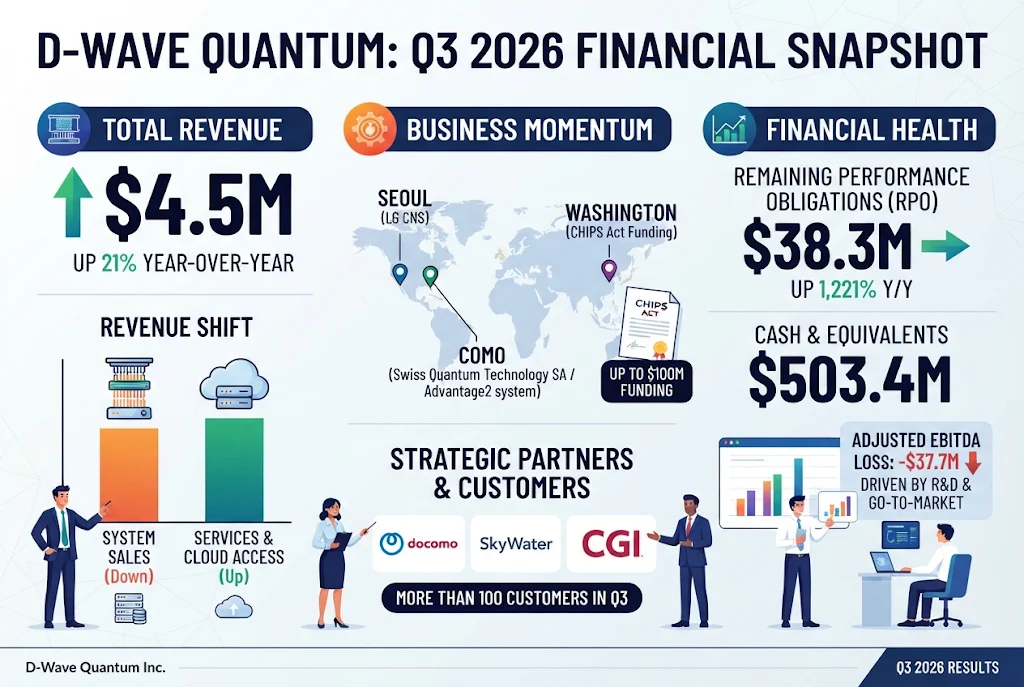
D-Wave Quantum reported third-quarter revenue of $4.5 million, up 21% from a year earlier, in results that show its business tilting from selling quantum computers toward services and cloud access. Professional services revenue rose by $1.5 million and quantum computing as a service revenue rose by $0.8 million, while system sales revenue fell by $1.5 million, according to the company’s results release.
The quarter’s bookings, which D-Wave defines as customer orders expected to generate revenue in the future, were $1.9 million, a year over year decrease of approximately $0.4 million, or 19%. The company says bookings in any single quarter can vary with the timing of larger transactions, and the nine-month figure tells a different story: bookings for the first nine months of 2026 were $37.4 million, up $32.1 million, or 611%, from the same period of 2025. That total includes $2.3 million in Quantum Circuits bookings closed immediately before D-Wave completed its acquisition of that company in January 2026, the release notes.
Remaining performance obligations, the value of non-cancellable orders not yet delivered, stood at $38.3 million as of September 30, 2026, up 1,221% from $2.9 million a year earlier. D-Wave expects approximately 59% of that balance to be recognized as revenue within the following 12 months and approximately 71% within 24 months. The company recognized revenue from more than 100 customers in the quarter, 48% of them commercial enterprises.
“From Seoul to Como to Washington, we are seeing growing interest in D-Wave’s differentiated dual-platform approach and a determination to put our quantum computing technology to work today,” said Dr. Alan Baratz, CEO of D-Wave, in the release.
The cost of chasing that interest is visible in the expense lines. GAAP operating expenses were $55.9 million, up $25.5 million, or 84%, driven mainly by a $12.3 million increase in personnel costs, $4.1 million more in non-cash stock-based compensation and $4.6 million more in non-cash depreciation and amortization. Adjusted EBITDA loss, a non-GAAP measure, widened by $17.0 million, or 83%, to $37.7 million, which the company attributes to spending on product development and go-to-market initiatives.
GAAP gross profit was $2.4 million, down $0.3 million, or 11%, and GAAP gross margin was 52.9%, which the release describes as a year over year decrease of 18.5%. D-Wave says the margin fell primarily because a larger share of revenue came from lower-margin professional services.
Net loss was $48.2 million, or $0.13 per share, compared with a loss $91.8 million larger a year earlier. The improvement is an accounting effect rather than an operating one: the release attributes it primarily to a $121.9 million decrease in non-cash, non-operating charges tied to remeasuring the company’s warrant liability, and notes that all remaining publicly traded warrants were redeemed in November 2025.
D-Wave closed the quarter with $503.4 million in cash and marketable investment securities. During the quarter it executed a definitive agreement with the U.S. Department of Commerce giving it access to up to $100 million of CHIPS and Science Act funding, paid in installments as specified milestones and conditions are met. The funding is intended to support a 100,000-qubit annealing quantum computer and a 10,000-qubit gate-model machine designed to deliver 100 logical qubits, according to the release.
The customer list in the release includes NTT DOCOMO, which D-Wave says has deployed a second production application on its hybrid quantum technology to optimize network signaling, and the delivery of a 4,400-plus qubit Advantage2 system to Como, Italy, funded by Swiss Quantum Technology SA. D-Wave also cites a multi-year semiconductor manufacturing agreement with SkyWater, a partnership with CGI and a memorandum of understanding with LG CNS in South Korea. Contract values for these arrangements are not disclosed.
The release contains no revenue or bookings guidance for the fourth quarter or the full year. The next things to watch are whether fourth-quarter system sales recover, how quickly the $38.3 million in remaining performance obligations converts to revenue, and when the first CHIPS Act installment is paid; the company’s quarterly report on Form 10-Q will carry the detail behind the figures above.
Leave a Reply