By news editor
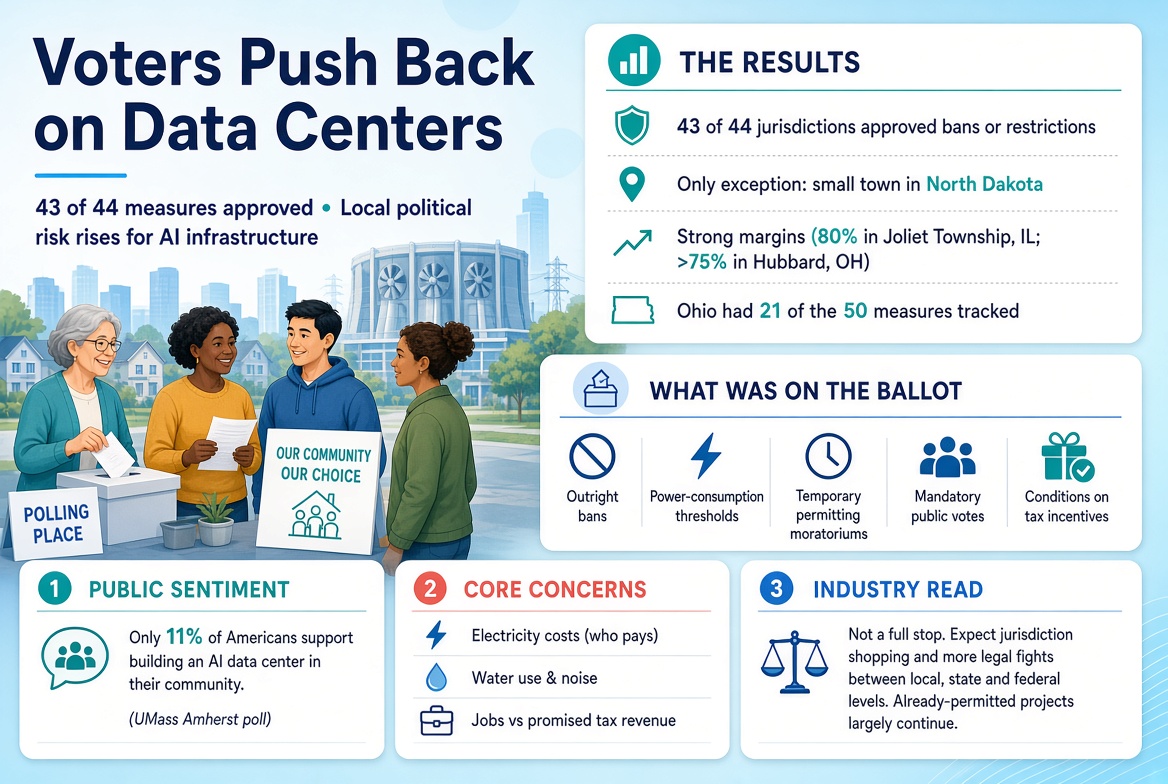
Voters in at least 43 of 44 jurisdictions with data center measures on the midterm ballot approved bans or restrictions on the facilities, according to a Network World tally, a result that adds a layer of local political risk to projects that were already contending with grid delays and rising construction costs.
The lone exception, Network World reports, was a small town in North Dakota that voted down a restriction on new construction. Everywhere else the measures carried. In Joliet Township, Illinois, a restriction on new data centers passed with 80% of the vote, and in Hubbard, Ohio, more than three-quarters of voters backed limits.
Ohio was the main battleground, accounting for 21 of the 50 measures tracked by Ballotpedia, as reported by Network World. The approaches on the ballot ranged from outright bans to power-consumption thresholds, temporary permitting moratoriums, mandatory public votes on new facilities and conditions on developers seeking tax incentives. In California, voters in Alhambra and Monterey Park approved a measure prohibiting data centers, and in Edgewater, Florida, voters passed a charter amendment opposing new data centers and expansions of existing ones.
The votes track a broader shift in opinion. A University of Massachusetts Amherst poll, cited by Stateline and carried by Network World, found that just 11% of Americans supported building an AI data center in their community. At the state level, Network World reports that Democratic candidate Gina Hinojosa made slowing data center construction the centerpiece of her campaign and became the first Democratic governor of Texas since Ann Richards in 1994.
Analysts who follow the build-out are not reading the results as a halt. “The local moratoriums we had seen were mostly short, and projects that were already permitted could keep moving,” said Alex Cordovil, research director with Dell’Oro Group, in an interview with Network World. “So we expected limited impact on the overall build-out. What we did expect was a lot of jurisdiction shopping, with developers seeking out the authorities most welcoming to data centers.” Cordovil also expects more legal fights among federal, state and local governments as different levels of government pull policy in different directions.
The exposure is uneven. Network World’s reading is that the biggest risks fall on projects whose sites, zoning approvals or financing arrangements are directly affected, while established data centers and projects that have already secured approvals are not automatically subject to new restrictions. Many of the measures, it notes, amount to a demand to slow down and evaluate rather than a permanent prohibition.
Three issues ran through the campaigns, according to the report: electricity demand and who pays for it, with residents seeking assurances that utilities will recover grid costs from data center customers rather than households; water consumption and local environmental effects such as noise from cooling equipment and generators; and the gap between the construction spending and tax revenue developers promise and the relatively small permanent workforce a facility employs.
The newly elected officials now own both sides of that ledger. “Opposing data centers is easy from the outside. Governing is harder,” said Cordovil. Alan Howard, senior analyst with Omdia, told Network World that reasonable restrictions and a requirement that operators pay their fair share are fair, with one qualification: “What is misguided is believing the solution is moratoriums,” said Howard.
No dollar value for projects delayed or cancelled by the votes has been published, and the count of measures is Ballotpedia’s as relayed by Network World rather than a figure this publication has verified at the source. The next thing to watch is whether developers with pending applications in Ohio, Illinois and Texas withdraw them or move to friendlier counties, and whether state legislatures move to pre-empt the local measures before the next round of permitting.
Leave a Reply