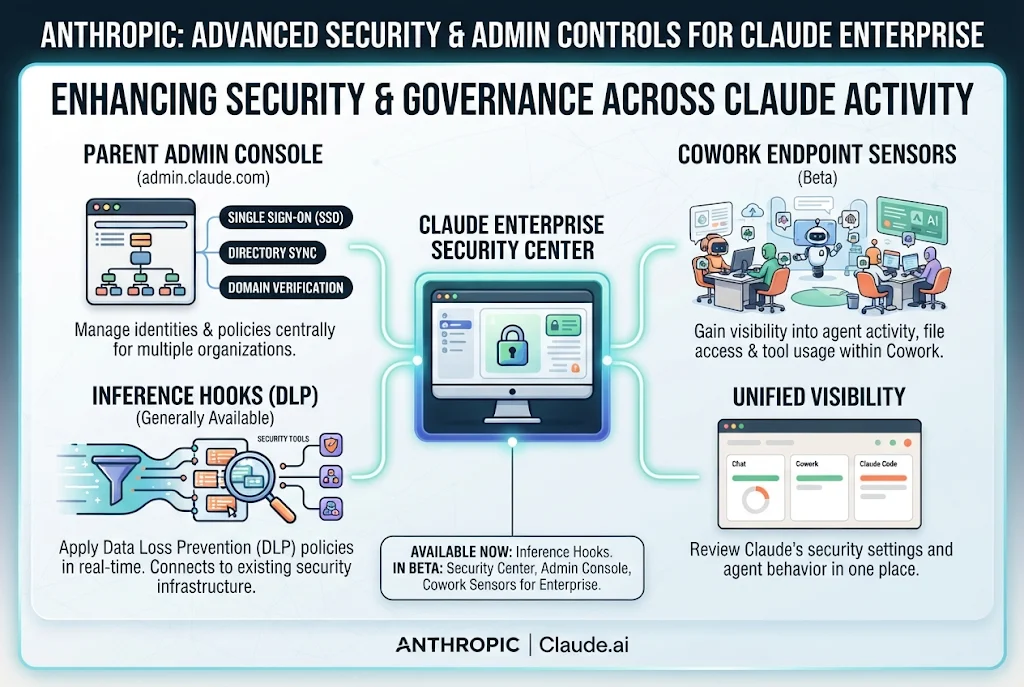
Anthropic announced a set of security and administration features for Claude Enterprise on November 5, giving security teams more visibility into how Claude is configured, what it does on company devices and how data is handled as people work. The update includes a security center, generally available inference hooks, centralized management and new access controls, along with an endpoint detection and response integration announced recently.
The security center is a new page in Organization settings that shows how an organization’s Claude settings compare with Anthropic’s recommended configuration for chat, Cowork and Claude Code. For each control, it shows the current value, the recommended value where there is one, and a link to the setting where it can be changed, and it flags which settings are new or recently changed. The page checks configuration each time it loads, and organizations with the Compliance API can read the same results through it. Admins can use attestations as a shared workspace for security reviews, recording the state of each control, accepting risks and flagging issues, and they can download the page as a report for auditors and stakeholders. Anthropic notes that the security center is guidance based on its recommendations, not a certification or guarantee of compliance with any law or standard.
Inference hooks, now generally available, connect Claude to the data security tools an organization already uses so its data loss prevention and security policies can apply to prompts and tool calls as people work. There are two kinds: prompt hooks send prompts from supported Claude products to the organization’s security tool for a check, and pre-tool-call hooks check tool calls before they run. The hooks work with security vendors, so teams keep the policies they have already written and apply them to Claude.
Centralized management gives a parent organization, which represents a company across its Claude Enterprise and Claude Platform organizations, its own admin console at admin.claude.com. Admins can manage company-wide settings there once, including single sign-on, directory sync, domain verification, groups and Compliance API keys. The console shows every organization under the parent in one place and adds two roles: parent organization owners can manage everything at the parent level, and parent organization admins can manage everything except role assignments.
New access controls round out the release. Security teams can sign a member out of Claude with a single Admin API call, ending that member’s sign-in sessions on every browser and device without removing them from the organization. Enterprise admins can now set up and manage their own IP allowlist without going through Anthropic. Admins can also set the most-used Claude Desktop settings without a device management push, and they can block personal and other outside Claude accounts in Claude Desktop on managed computers to help prevent shadow IT.
For endpoint visibility, admins can run their organization’s EDR sensor inside the virtual machine that Cowork and unified Claude use when working locally. The sensor reports activity there to the same console the security team already monitors, covering the virtual machine on the user’s computer rather than cloud sessions. Admins set it up through device management on macOS and Windows, Claude verifies the sensor package’s signature from the EDR vendor each time the virtual machine starts, and the sensors run in detection mode, reporting activity without blocking it.
The release reflects where enterprise AI adoption is heading. As companies move from chat to agents that read files and call tools, security teams want the same inspection points they have for email and endpoints. Hooks that plug into existing security vendors, centralized identity management and endpoint visibility make it easier to extend current governance rather than rewrite it.
Leave a Reply