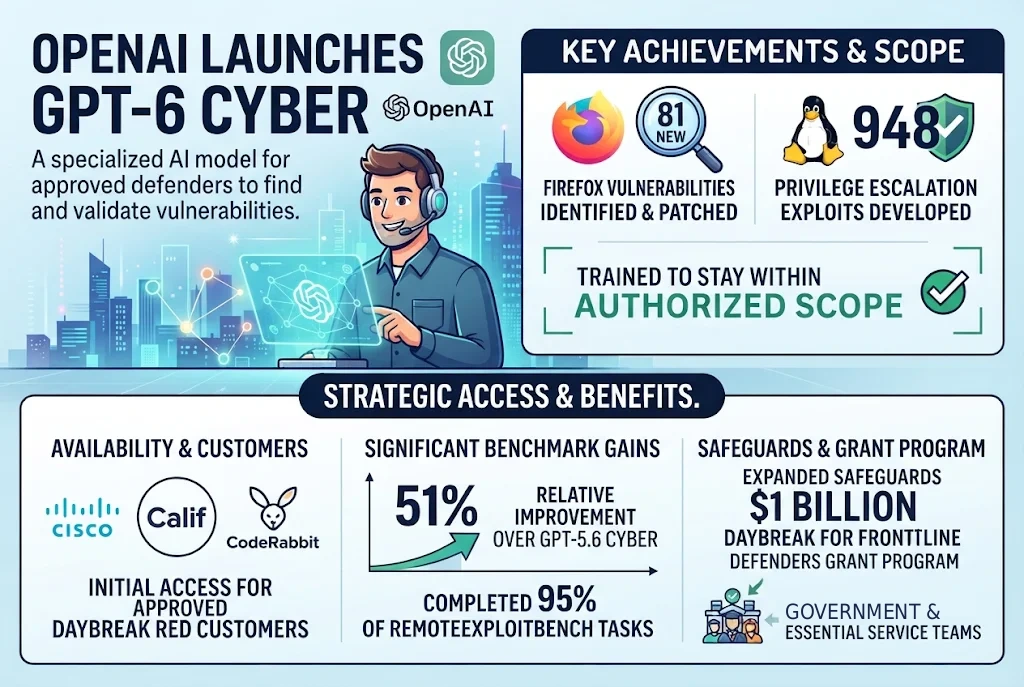
OpenAI introduced GPT-6 Cyber on November 5, a cybersecurity model trained to find and validate exploitable vulnerabilities while staying within the scope that researchers set. The company says it is a major leap in security research, more capable at finding and fixing vulnerabilities and far more reliable at staying within the boundaries researchers set. GPT-6 Cyber is initially available through the API and Codex to a select group of approved Daybreak Red customers, and OpenAI says access will expand progressively to all Daybreak Red customers soon.
The real-world results are significant. OpenAI’s researchers used the model to develop 948 privilege escalation exploits in Linux and to identify 81 previously unknown high-severity vulnerabilities in Firefox, despite extensive prior testing with frontier models. The model also helped develop candidate patches, and Mozilla has released fixes for many of the Firefox vulnerabilities. OpenAI says GPT-6 Cyber has already uncovered and validated thousands of exploits in security-critical codebases such as Linux and Firefox. Security teams at Cisco, Calif and CodeRabbit are using it for vulnerability research and code review, and OpenAI says it has relied on it to find and fix weaknesses in its own infrastructure.
The benchmark gains are clear. On ExploitGym, which tests whether models can exploit a specified vulnerability in a remote target, GPT-6 Cyber scores 48.5%, up from 32.1% for GPT-5.6 Cyber, a 51% relative improvement. On RemoteExploitBench, a new benchmark that uses known vulnerabilities in applications such as GitLab, PostgreSQL and Jenkins deployed in a controlled environment, GPT-6 Cyber completed 95% of tasks, with its only failure being an exploit it could not get working remotely. In a new evaluation of offensive web penetration testing, where models probe web applications without access to source code, it achieved 40.3% recall of vulnerabilities, compared with 32.0% for GPT-6 Astra.
OpenAI also highlighted how well the model stays within bounds. One risk for cybersecurity agents is that they go outside the scope of an assigned task or disregard a researcher’s rules of engagement, so OpenAI made alignment a central focus. In a separate alignment evaluation, GPT-6 Cyber avoided exploiting out-of-scope services in 99.93% of tests without its deployment prompt, and in 100% of tests with it, reflecting dedicated training to respect authorized scope and report results accurately.
Based on its evaluations, OpenAI classifies GPT-6 Cyber as Critical in cybersecurity under its Preparedness Framework, up from High for GPT-5.6 Cyber, and is pairing the release with expanded safeguards. The company says it has refined protections against assistance that could compromise industrial controls or safety-critical systems, and it increased its investment in threat investigations to detect model usage involving operational technology and industrial control systems.
Critical infrastructure defenders are a focus. A $1 billion Daybreak for Frontline Defenders grant program subsidizes access for resource-constrained teams such as government organizations and essential service providers, and a new group within Daybreak Red, Daybreak Red for Critical Infrastructure, gives approved defenders permission to conduct authorized testing of critical systems while keeping safeguards against model misalignment. OpenAI partnered with Dragos, a provider of operational technology cybersecurity, to evaluate how the models can help defend critical infrastructure. In a controlled lab simulating a power plant, a cyber-permissive Daybreak Red model separated operational technology assets from IT noise on its own and found two zero-day vulnerabilities in engineering software that manages protective relay data, according to Dragos, which used the feedback to help refine OpenAI’s safeguards.
The access model is as important as the model itself. GPT-6 Cyber is offered to approved defenders rather than the general public, which reflects the dual-use nature of tools that can both find and exploit software flaws. Limiting availability, pairing it with expanded safeguards and funding access for under-resourced teams is an attempt to put the capability first in the hands of the people who patch systems rather than the people who attack them.
Leave a Reply