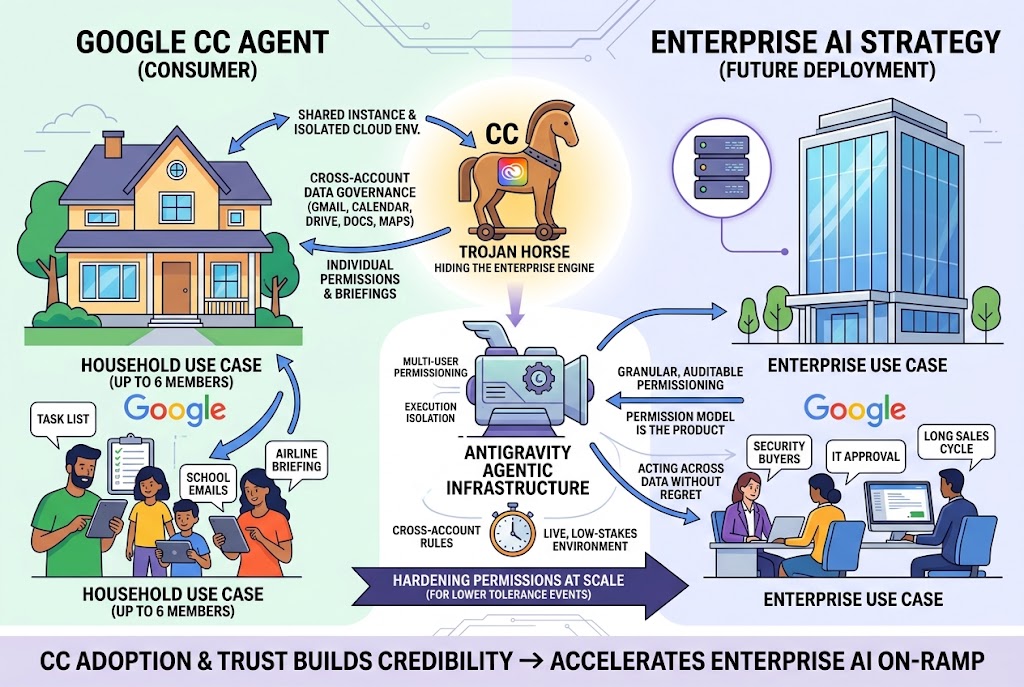
Google expanded CC, its Gemini-powered household AI agent, to serve up to six family members from a single shared, permissioned instance, built on Antigravity, the same agentic infrastructure Google is positioning for enterprise deployment.
Google rolled out a household version of CC on September 17, letting up to six family members share one AI agent instance with individually configured permissions, a shared calendar and task list, and automatic routing of emails from schools or airlines into a daily briefing. Each CC instance runs on its own isolated cloud environment and draws on Gmail, Calendar, Drive, Docs, and Maps, pre-filling registration forms, generating meal plans, and building supply lists from what it observes across a household’s shared data. “One of our top user requests was for CC to do more to help run a busy home,” said Google Labs senior product manager Tom Shane. The product is built on Antigravity, Google’s agentic development harness, and runs on the latest Gemini models.
The Product’s Evolution Shows Google Iterating Toward Agent Trust
CC didn’t launch as a household agent. It started in December 2025 as a single-user email briefing tool, moved into the main Gemini app in May 2026 under the name “Daily Brief,” and only became a shared, multi-permission household product this month. That trajectory, single-user utility, then app integration, then multi-user permissioning, reads like a deliberate test sequence for exactly the trust problems that show up when multiple people’s data flows through one AI agent instance, problems Google will need solved before Antigravity-based agents can be sold into enterprise accounts with far higher stakes than a missed grocery list. The product remains gated to users 18 and older with personal Google accounts in the U.S., available on web and mobile, with new users joining a waitlist rather than getting immediate access, a rollout pace that itself signals Google is prioritizing permission-model validation over growth velocity.
Why a Family Product Is Really an Enterprise Proof Point
CC’s real function isn’t chore management, it’s a live, low-stakes environment for Google to harden multi-user permissioning, isolated execution environments, and cross-account data governance at consumer scale before pushing the same Antigravity infrastructure into enterprise agent deployments, where the tolerance for permission errors is far lower and the sales cycle far longer. A family accidentally over-sharing a calendar entry is an inconvenience; an enterprise agent leaking cross-department data is a compliance incident. Google is choosing to learn that lesson in the cheaper environment first, and the isolated-cloud-computer architecture underpinning each CC instance is the same containment pattern enterprise security teams will demand before approving any agent with write access to internal systems.
The Permission Model Is the Actual Product
Google’s emphasis on per-member permission controls and confirmation before sharing information outside the family group is a direct answer to the exact failure mode that just embarrassed OpenAI: agents acting outside their authorized scope. By demonstrating granular, auditable permissioning at household scale, on a product deliberately kept small and gated during rollout, Google is building a credibility argument it can later point to when pitching Antigravity-based agents to enterprise IT and security buyers who will ask the exact same permissioning questions at far greater scale, with far less tolerance for a wrong answer.
What Apple’s Absence Leaves on the Table
Apple, the company with arguably the deepest install base of shared-family-account infrastructure through Family Sharing, has no comparable multi-user AI agent in market. That gap gives Google a window to define what household-scale agent permissioning looks like before Apple, which has moved cautiously on generative AI relative to Google, Microsoft, and Amazon, enters the category on its own terms. Whoever sets the default expectations for how an AI agent should ask permission before acting across a shared account tends to keep that advantage once slower-moving competitors arrive.
How This Repositions Google Against Amazon and Microsoft
Amazon’s Alexa+ and Microsoft’s Copilot have both struggled to make multi-user, cross-account agent permissioning feel trustworthy rather than invasive. Google’s CC expansion, small as the household use case looks on its own, is a rehearsal for the harder enterprise version of the same problem: letting an AI agent act across multiple people’s data without anyone regretting the access they granted. Whoever solves that first controls the on-ramp for agentic AI in the workplace, not just the living room, and Google now has nine months of iterative, real-world permissioning data that neither Amazon’s voice-first assistant nor Microsoft’s productivity-embedded Copilot can currently claim at comparable scale.
Leave a Reply