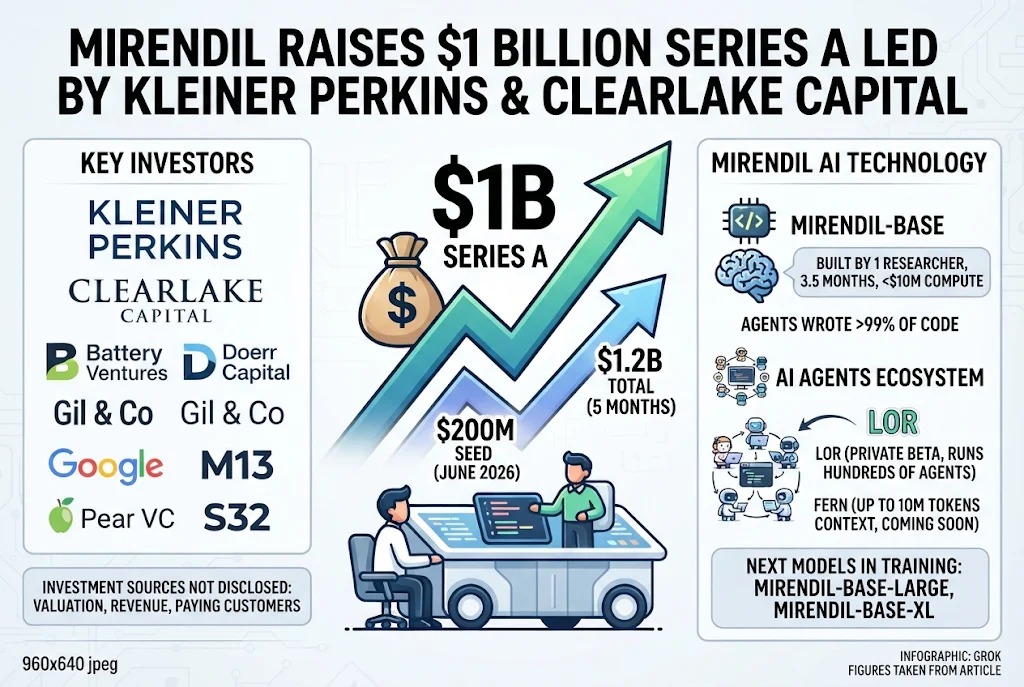
AI-generated infographic: mirendil series a funding round. Its figures are taken from this article. Infographic: Grok.
By news editor
Mirendil, an AI lab that formally announced itself in June, says it has raised $1 billion in a Series A round led by Kleiner Perkins and Clearlake Capital. The announcement, distributed through PR Newswire and posted on Mirendil's site, gives no valuation, no revenue figure and no breakdown of how the money will be spent.
Seven other participants are named: Battery Ventures, Doerr Capital, Gil & Co, Google, M13, Pear VC and S32. The company says other new and existing investors also took part and does not identify them.
The round follows quickly on the last one. On June 24, 2026, in the post that announced the company, Mirendil said Andreessen Horowitz and Kleiner Perkins had led a seed round of $200 million, followed by an investment from Nvidia among others. The two rounds it has put a number on add up to $1.2 billion in less than five months. Kleiner Perkins is the only firm named as a lead in both. Neither Andreessen Horowitz nor Nvidia is named in the Series A announcement, though its investor list is open-ended.
Google is both an investor in the new round and a supplier. On August 6, 2026, Mirendil announced a multi-year partnership with Google Cloud under which it will run training, inference and research workloads on Google Cloud, using both Google's TPU chips and Nvidia hardware. Mirendil's posts disclose neither the size of Google's investment nor the value of the cloud agreement.
The company's main published result so far is about cost. Mirendil says it builds models and tools that let AI agents, software that carries out multi-step work on its own, do most of the hands-on labor of AI research. Its evidence is Mirendil-Base, a coding model it described in an October post: "Our first pretrained model was built by one researcher in 3.5 months, with less than $10M in compute." The company says that figure is all-in, covering the agents' token spend and data processing, and that agents wrote over 99% of the code.
Those numbers are Mirendil's own, and the materials cite no outside evaluation. The comparison it publishes uses bits per byte, a measure of how well a model predicts text in which lower is better. Across seven external code repositories, Mirendil-Base averaged 0.222, behind Kimi-K3 at 0.193 and ahead of GLM-5.3 at 0.242, DeepSeek-V4-Pro-Base at 0.243 and Nemotron-550B-Base at 0.247, by the company's table.
Two products sit on top of that model. Fern is a version of Mirendil-Base that the company says can hold up to 10 million tokens of context, meaning the amount of text and code a model can consider at once. The Fern page lists access as coming soon, promises fuller long-context results later, and carries an edit note saying the company corrected two of its figures to reflect its training results more accurately.
Lor, the second, is a tool that runs hundreds of agents at a time on code and experiments. According to its product page, Lor is in private beta by invitation, is free during the beta and comes with its own compute. No price after the beta is given, and no customer is named. The one user the funding announcement identifies is the company itself: "Mirendil runs on Lor every day."
Headcount is also undisclosed. In June the company said its founding team consisted of 20 researchers and engineers from institutions including Anthropic, xAI, Google DeepMind and OpenAI. The Series A announcement says only that the team is still small, and it quotes no executive by name.
Two larger models come next. Mirendil says Mirendil-Base-Large and Mirendil-Base-XL are still in training and that it will share updates on both. The other items to watch are a price for Lor once the private beta ends, and whether anyone outside the company publishes results for Fern.
Leave a Reply