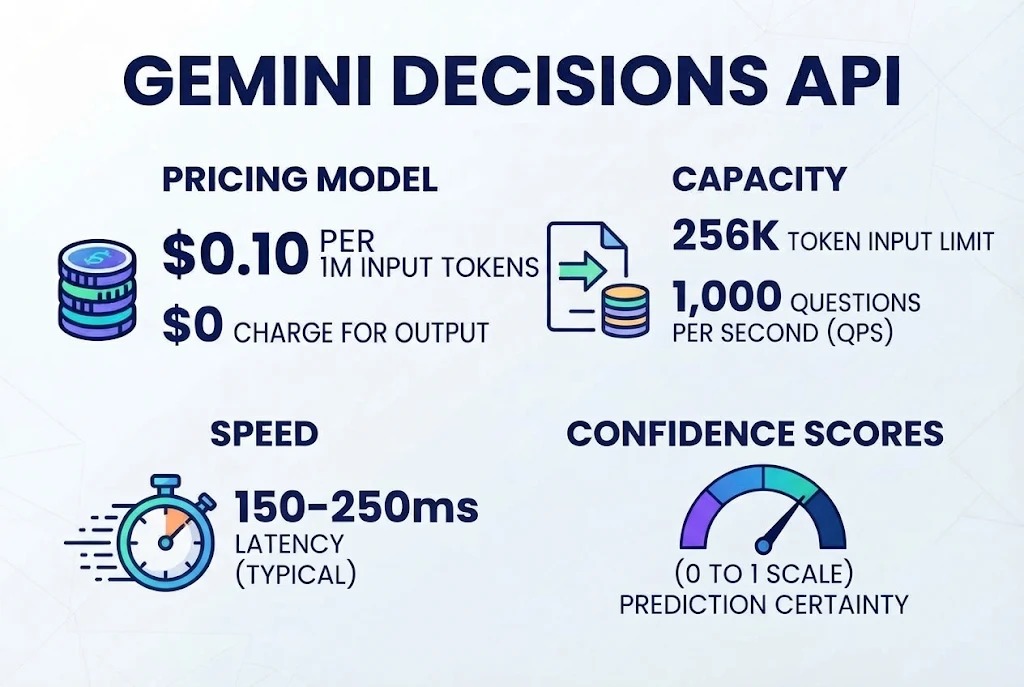
AI-generated infographic: google gemini decisions api launch and pricing. Its figures are taken from this article. Infographic: Grok.
By news editor
Google has introduced the Gemini Decisions API, a service that returns yes/no answers, multiple-choice picks and rubric scores, each with a confidence figure, instead of generated text. The company priced it at $0.10 per 1 million input tokens, with no charge for output. Tokens are the units of text and other content by which AI services bill.
The service is aimed at the routine judgments an AI application makes around its calls to a larger model. In the announcement, Min Choi and Felix Yu of Google DeepMind list tool selection, policy checks, model routing and context grading. Developers reach it through the Gemini API in Google AI Studio. Support for Gemini in Google Cloud is to follow, and the post gives no date.
A single request can carry one input of up to 256K tokens, made up of text, images, audio, video and PDFs, along with up to 1,000 independent questions. A new model, Gemini Decision 1, scores the candidate answers in one pass and does not generate text token by token. Every answer comes with a confidence score from 0 to 1, which Google says lets an application send ambiguous cases to a fallback or a human reviewer.
Billing follows the input, not the number of questions. The post states: "Your shared input is billed once per request no matter how many questions you evaluate (each question adds only its own instruction and criteria tokens)." Google adds that there are no output-token charges, no variable thinking-token bills and no separate costs for audio transcription or optical character recognition, and that a no-cost tier is available in AI Studio for prototyping.
On speed, Google claims end-to-end latency of 150 to 250 milliseconds. That figure is stated for contexts of up to 16K tokens and is described as nearly flat from 1 to 100 questions per request. The post gives no latency number for a request at the 256K-token or 1,000-question limits.
Two other claims rest on Google's own testing. The company says Gemini Decision 1 leads a benchmark suite covering agent routing, reasoning, ranking and multimodal understanding, with the lowest calibration error, meaning its confidence scores track how often it is right. It also says the service is nearly 5x cheaper across that suite than its own Gemini 3.5 Flash-Lite model used through a different API. No independent test is cited.
Every user named in the post is inside Google. Gemini Notebook uses the API to route each query to a model tier, which Google says serves everyday queries with up to 40% lower latency. Stitch, a design tool, uses it to generate wireframes and apply edits. CC, a Google Labs product, uses it to pick emoji reactions, and Google Search uses it as a safety layer for Model Context Protocol tools. Integrations with outside developer tools including OpenRouter, LangChain, Vercel and LiteLLM are described as rolling out. No external customer is named.
OpenAI already sells a service of the same name. Its documentation says the OpenAI Decisions API is generally available, accepts up to 400 questions per request and evaluates text, images and JSON, with files and audio not supported. Uncached input on its gpt-6-luna model costs $0.10 per 1M tokens, output tokens are not charged, and cached input is discounted. InfoWorld reports that OpenAI's service reached general availability in October.
That leaves the list price for fresh input identical. Google's stated advantages are the larger question limit and audio, video and PDF input. OpenAI's is the cache discount, which Google's post does not mention for its own service.
An analyst quoted by InfoWorld puts the weight elsewhere. "The true benefit lies in the reduced misjudgment and improved decision-making quality," Lian Jye Su, chief analyst at Omdia, says in that report. Su also warns, according to InfoWorld, that shifting or deliberately manipulated inputs could lead such services to wrong judgments, and that a confidence score alone does not establish whether an assessment can be trusted.
Still to come are a date for Google Cloud availability, results from customers outside Google, and any response on price from either company.
Leave a Reply