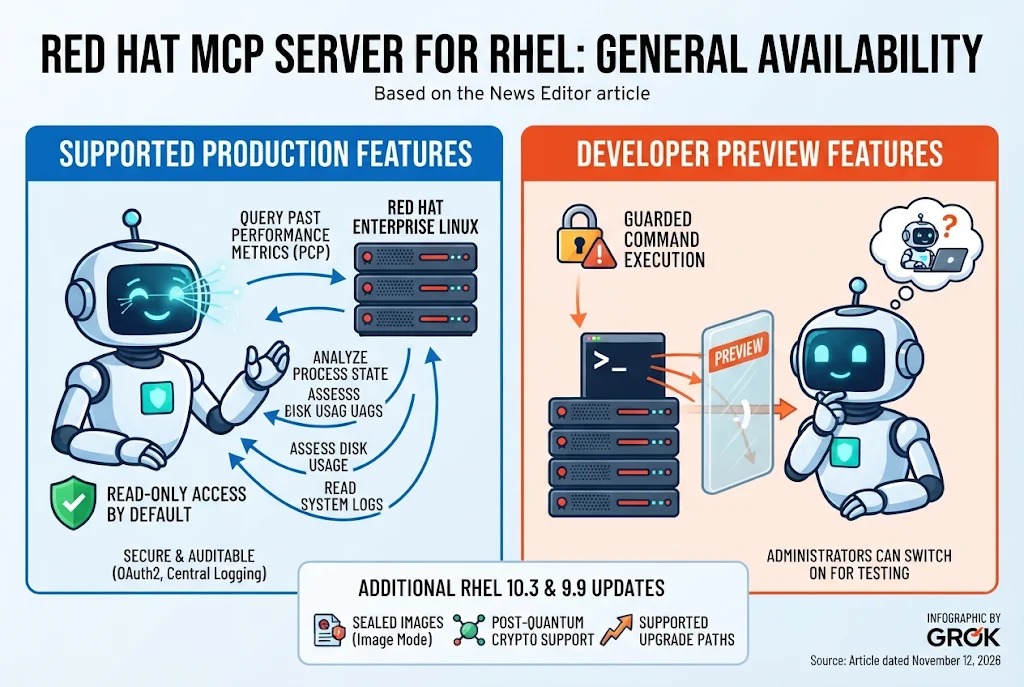
AI-generated infographic: red hat mcp server for rhel general availability. Its figures are taken from this article. Infographic: Grok.
By news editor
Red Hat has moved its Model Context Protocol (MCP) server for Red Hat Enterprise Linux from Developer Preview to general availability, giving companies a supported way to let AI assistants read diagnostic data from their Linux servers. The change arrived with RHEL 10.3 and RHEL 9.9, which the company announced together.
MCP is an open standard that AI models and agents use to connect to tools and data. In a separate post, Red Hat product manager Brian Smith describes the server as a bridge between large language models and RHEL infrastructure. It lets an assistant read system logs, assess disk usage and analyze process state, to help troubleshoot problems such as a failing service or a filesystem nearing capacity.
What is supported in production is limited to reading. Smith writes: "With the GA release, administrators now have a supported, production-ready toolset, which provides read-only tools by default." A feature that lets a model generate and run commands or scripts, which Red Hat calls guarded command execution, remains in Developer Preview. Administrators can still switch it on to test it, under that narrower scope of support.
Two additions come with the release. The server now includes tools from Performance Co-Pilot, a performance-tracking tool available in RHEL, so an assistant can query past performance metrics; before, Smith writes, it could retrieve only current, real-time information. Companies can also run the server centrally in a shared mode, with authentication through an external OAuth2 authorization server, central logging, and a policy file that sets which hosts each user can reach and which tools they may use.
For installation, the server ships as an RPM package in the RHEL extensions repository. Neither post gives a price, and neither names a customer running the server.
The RHEL 10.3 and 9.9 releases carry other changes for IT teams. Sealed images for image mode, generally available in RHEL 10.3, cryptographically verify that the operating system content on a machine matches what was deployed, from firmware to the root filesystem. Red Hat also cites new post-quantum cryptography support aimed at CNSA 2.0 compliance requirements, and supported upgrade paths from RHEL 9.9 to 10.3 and from RHEL 8.10 to 9.9. A self-managed version of the RHEL command-line assistant, running on inference the customer hosts, is in Developer Preview.
Other Red Hat products are gaining MCP access too, at varying stages of maturity. Mike Barrett, vice president and general manager of Red Hat Hybrid Platforms, writes in a post introducing OpenShift 5 that the new major version of the company's application platform ships MCP endpoints, and that its AI-driven features are optional. Advanced Cluster Management 5.0, Red Hat's tool for running fleets of Kubernetes clusters, adds an MCP server for its search service only as a technical preview.
An analyst quoted by Network World ties that caution to how buyers behave. "Nobody is going to hand an autonomous agent the keys to production on day one. Red Hat seems to understand that," Matt Kimball, an analyst at Moor Insights & Strategy, says in the outlet's report on Red Hat's agent tools.
That report also carries a comparison that does not favor Red Hat. Donovan Brady, vice president of developer relations at Leapwork, a software testing company, says in the report that Microsoft's Azure Agent 365 supports agents wherever they are deployed, and adds: "Red Hat definitely does not have that same single control plane." A control plane, in this sense, is one place from which a company manages all of its agents.
Two preview features have no graduation dates in Red Hat's posts: guarded command execution on RHEL and the cluster management search server. Those dates, along with any pricing or named customers for the RHEL server, are the next things to watch.
Leave a Reply