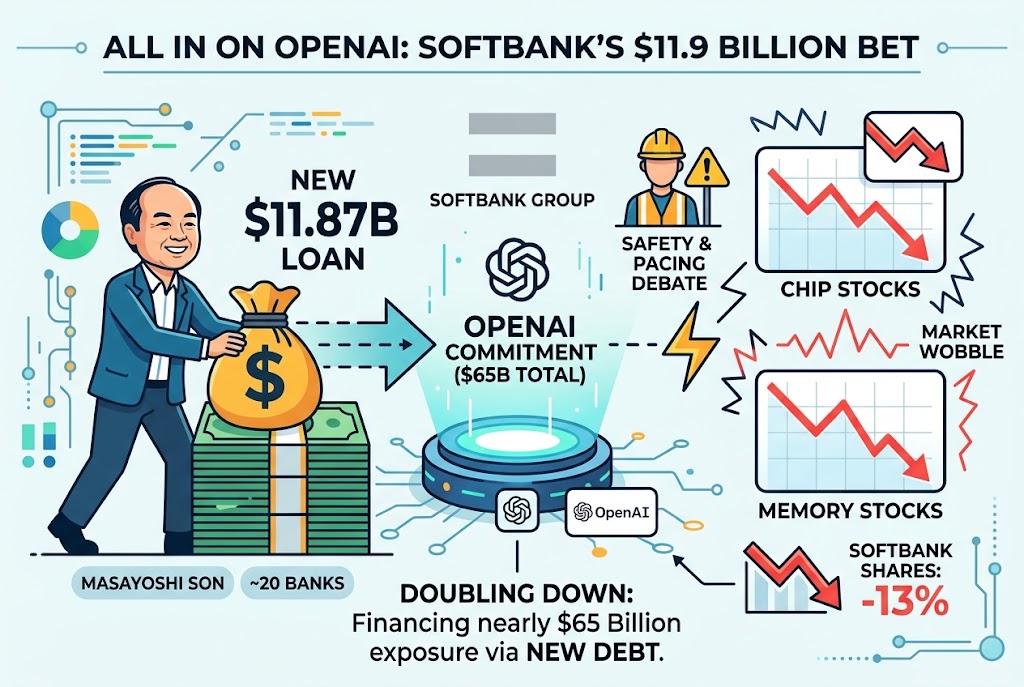
SoftBank has locked in an upsized $11.87 billion loan from roughly 20 banks — well above its original $10 billion target — to keep financing its nearly $65 billion commitment to OpenAI. The two-year facility lands in the same week the AI industry’s “pacing” debate wiped billions off chip and memory stocks, and it sent SoftBank’s own shares down 13%, their sharpest drop since mid-July. Rather than pull back, Masayoshi Son is doubling down.
Financing an All-In Bet
The new loan is only the latest piece of a debt stack SoftBank has been assembling all year to fund its OpenAI position. The company has already raised roughly $37 billion through bond sales and other debt markets in 2026, and it is separately unwinding a $40 billion bridge facility — paying down $25.9 billion of that balance on September 15, with the remainder not due until March 2027. SoftBank is also exploring a further $10 billion to $20 billion high-yield bond sale to keep the capital structure moving. Taken together, the financing shows a conglomerate willing to lever up heavily on a single bet rather than fund it from cash on hand.
Conviction Against the Grain
The timing is pointed. SoftBank priced this financing days after Anthropic CEO Dario Amodei’s call to “pace the frontier” triggered a selloff across the semiconductor supply chain, and just as OpenAI CEO Sam Altman confirmed the company would not proceed with an IPO this year, citing safety and governance priorities. That combination — a paused path to public-market liquidity plus an industry-wide safety pause — would ordinarily argue for caution. SoftBank went the other direction, treating the moment as one to secure financing rather than wait it out.
“SoftBank is betting that OpenAI will continue to sit at the center of that stack,” said Stephanie Walter of HyperFRAME Research. “The unknown is whether OpenAI can turn its early lead into a business that justifies this level of investment.”
Why This Matters Beyond SoftBank
SoftBank’s exposure to OpenAI is now overwhelmingly debt-financed, which means its own balance sheet is increasingly tied to a company that has just pushed its liquidity event further out and whose industry is publicly debating whether it is moving too fast. That’s a different risk profile than the equity-funded infrastructure bets other hyperscalers are making, and it raises a question the rest of the market will be watching closely: what happens to the AI financing ecosystem if a bet this concentrated, this leveraged, and this exposed to a single lab’s roadmap goes sideways before that lab’s investors get a path to cash out. For now, SoftBank is signaling that the answer is worth the risk.
Leave a Reply