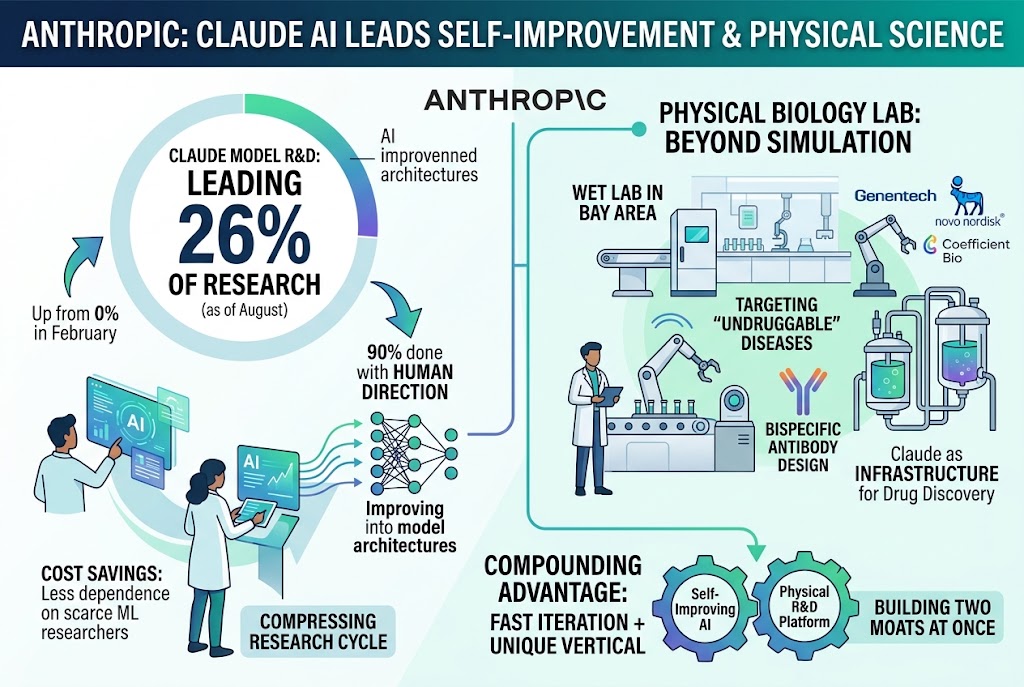
Anthropic says Claude now leads 26% of its own model research and development, up from zero in February, while quietly opening a wet biology lab to move Claude’s drug-discovery work from simulation into physical experimentation.
Anthropic disclosed that Claude is leading 26% of the company’s model R&D as of August, a jump from 0% just six months earlier, with roughly 90% of R&D now done in direct collaboration with the model under human direction. Separately, the company has opened a physical biology lab in the Bay Area, pushing its life-sciences work beyond computer simulation and into real experimentation. “We believe that to do biology, the final test is still and will be for a while in real lab work,” said Eric Kauderer-Abrams, Anthropic’s head of life sciences. The lab is not currently running clinical trials; its mandate is earlier-stage discovery work, including bispecific and trispecific antibody design aimed at conditions the pharmaceutical industry has historically classified as “undruggable.”
The Revenue Number That Puts This in Context
Anthropic’s annualized revenue run rate topped $65 billion ahead of its IPO as of mid-August, surpassing OpenAI’s roughly $40 billion run rate reported around the same time. That reversal, Anthropic out-earning the company that still leads on consumer name recognition, is happening in the same window Anthropic is disclosing that Claude does a growing share of its own R&D and operating a physical science lab. The R&D efficiency story and the revenue story are not separate narratives; they’re evidence the same operating model, compressing research cycles while expanding into high-value verticals like pharma, is translating directly into commercial results.
Why a Self-Improving Model Changes Anthropic’s Cost Structure
If Claude is doing a quarter of the R&D work that would otherwise require Anthropic to hire and retain scarce machine learning researchers, that’s a direct hit to the single largest cost center in frontier AI development: talent. OpenAI, Google DeepMind, and Meta are all still scaling largely through headcount and compute; Anthropic is testing whether it can scale through model leverage instead, compressing the research cycle for each successive Claude generation. Kauderer-Abrams framed the calculus directly: “There’s some things that we can do much faster in our own hands…to operate at the largest possible scale,” a comment aimed at R&D velocity but equally applicable to Anthropic’s broader strategy of building internal capability rather than renting it through partnerships alone.
The Biology Push Is a Market-Positioning Bet, Not a Side Project
Anthropic’s wet lab, backed by its roughly $400 million acquisition of Coefficient Bio and the addition of Novartis CEO Vas Narasimhan to its board, targets “undruggable” disease targets and bispecific antibody design, with partners including Genentech and Novo Nordisk. That’s a direct bid to establish Claude as infrastructure inside the pharmaceutical R&D pipeline, a vertical OpenAI and Google have talked about but not staffed at this depth. Automating lab work through AI-directed robotic systems, rather than simply advising human researchers, puts Anthropic in direct contact with the physical bottlenecks, reagent costs, assay turnaround, experimental failure rates, that have slowed computational drug discovery promises for a decade.
The Personal Motivation Behind the Strategic Bet
The initiative traces in part to CEO Dario Amodei’s own experience: his father died before a cure for his condition became available, a loss Amodei has cited as motivation for pushing Claude toward tangible medical impact rather than purely commercial or capability benchmarks. Whether or not that framing resonates with enterprise buyers, it gives Anthropic a differentiated brand narrative against OpenAI and Google, both of which market AI capability in more abstract, benchmark-driven terms.
Why This Alters the Landscape Against Legacy AI Labs
The 26% figure matters less as a snapshot than as a growth curve: zero to a quarter of R&D output in six months implies a compounding advantage if the trend holds. Combined with a physical science lab that turns Claude into a lab-automation platform, not just a chatbot, and a revenue run rate that now exceeds OpenAI’s, Anthropic is building three moats at once: faster internal iteration, a defensible position in a vertical general-purpose competitors haven’t staffed for, and the commercial results to fund both. The risk Anthropic has flagged itself: a model that accelerates its own development also gets harder for humans to fully understand or control, a tension that puts Anthropic in the unusual position of racing toward a capability it is simultaneously warning the industry about.
Leave a Reply