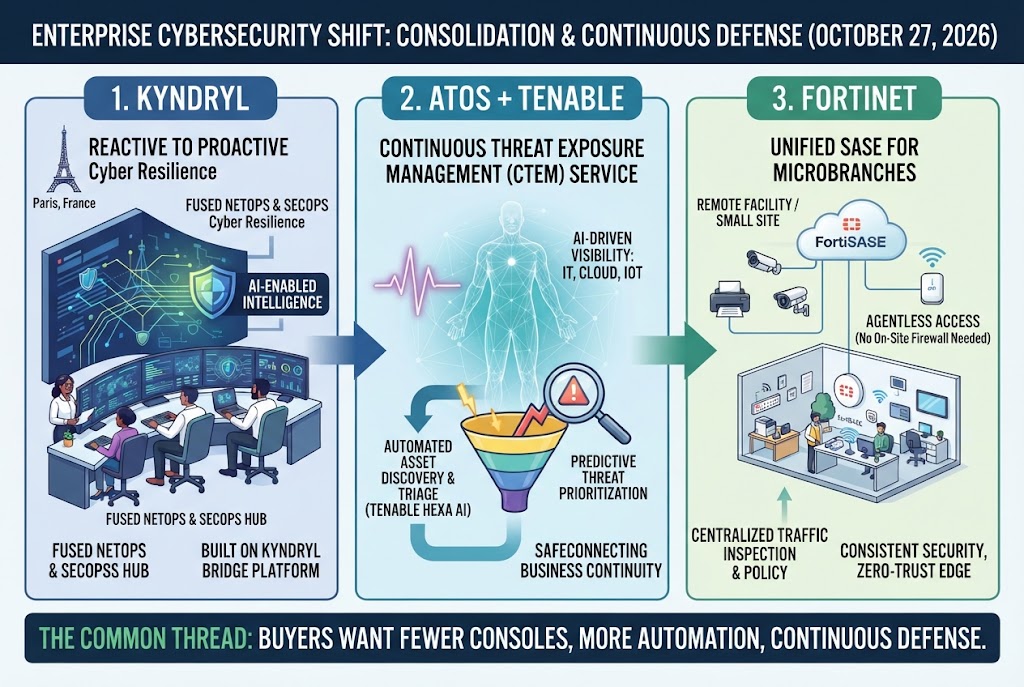
Three security announcements on October 27, 2026, point to the same enterprise shift: buyers want fewer consoles, more automation and continuous rather than reactive defense. Kyndryl opened a combined network and security operations hub in Paris, Atos picked Tenable to run its continuous threat exposure management service, and Fortinet extended its unified SASE offering to small sites that have no on-site firewall.
Kyndryl (NYSE: KD) unveiled a Cyber Defense Operations Center in Paris, the company’s first center of its kind in Europe. The facility combines network operations, cybersecurity operations and AI-enabled intelligence in a single operating model, built on Kyndryl Bridge, the company’s AI-powered, open-integration digital business platform. More than a dozen technology alliances and partnerships support the center across threat detection, vulnerability management, security automation, incident response and network monitoring.
The center builds on Kyndryl’s announcement at Choose France 2025 and complements its AI Innovations Labs in Luxembourg and Dallas. Kyndryl’s network and security operations centers span North America, Europe, Asia-Pacific and Latin America, with delivery capabilities in more than 60 countries. The company tied the investment to regulatory pressure, citing the EU’s Digital Operational Resilience Act (DORA), and to complexity: its 2026 State of Modernization Report found that 68% of organizations are increasing their use of at least four technology environments at once, while 59% of French organizations cite delivery disruption, project delays or operational downtime as modernization challenges.
“The new center in Paris is the first of its kind for Kyndryl in Europe,” said Jérôme Calmelet, President and Strategy Director, Kyndryl France, adding that it “brings the strength of both our global and local capabilities into one place.” Paul Savill, Senior Vice President and Global Practice Leader for Cyber Resilience and Connectivity at Kyndryl, said: “This enables our customers to effectively move from reactive monitoring to proactive cyber resilience.”
Tenable (NASDAQ: TENB) said Atos, a global leader in AI-powered digital transformation, selected it to power Atos’s Continuous Threat Exposure Management (CTEM) service, with Tenable named one of Atos’s preferred partners. The companies announced the deal at the it-sa Expo&Congress in Nuremberg, Germany, which runs October 27 to 29, where Tenable is exhibiting in Hall 7.
The service is built to help organizations move from reactive remediation to proactive risk reduction. According to the GlobeNewswire release, exposures such as misconfigurations, overpermissioned identities and shadow AI are multiplying as enterprises rapidly adopt AI agents, deploy applications continuously and migrate to the cloud.
Atos chose Tenable One for its global CTEM operations, citing unified, AI-driven visibility across IT, cloud, identity and operational technology environments. The platform pairs predictive threat prioritization with the ability to translate attack path analysis into actionable business risk reduction, and adds Tenable Hexa AI, which Tenable describes as an autonomous engine that automates asset discovery, tagging and triage.
“When building our next-generation CTEM services, choosing Tenable as our strategic technology partner was an easy decision,” said Farah Rigal, Head of Global Cyber Security Products and Services at Atos. “The Tenable One Exposure Management Platform is hands-down one of the most comprehensive platforms on the market today.”
“Modern cybersecurity isn’t about fixing every flaw, it’s about safeguarding business continuity before threats materialize,” said Greg Goetz, VP of Global Strategic Partners at Tenable. Tenable, which reports more than 40,000 customers, posted second quarter 2026 revenue of $268.5 million, up 8.6% year over year.
Fortinet (NASDAQ: FTNT) introduced the FortiLink SASE Service, which connects local networks at small branch offices, remote facilities and temporary sites to FortiSASE through supported Fortinet Wi-Fi access points and Ethernet switches. The approach removes the need for an on-site FortiGate firewall while centralizing traffic inspection, policy enforcement and management in the cloud, with supported networking devices and security policies handled from a single console.
The service brings entire local networks under one security policy. It protects wired and wireless devices, including employee devices, printers, cameras and IoT equipment that cannot run endpoint agents such as FortiClient, at sites with limited on-site IT staff. According to the GlobeNewswire release, the benefits include protecting more devices, simplifying deployment by avoiding per-device agents and per-site security appliances, and centralizing management.
“Organizations need flexibility in how they secure distributed locations, particularly where dedicated security infrastructure or agents may not be practical,” said Anthony James, EVP of Marketing at Fortinet. “By extending FortiSASE to local networks, we’re giving organizations a simpler way to protect users and devices while maintaining consistent security and centralized control.”
SASE is a growth engine for Fortinet, which reports more than one million lifetime customers. In the second quarter of 2026, FortiSASE billings more than doubled year over year and unified SASE billings rose 35%, while total revenue climbed 26% to $2.05 billion, according to Pulse 2.0.
Together, the three announcements show the security industry delivering on what enterprises are asking for. Kyndryl is bringing network and security operations together under one roof in Europe, Atos and Tenable are making continuous exposure management a managed service backed by AI-driven prioritization, and Fortinet is extending enterprise-grade cloud security to the smallest sites in a network. Each points toward a future of unified operations, smarter automation and proactive defense.
Leave a Reply