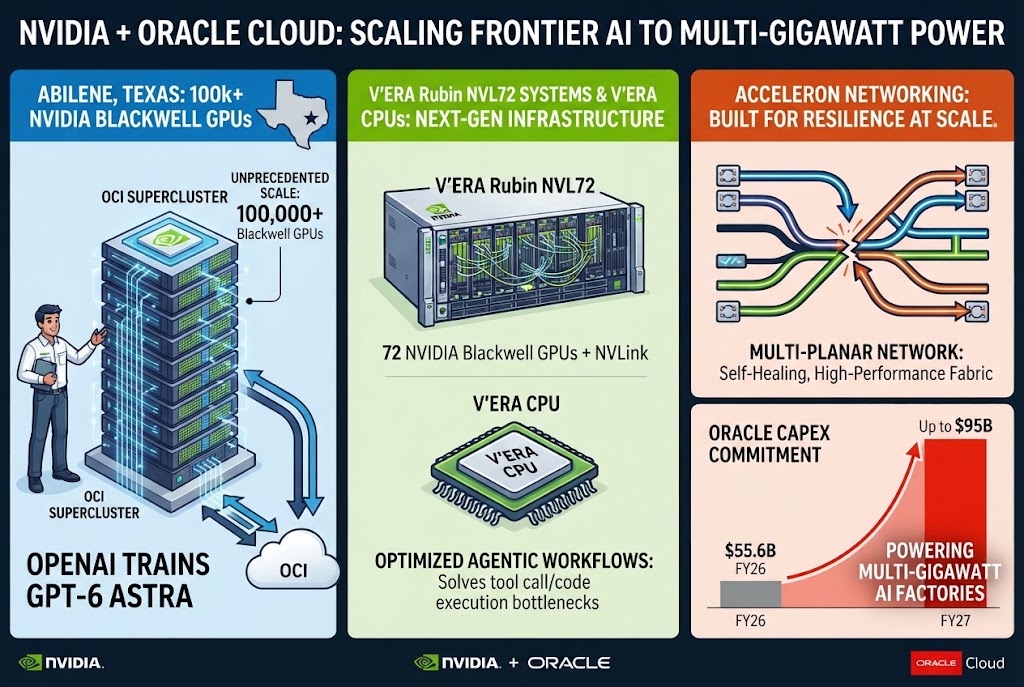
NVIDIA and Oracle plan to grow Oracle Cloud Infrastructure (OCI) Superclusters built on NVIDIA Vera Rubin NVL72 systems to multi-gigawatt scale, a power envelope that commits Oracle to utility-scale capital spending for years. The companies also made Vera Rubin NVL72 systems and NVIDIA Vera CPUs generally available on OCI, giving frontier labs and enterprises access to NVIDIA’s newest rack-scale platform on Oracle’s cloud. NVIDIA announced the expansion on October 27, 2026, at Oracle AI World in Las Vegas.
The release also disclosed a production reference point: in Abilene, Texas, OpenAI has trained and served GPT-6 Astra on an OCI Supercluster with more than 100,000 NVIDIA Blackwell GPUs.
Cloud providers compete for frontier labs on proof, not specifications, and a named frontier model trained on a single 100,000-GPU Supercluster is that proof. The Vera Rubin expansion builds on OCI’s existing GB200 and GB300 NVL72 deployments, so customers can move to the new generation inside the same Supercluster architecture.
“As our frontier models advance, we need infrastructure that can keep pace,” said Sreekanth Pothanis, engineering leader, compute infra at OpenAI.
OCI Superclusters combine NVL72 rack-scale systems, Oracle Acceleron networking, NVIDIA Spectrum-X Ethernet with Spectrum-6 switches and BlueField-4 DPUs, and gigawatt-class power and cooling. Each rack links 72 GPUs through NVLink scale-up networking, and NVIDIA says OCI’s network scales across hundreds of thousands of GPUs.
The general availability of standalone Vera CPUs marks a shift in what AI clouds sell. Agentic workloads spend much of their time on tool calls, code execution and concurrent tasks that run on CPUs, and slow CPU work leaves expensive GPUs idle. NVIDIA positions Vera’s single-thread performance and memory bandwidth as the fix. OCI Kubernetes Engine lets customers scale CPU and GPU resources independently, and Oracle Acceleron provides hardware-based isolation for untrusted, AI-generated code.
OpenAI is among the early-access customers. Uday Ruddarraju, chief technology officer of compute at OpenAI, said “NVIDIA Vera CPUs on OCI deliver the world-class loaded performance needed to execute code and run tools,” and said OpenAI is bringing Vera into production on OCI.
For customers that want x86, OCI plans to introduce HGX Rubin NVL8 systems, which are not yet available. Each server pairs eight NVLink-connected Rubin GPUs with two 64-core Intel Xeon 6 CPUs, 4TB of DDR5 memory and 6.4 Tbps of RDMA networking.
At hundreds of thousands of GPUs, link and NIC failures are routine, and a single stalled collective operation can idle an entire training job. In a separate announcement the same day, Oracle added capabilities to Acceleron, its networking and infrastructure suite. The Oracle Collective Communications Library spreads collective traffic across OCI’s backend Multiplanar Network, steers it toward healthier paths and aims to recover workloads quickly when links, ports or NICs fail. Transparent Front-End Multiplanar Networking adds automatic path selection, failover and congestion control for front-end RDMA traffic.
Oracle also introduced the Acceleron High-Performance Fabric for RDMA on front-end compute serving inference, storage and HPC, and expanded NVMe block-storage options with performance gains of up to 3x. “AI infrastructure can be unforgiving when it comes to network friction,” said Pradeep Vincent, executive vice president, Compute and AI Infrastructure, Oracle Cloud Infrastructure. Oracle gave no availability dates or pricing for the networking features.
Multi-gigawatt ambitions require matching capital. Oracle guided fiscal 2027 capital expenditures of up to $95 billion, with up to $25 billion expected to be repaid by customers, after spending about $55.66 billion in fiscal 2026, Reuters reported in June. Analysts had expected $67.66 billion. Oracle also said capacity delivered in its fiscal first quarter was approaching one gigawatt, which frames how far multi-gigawatt Vera Rubin clusters stretch its buildout. The spending is showing up in revenue: cloud infrastructure sales rose 121% to $7.4 billion in the fiscal 2027 first quarter, according to Verdict.
“Oracle Cloud Infrastructure gives customers the performance, security and scale to advance frontier AI,” said Mahesh Thiagarajan, president of Oracle Cloud Infrastructure. Ian Buck, vice president of hyperscale and high-performance computing at NVIDIA, said AI factories “must be productive, durable and fungible.”
OCI now competes for frontier training at a scale that was the domain of the three largest clouds. Amazon Web Services reported second-quarter 2026 revenue of $42.2 billion, up 37%, Quartz reported, and Google Cloud posted $24.8 billion, up 82%, with a $514 billion backlog, according to Tech Insider. Oracle’s infrastructure business remains smaller, but its 121% growth rate and OpenAI references give it a credible claim on frontier workloads.
Both AWS and Google design their own AI accelerators, Trainium and TPU, while Microsoft Azure competes with OCI for large NVIDIA GPU deployments. Oracle’s bet runs the other way: tie OCI tightly to NVIDIA’s roadmap, from Vera Rubin racks to Vera CPUs, and differentiate on networking resilience and power scale. For CoreWeave and other GPU-focused neoclouds, OCI’s general availability of Vera Rubin raises the bar on how quickly new NVIDIA generations reach customers.
Leave a Reply