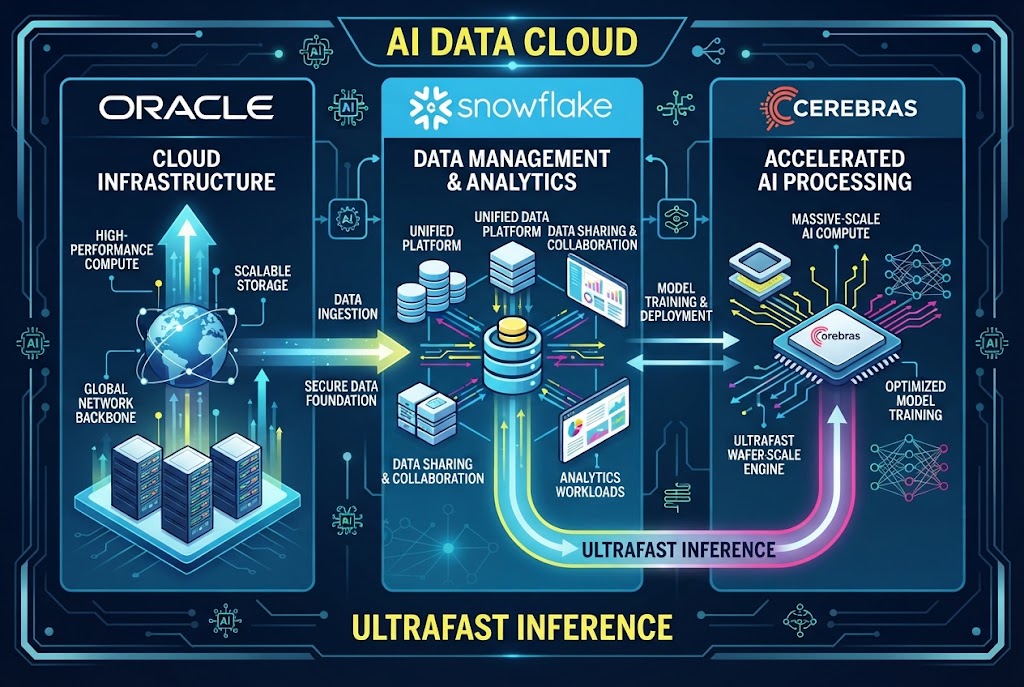
Oracle is turning Oracle Cloud Infrastructure (OCI) into a marketplace for rival technology, adding Snowflake’s AI Data Cloud as a native first-party service and lining up Cerebras inference as an alternative to GPU-based serving. Both moves let enterprises buy non-Oracle platforms through Oracle contracts and credits, which lowers procurement friction and keeps workloads and spending inside OCI. Oracle, Snowflake and Cerebras announced the expansions on October 27, 2026, at Oracle AI World in Las Vegas.
Under the Snowflake agreement, customers will buy and provision Snowflake on OCI directly through Oracle, and Oracle handles pricing, discounts and billing as a single commercial relationship. Customers can also apply Oracle Universal Credits to Snowflake usage. Supported data sources include Oracle Fusion Cloud Applications, Oracle NetSuite, Oracle Autonomous AI Database, MySQL HeatWave and Oracle NoSQL Database.
The economic argument centers on data movement. Oracle says native data transfer reduces the need for custom pipelines, and keeping movement within OCI lowers cross-cloud egress costs. Customers retain control over data access, use and governance. The release gives no launch date or regional availability.
“Organizations are looking for faster, simpler ways to turn their enterprise data into business value with AI,” said Clay Magouyrk, CEO of Oracle. “By making Snowflake available as a native OCI service, we’re giving customers more choice.”
“AI has dramatically shortened the distance between enterprise data and real business value,” said Sridhar Ramaswamy, CEO of Snowflake, adding that Snowflake is “excited to be the flagship AI data platform partner” running “as a first party offering inside Oracle Cloud Infrastructure.”
Snowflake brings scale to the arrangement. The company reported second-quarter fiscal 2027 product revenue of $1.49 billion, up 37%, and remaining performance obligations of $9.00 billion, up 30%, in results filed with the SEC on September 2, 2026. It counted 828 customers with more than $1 million in trailing 12-month product revenue and a 126% net revenue retention rate. The Oracle release says more than 14,500 customers use Snowflake worldwide.
For Snowflake, OCI opens access to Oracle application and database customers whose data previously had to leave Oracle’s cloud to reach a Snowflake warehouse. For Oracle, which competes with Snowflake through Autonomous AI Database and MySQL HeatWave analytics, hosting the rival keeps the compute and storage consumption on OCI even when the customer picks Snowflake.
The Cerebras partnership addresses a different constraint: latency in agentic AI. The service is aimed at AI labs, enterprises and developers. Every additional model call adds delay, and multi-step agent workflows compound it. Cerebras’ Wafer-Scale Engine integrates compute and memory on a single processor, which the company says cuts data movement and inter-chip communication to speed token generation. Cerebras Inference on OCI is planned for calendar year 2027 and builds on Oracle’s existing inference options, including Dedicated AI Clusters in OCI Enterprise AI. The release gives no throughput figures, supported models or regions.
“Every step an agent makes requires inference, whether it’s reasoning, checking its work, or taking action,” said Andrew Feldman, co-founder and CEO of Cerebras. “The faster the inference, the more work AI can do without making users wait.”
“AI inference demands choice,” said Mahesh Thiagarajan, president, Oracle Cloud Infrastructure. “As agents take on more complex work, customers demand compute that matches each application’s performance needs.” He said Cerebras “will add another ultrafast and deterministic option to our broad compute portfolio.”
The OCI deal adds another major cloud channel for Cerebras, now listed on Nasdaq under CBRS. According to a Futurum Group analysis of its IPO filing, Cerebras reported 2025 revenue of $510 million, up 76%, with two related UAE entities, MBZUAI and G42, accounting for 86% of it. The filing disclosed an OpenAI agreement valued at more than $20 billion covering 750 megawatts of inference capacity, expandable to 2 gigawatts by 2030, and a binding term sheet with Amazon Web Services to bring Cerebras hardware into Amazon Bedrock. The Oracle announcement itself lists customer concentration and a history of net losses among Cerebras’ risk factors, so a hyperscale channel like OCI helps broaden its revenue base.
Amazon Web Services, Microsoft Azure and Google Cloud have long won data platform workloads by default because Snowflake, Databricks and their own warehouses run there. A first-party Snowflake service, payable with Oracle credits, removes one reason for Oracle application customers to route analytics to those clouds, and puts Oracle in more direct competition with Databricks for AI data platform spend on OCI.
On inference, Cerebras gives OCI a specialized low-latency option to set against Google’s TPUs and AWS’s Trainium and Inferentia chips, while competing with Groq and SambaNova for latency-sensitive agent workloads. Oracle’s infrastructure momentum supports the strategy: cloud infrastructure revenue rose 121% to $7.4 billion in the fiscal 2027 first quarter, and remaining performance obligations grew by $209 billion year over year to $664 billion, according to Verdict. Oracle also delivered more than 300,000 GPUs to AI cloud customers in the quarter, nearly tripling the prior quarter’s capacity. The open question is timing. With no Snowflake launch date, Cerebras slated for 2027 and a Cerebras term sheet already signed with AWS, neither partner gives OCI an exclusive edge.
Leave a Reply