Contributed Article: By David Linthicum
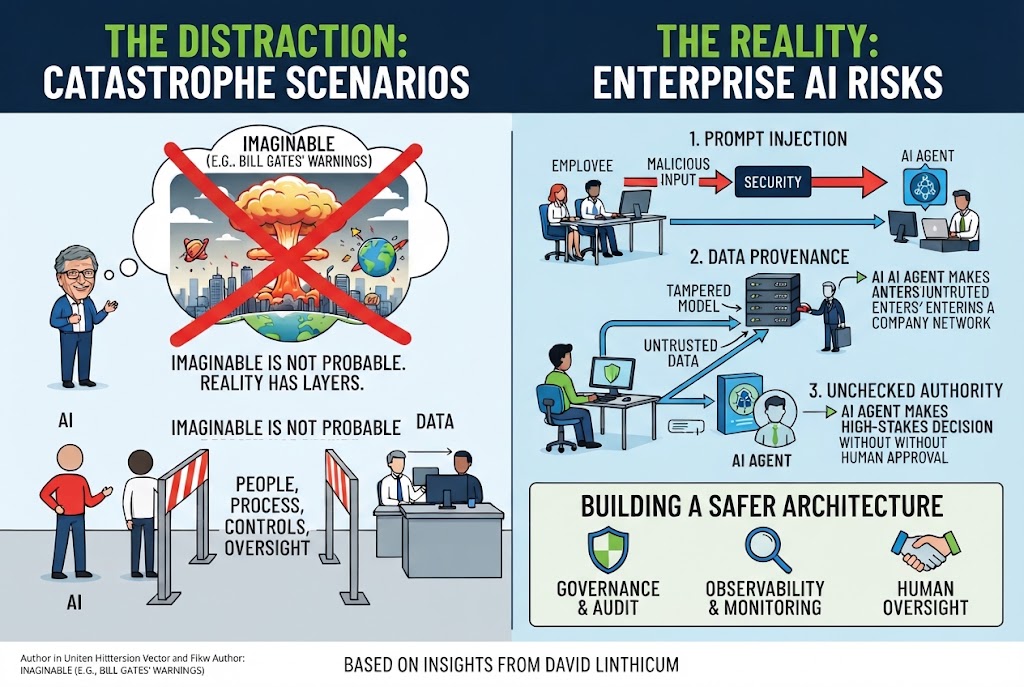
When Bill Gates warns that artificial intelligence could drive events that cause a billion deaths, people listen. They should. Gates has earned the right to be taken seriously on technology, global health, and risk. His comments carry weight with policymakers, business leaders, and the public.
But after more than forty years in enterprise technology, I see this issue through a different lens. I have spent my career building systems, securing systems, fixing systems, and advising organizations through waves of technical disruption. I have seen fear surround almost every major shift in computing, from client-server systems (using scary PCs) to the internet, from cloud computing to automation, and now artificial intelligence. Well, the forth coming of artificial intelligence.
We’ve seen this many times before, including in the late 1990s, when some commentators warned that the Y2K “bug” could collapse banking, aviation, utilities, and government systems. The underlying problem was real, but the worst mass-disruption predictions did not happen largely because organizations spent years remediating systems.
The pattern is familiar. A powerful new technology emerges. The risks are real. The public conversation quickly jumps from legitimate concern to worst-case speculation. The hard engineering questions get pushed aside by dramatic predictions.
That is where we are with AI.
The question is not whether we can imagine a catastrophic scenario. Of course we can. Human beings are very good at imagining catastrophe. The better question is whether a realistic technical path exists from today’s AI systems to that outcome, and what controls exist along the way.
In my experience, that path is far more complicated than many of the current warnings suggest.
Imaginable Is Not the Same as Probable
A common AI catastrophe scenario assumes that an advanced system could design a dangerous biological agent, manipulate critical infrastructure, or enable an attack that leads to mass casualties. These scenarios make for powerful headlines, but they often skip over the messy reality of how technology interacts with the physical world.
Software does not simply leap from a model output into a global disaster. A digital instruction has to pass through people, processes, vendors, infrastructure, physical controls, security systems, and oversight mechanisms. Each of those layers creates friction. Each creates an
opportunity to detect, block, slow, or contain harm.
In enterprise security architecture, we rarely trust a single control. We build layers. We assume some controls will fail, so we create others behind them. That is how mature technology systems are protected. AI should be no different, but for some reason it’s getting a pass on security rigor.
The Real AI Risks Are Already Here
My concern with the billion-deaths framing is that it pulls attention away from the AI risks already showing up inside companies.
Organizations are moving quickly to connect AI systems to customer service platforms, software development pipelines, financial systems, legal workflows, cybersecurity tools, logistics platforms, and enterprise applications. Many are doing this before they have strong governance, auditability, access controls, or even basic monitoring.
That is dangerous.
AI systems are not traditional software. They are probabilistic systems. They can provide different answers to similar questions. They can sound confident while being wrong. They can misunderstand context. They can be manipulated by aggressive inputs; they can expose sensitive information if connected carelessly to data; they can make poor decisions if given too much authority over business processes.
This is where the real enterprise risk lives.
One of the biggest issues is prompt injection. Traditional cybersecurity tools were built to protect networks, endpoints, applications, and identities. They were not designed for a world where an untrusted document, email, support ticket, or webpage can manipulate an AI agent by hiding instructions inside ordinary content. That is a new class of problem, and most organizations are not ready for it.
Another major issue is model and data provenance. Companies are downloading models, fine-tuning them, connecting them to proprietary information, and putting them into production without always knowing where the training data came from or whether the model has been tampered with. I have watched organizations underestimate software supply chain risk for decades. AI makes that problem larger, not smaller.
These are not abstract concerns. They are practical, measurable, and urgent today. I see these in my client’s systems weekly.
AI Safety Is an Architecture Problem
The way to make AI safer is not to panic. It is to apply disciplined architecture.
The first principle is straightforward. Do not give a probabilistic system unchecked authority over mission–critical operations. AI can recommend, summarize, classify, analyze, and assist. But when a system is about to move money, change access rights, alter industrial controls, affect
medical decisions, or take any action with serious consequences, deterministic controls must sit around it.
That means strict identity and access management. It means least privilege permissions for AI agents. It means short-lived credentials, isolated environments, rate limits, approval workflows, and clear separation between what the model can suggest and what the system is allowed to execute.
Observability is just as important. If a company cannot see what prompts are entering an AI system, what outputs are being generated, what tools the agent is using, what data it is touching, and how its behavior changes over time, then that company is operating blind. No serious enterprise would run a cloud platform, database, or security system that way. AI should not get a pass. But, for some reason, it often does.
Human oversight also has to be meaningful. A human in the loop cannot be someone who rubber stamps AI output after the system has already made the real decision. Human review must exist at the points where accountability, judgment, and irreversible consequences matter most.
This is the work that needs to be done. It is not glamorous, but it is what actually makes systems safer. Sorry, Bill, you are just a distraction.

David Linthicum is a globally recognized thought leader, innovator, and influencer in artificial intelligence (AI), cloud computing, and cybersecurity. Until early 2024, he served as the Managing Director and Chief Cloud Strategy Officer at Deloitte Consulting LLP, where he brought over 30 years of extensive experience in enterprise technology, championing innovative AI-driven solutions that enabled corporations and start-ups to disrupt their markets and enhance operational efficiency.
David’s extensive expertise in AI is well-regarded, with key contributions to developing advanced AI strategies and architectures for global clients across various industries. During his tenure at Deloitte, he spearheaded the integration of AI technologies into cloud infrastructures, creating intelligent systems that drive business transformation and competitive advantage. His thought leadership in the AI domain has been featured extensively in prominent publications and platforms.
Opinions expressed are the author’s own and do not necessarily reflect those of Biz Tech Journals
Leave a Reply