By news editor
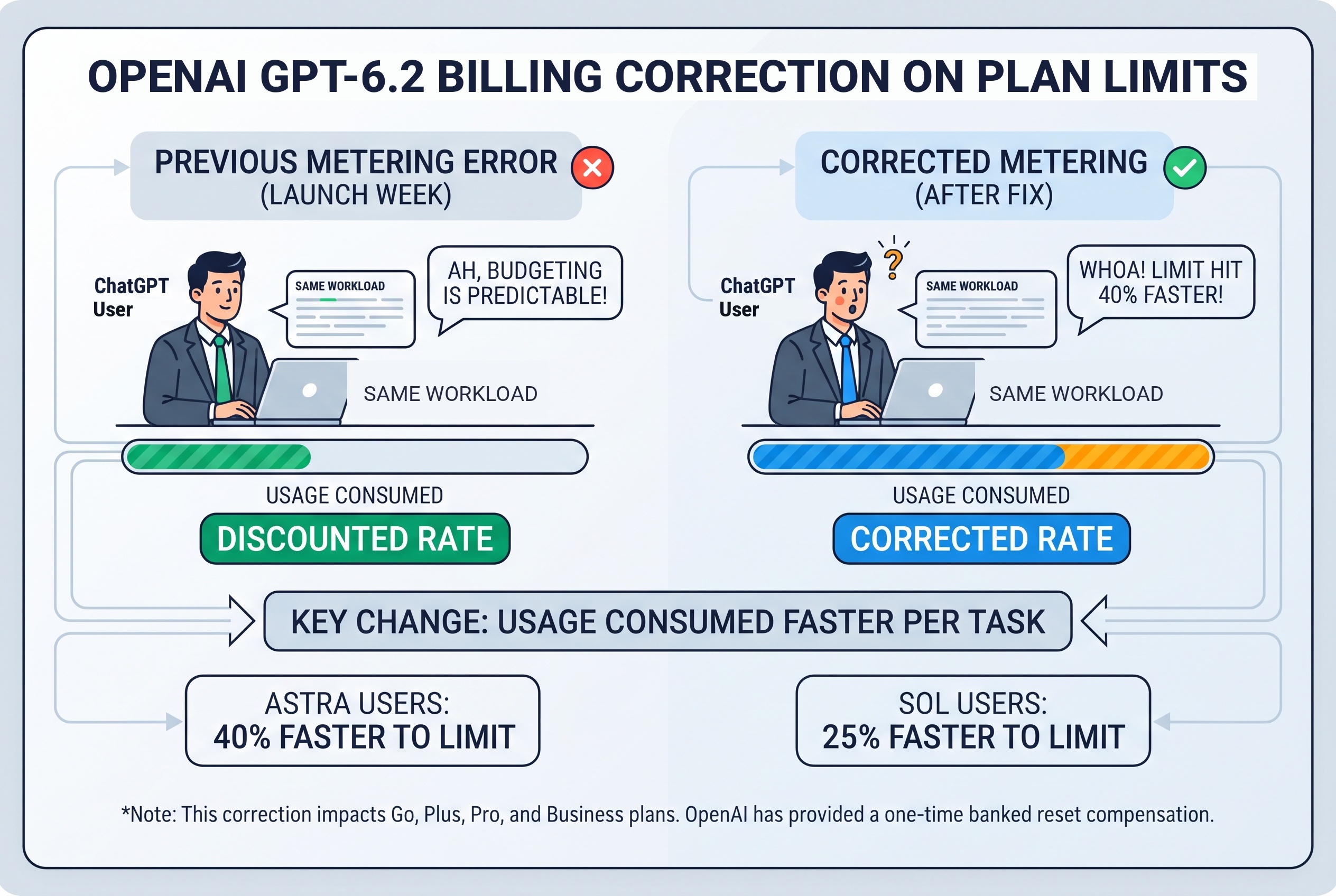
OpenAI has corrected a billing error that undercounted usage of its GPT-6.2 Astra and Sol models, and subscribers running the same workloads will now reach their plan limits sooner, InfoWorld reports. Astra users will hit their limits 40% faster than they did the week before and Sol users 25% faster, according to a post on X by Thibault Sottiaux, who works on ChatGPT and Codex at OpenAI, as relayed by the outlet.
Sottiaux wrote that a mistake at the launch of GPT-6.2 had incorrectly discounted Astra and Sol usage for most users, and that after the fix the same work uses more of a plan's usage allowance, InfoWorld reports. OpenAI said other models were not affected and that it would not charge customers retrospectively for the difference in past usage.
Compensation, per the post, is one banked reset for everyone on the Go, Plus, Pro and Business plans.
Several details a finance team would need are missing. According to InfoWorld, the post did not say what caused the discount, which users escaped it or what the corrected metering rates are. It also did not say whether the 40% figure means usage is consumed 1.4 times as fast or that an allowance now lasts 40% less time, two readings that produce different budgets.
InfoWorld puts the discounted period at nine days. The two models were released in ChatGPT Work and Codex for Plus, Pro, Enterprise and Edu users, and OpenAI's launch announcement said Astra set new benchmark highs at less than a third of the cost per task of GPT-6 Astra, the outlet reports.
Analysts in InfoWorld's report focused on budgeting. "OpenAI did not raise the price of GPT-6.2. It changed how much work the price buys, and that is the harder number to budget," said Sanchit Vir Gogia, chief analyst at Greyhound Research.
Gogia's point for buyers is that cost-per-task measurements taken in launch week were made on metering that has since changed. He advised teams to rerun the same task set on the corrected metering and compare Astra against Sol again. Chief information officers should budget AI allowances as a range, fund the top of it, and ask OpenAI in writing how it will announce corrections, he said.
Business plans are among those affected and receive the banked reset, while Enterprise and Edu are not named in the compensation, InfoWorld reports. OpenAI's pricing page says Enterprise and Edu plans without flexible pricing have the same per-seat usage limits as Plus for most features, while those with flexible pricing have no fixed rate limits and usage that scales with credits. Sottiaux did not say whether credit-based workspaces were undercharged during the launch window, according to InfoWorld.
Neil Shah, VP for research and partner at Counterpoint Research, said in the same report: "A token metering error of this scale keeps seat-based AI pricing in a black box rather than making it a transparent, predictable IT tool for CIOs."
Shah recommended a 30% to 40% contingency buffer in AI budgets. He also suggested moving production workloads to direct API metering, where raw token counts are visible in real time.
For usage-based billing in US dollars, OpenAI's pricing page lists GPT-6.2 Astra at standard speed at $8 per million input tokens and $40 per million output tokens, and GPT-6.2 Sol at $2 and $10. Tokens are the small units of information a model reads and writes.
The correction is the second allowance change Sottiaux has announced in a month, InfoWorld notes. In October, OpenAI dropped a planned cut to the Work and Codex allowance of its Pro 200 tier. The company did not immediately respond to InfoWorld's request for comment.
Two disclosures would settle the open questions: the corrected metering rates for Astra and Sol, and whether credit-based Enterprise and Edu workspaces were affected. If OpenAI publishes neither, the first full billing period on the corrected metering would be the earliest point at which customers could measure what their plans now buy.
Leave a Reply