By news editor
A security researcher has published a working exploit for an unpatched flaw in Cacti, the open-source network monitoring tool, that lets an attacker with no account run commands on the server. No fix is available, and the researcher did not report the flaw to the Cacti project before releasing it, BleepingComputer reports.
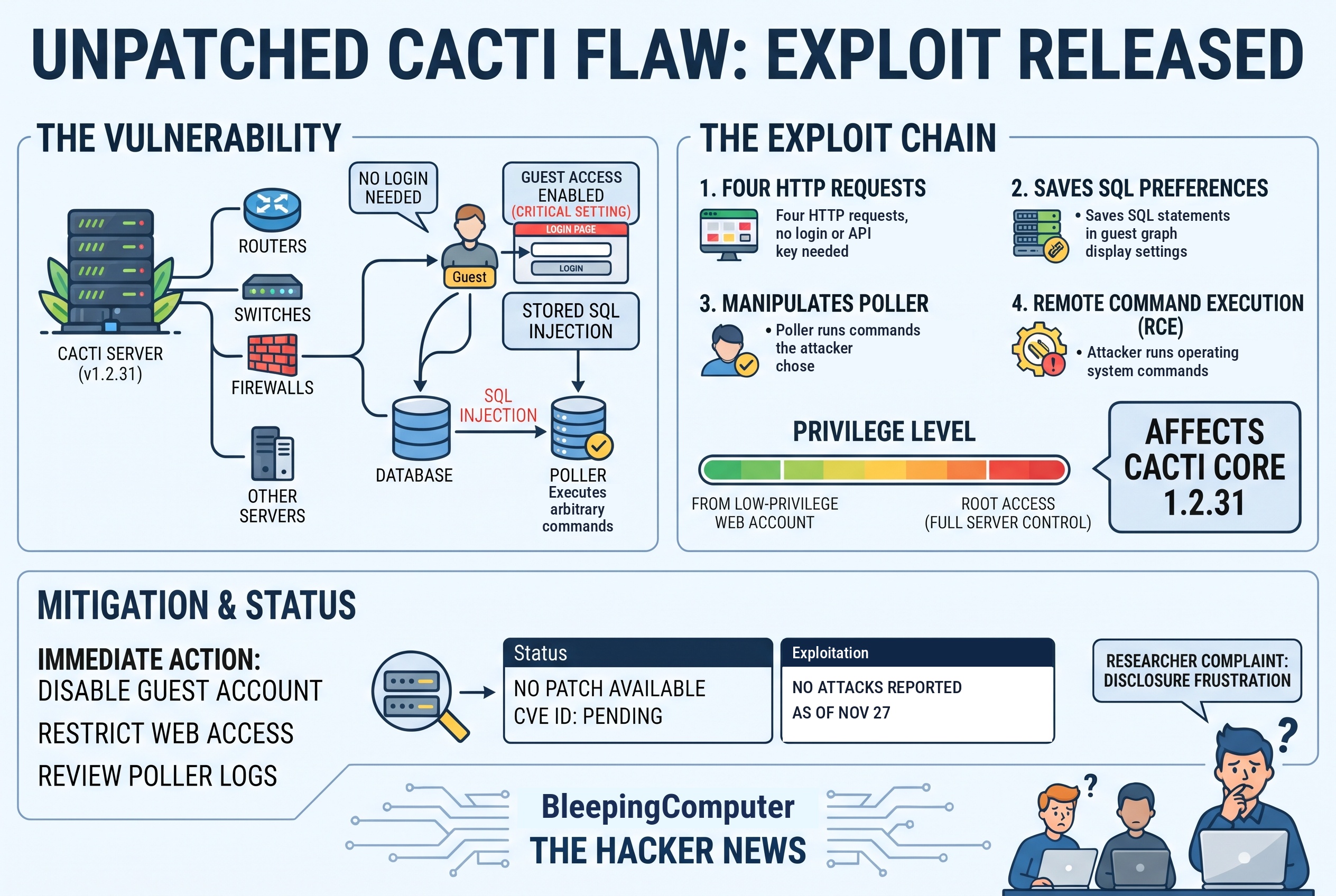
The exploit carries the name 4HTTP2SHELL, previously 4HTTP2ROOT, and comes from a researcher who uses the alias ek0ms savi0r. According to BleepingComputer, the researcher posted a technical write-up, proof-of-concept code and a video demonstration to a GitHub repository. The write-up says the attack takes four HTTP requests and needs no login, no valid API key and no phishing.
The Hacker News reports that the flaw has not yet been assigned a CVE identifier, the catalog number used to track a publicly known vulnerability.
Exposure turns on one setting. The attack requires Cacti's guest account to be enabled, although the attacker needs no valid credentials, BleepingComputer reports. The Hacker News notes that the guest account has been disabled by default since Cacti version 0.8.7, which confines the risk to installations where guest access has been switched on.
Both outlets name Cacti Core 1.2.31 as the affected release, and The Hacker News describes it as the latest version. BleepingComputer says the researcher tested the exploit against 1.2.31 and that it is unclear whether earlier versions are also vulnerable.
For a business, the concern is what a monitoring server holds. Cacti tracks the performance of servers, routers, switches, firewalls and other network equipment, and it can store the credentials and SNMP passphrases used to access or read data from those devices, according to BleepingComputer. Security firm watchTowr, in an advisory cited by The Hacker News, says an attacker who reaches command execution on a Cacti server can gain a foothold that extends far beyond the monitoring server itself.
Weak input validation is the root of the flaw, BleepingComputer reports. Citing security firm RavenAI, it says the attack abuses poor checking of a guest user's graph display settings to save SQL statements in Cacti's database, a technique known as stored SQL injection. When Cacti later processes those saved preferences, the statements change the configuration of the poller, a component that executes commands on the server, and cause it to run operating system commands the attacker chose.
How much control an attacker gains varies. In the demonstration the exploit gave root access to a vulnerable server. watchTowr, as relayed by BleepingComputer, says the privileges depend on the account that runs the Cacti web server and poller processes, and BleepingComputer adds that in many deployments this could be a low-privileged web server account.
Neither report gives a count of Cacti installations with guest access enabled, so the number of exposed servers is unknown. BleepingComputer says that as of November 27 there have been no reports of the vulnerability being exploited in attacks.
Until a patch arrives, both reports advise administrators to disable the guest account, restrict access to the Cacti web interface and review poller configurations for unexpected commands. BleepingComputer adds that the web interface should be limited to trusted networks, and that application logs showing warnings about non-numeric values in graph display settings could indicate attempted exploitation.
The researcher tied the release to a wider complaint about disclosure. In a separate post on the same repository, BleepingComputer reports, the researcher expressed frustration with how companies handle vulnerability reports, describing years of submissions dismissed or closed as duplicates, expected behavior or issues that could not be reproduced.
The next marker is a patched Cacti release and a CVE identifier. Neither report mentions a response or a release date from the Cacti project. Reports of attacks in the wild would shorten the time administrators have to check whether guest access is enabled on their own installations.
Leave a Reply