By news editor
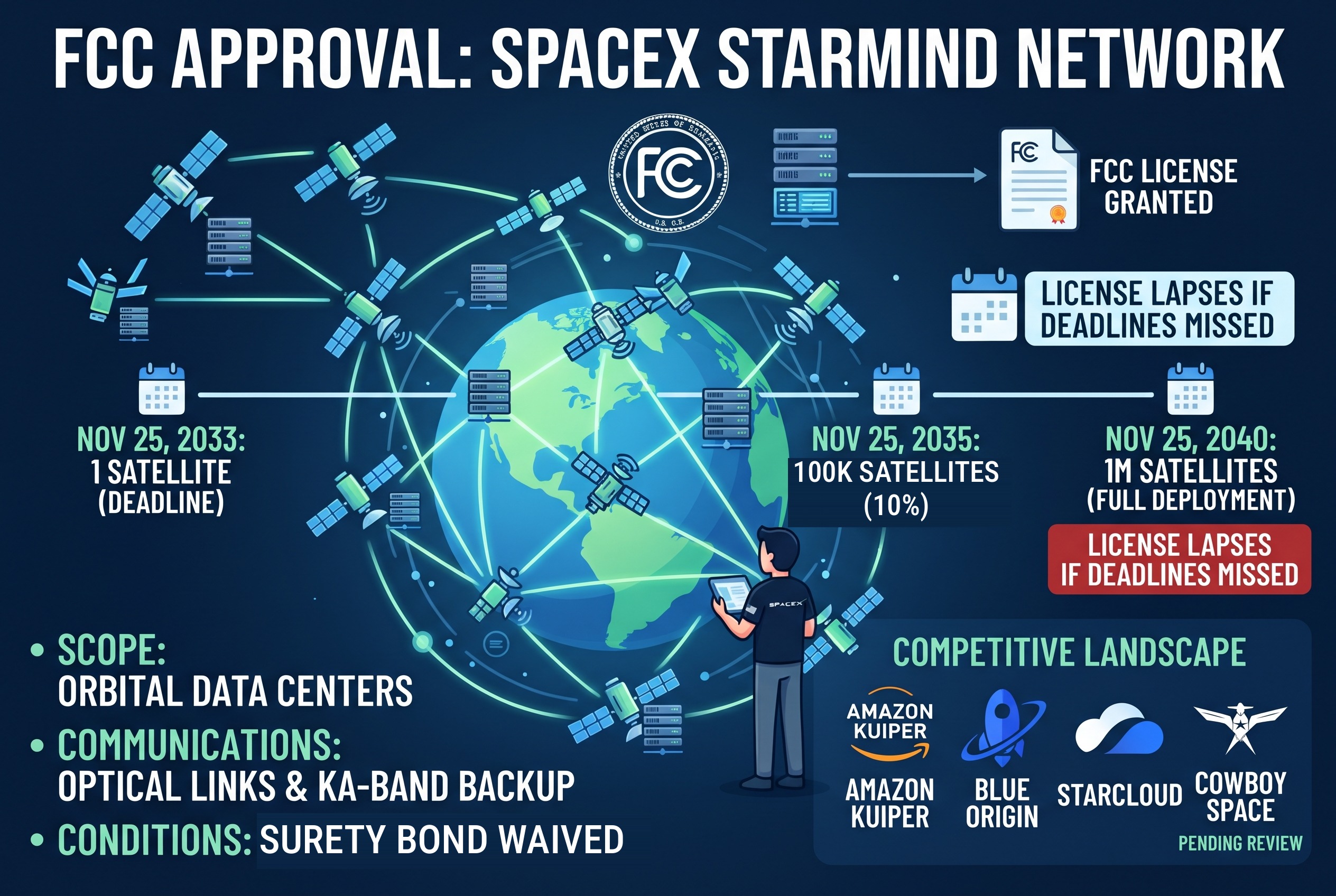
The Federal Communications Commission's Space Bureau has authorized SpaceX to deploy and operate Starmind, a constellation of up to 1,000,000 satellites designed to work as data centers in orbit. The order was adopted and released on November 25, and the agency's news release describes it as the first US authorization for a constellation of data centers in space.
In legal terms the grant is a radio license. Its stated scope is authority to use two Ka-band frequency ranges for backup and emergency telemetry, tracking and command, the links an operator uses to monitor and steer spacecraft. Starmind is to rely on optical links for its communications, the order says, and the radio bands may be used only on an unprotected, non-interference basis. The application is marked granted in part and deferred in part, with conditions.
Those conditions put dates on the project. The authorization becomes null and void unless SpaceX has one satellite operating by November 25, 2033, 10% of the maximum by November 25, 2035, 50% by November 25, 2038 and the remainder by November 25, 2040. On a ceiling of 1,000,000 satellites, the 2035 step works out to 100,000 spacecraft. The license term is 15 years, starting when SpaceX certifies that its first satellite is in orbit.
SpaceX operates nearly 11,200 Starlink satellites today, according to a count by astronomer Jonathan McDowell that Spaceflight Now cites. The 2035 milestone alone is about nine times that fleet.
On money, the Bureau waived two rules that normally apply. One requires a satellite operator to post a surety bond payable to the US Treasury within 30 days of a license grant, a rule the order says exists to deter the warehousing of spectrum and orbital resources. The order does not state what the bond would have been. The other waiver exempts SpaceX from the processing rounds in which rival applicants compete for the same bands. Under that waiver SpaceX gets no priority over other operators, must stop any transmission that causes harmful interference, and must file reports every six months on close approaches, satellites removed from service and re-entries.
One request was not granted. FCC rules require satellites that end their missions below 2,000 km to be disposed of by re-entering the atmosphere. SpaceX asked for flexibility to send satellites operating above 600 km into disposal orbits or orbits around the sun instead, and the Bureau deferred that request, saying the company had not provided enough information. Before deploying any satellite that will operate above 600 km, SpaceX must apply to modify the license and supply a final debris plan. Four of the six altitude bands listed in the order lie above 600 km.
Petitions to deny from Amazon's Kuiper Systems, Viasat and the American Astronomical Society were rejected. The Bureau said effects on optical astronomy and on the environment fall outside its authority. It also set aside public comments that doubted whether orbital data centers make economic sense. The order states: "In many cases, the comments seek to substitute the government’s judgment regarding the viability of business endeavors for that of the applicant and private enterprise. We decline to do so."
Nothing in the order gives a cost, a customer or a price for computing sold from orbit. The schedule SpaceX is working to comes from its founder: Spaceflight Now reports that Elon Musk told a Baron Capital event he anticipates a first launch in the third quarter of 2027, a forecast six years ahead of the FCC's first deadline. The same report has SpaceX executive Michael Nicholls saying in October that each satellite might be something like 250 kilowatts, roughly one rack of computing. GeekWire reports that SpaceX said in August it is working with Nvidia on the computing payload, using Rubin GPUs and Vera CPUs. SpaceX did not immediately respond to a request for comment from the Los Angeles Times.
Rivals are waiting on the same regulator. The FCC says it is still reviewing other orbital data center proposals. GeekWire lists Blue Origin's proposed 51,600-satellite Project Sunrise, an 88,000-satellite application from Starcloud and a 20,000-satellite plan from Cowboy Space, along with Google's Project Suncatcher, whose first satellites are planned to launch no earlier than 2029.
Two filings come next. SpaceX has 30 days from the order's release to decline the grant as conditioned, and silence counts as acceptance. The modification application on disposal will then decide whether and when the higher orbits, which make up most of the planned altitude bands, can be used.
Leave a Reply