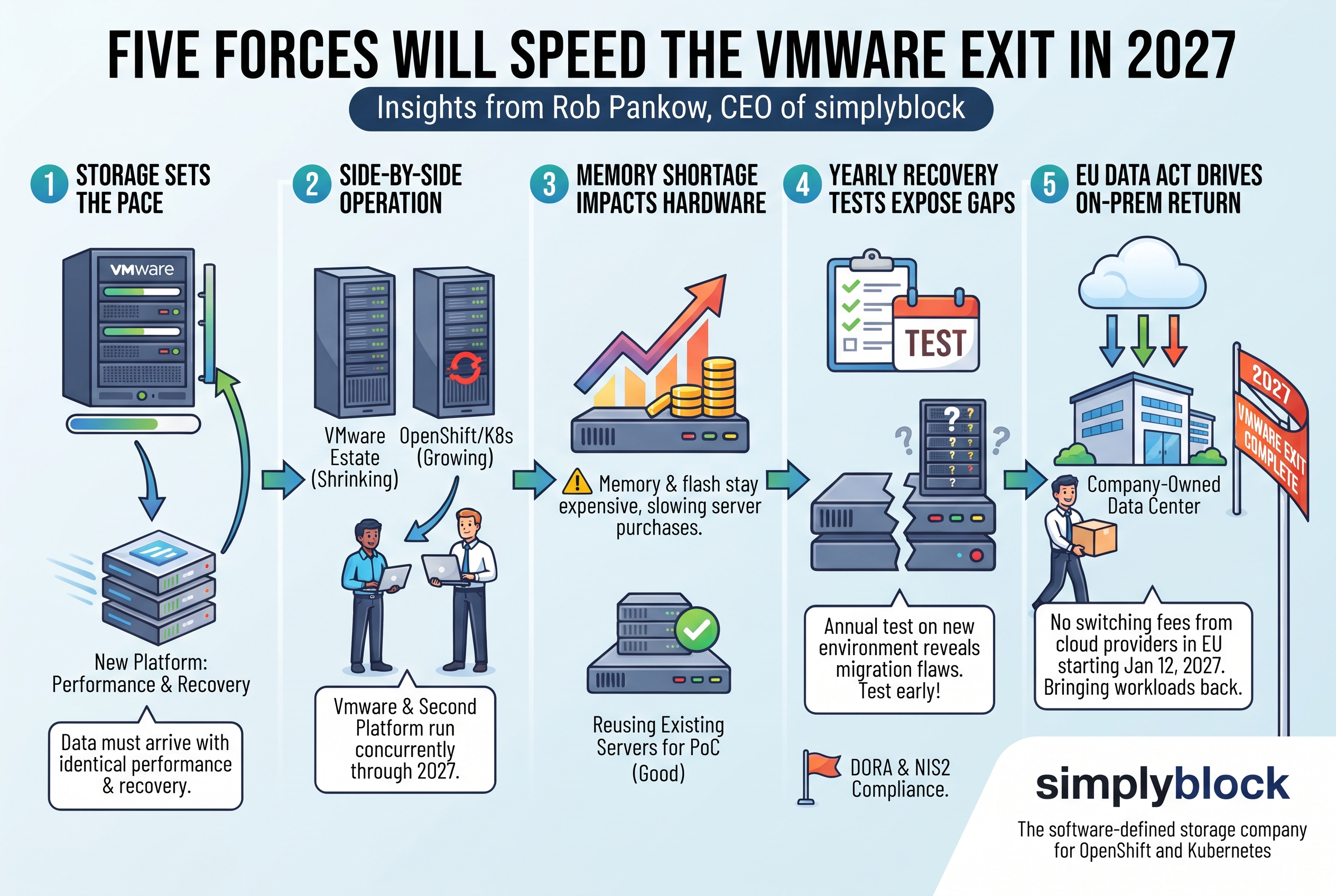
The VMware exit is moving from planning to execution, and enterprise storage will decide who finishes first. Rob Pankow, co-founder and CEO of simplyblock, the software-defined storage company for OpenShift and Kubernetes, expects 2027 to be the year inertia finally gives way, as Broadcom’s licensing changes push organizations to migrate without breaking the workloads that run on VMware today.
Analysts see the same direction. Gartner projects that 55% of enterprises will start proofs of concept for alternatives to their VMware-based deployments by 2029, up from 25% in 2026, according to The Register’s coverage of its Magic Quadrant for Distributed Hybrid Infrastructure. A CloudBolt survey reported by CIO Dive found 86% of organizations are actively reducing their VMware footprints, while only 4% have fully migrated. That gap between intent and completion is where Pankow’s five predictions for 2027 come in.
First, storage will set the pace. Data has to arrive on any new platform with the same performance and the same recovery the business relied on before, and for large companies, unwinding VMware dependencies can take years. Many customers assume they can bring vSAN along, yet SAN-style storage is typically not the right fit for modern virtualization and containers. Broadcom also made exits harder in August 2026 when it removed public downloads of VDDK, a VMware library many migration tools are built on. Pankow advises teams setting a timeline now to check which of their migration tools rely on it.
Second, VMware and a second platform will run side by side through 2027. Simplyblock has seen a big increase in OpenShift evaluations over the last two years, most of them from VMware shops, and those teams move in stages. Pankow expects many large customers to keep a smaller VMware estate after vSphere 8 reaches end of general support on October 11, 2027. Because storage and recovery must work on both platforms, he recommends testing them across both.
Third, the memory shortage will slow exits that depend on new servers. Memory and flash are expensive and are expected to stay that way into 2027, which means a bigger bill and a later start for any plan that begins with a hardware purchase. The pleasant surprise for many Simplyblock customers is that they can often reuse existing servers to run a proof of concept and begin the move. Pankow suggests confirming that before new hardware goes into the budget.
Fourth, yearly recovery tests will expose gaps in newly migrated platforms. Many companies will run their annual test on an environment they have only just moved to. DORA asks financial firms in the EU to test recovery plans every year, and NIS2 expects backup and disaster recovery from essential and important entities. If recovery was planned after the migration, the test will show it. Pankow recommends running a recovery test on the new platform well before the yearly one is due.
Fifth, the EU Data Act will bring some workloads back to company-owned data centers. From January 12, 2027, cloud providers can no longer charge EU customers switching fees, and the Act counts moving back on-premises as switching. Pankow expects many European teams to run a mix of cloud and their own facilities, and says now is a good time to identify which cloud workloads they would move once the fees disappear.
Pankow closes with a choice facing every VMware customer: stay in place on renewals priced at three to five times what they paid before, or begin a migration that delivers better cost, performance and flexibility. He predicts 2027 will bring much more of the latter as companies modernize legacy platforms with next-generation software-defined storage.
That shift reshapes the competitive field. Broadcom is steering customers toward VMware Cloud Foundation, while OpenShift, Nutanix and Microsoft Hyper-V compete for the workloads that leave. In that race, the platform that proves storage performance and recovery on day one, rather than the one with the longest feature list, is positioned to win the migration.
Leave a Reply