By news editor
Google Cloud says Sinch, a cloud communications company, has moved its core European data warehouse workloads from Snowflake to BigQuery and is now extending the migration to its Australian and US analytics. The account comes in a Google Cloud blog post bylined to a strategic cloud engineer and written from Google's side of the project. It carries no cost, savings or timeline figures.
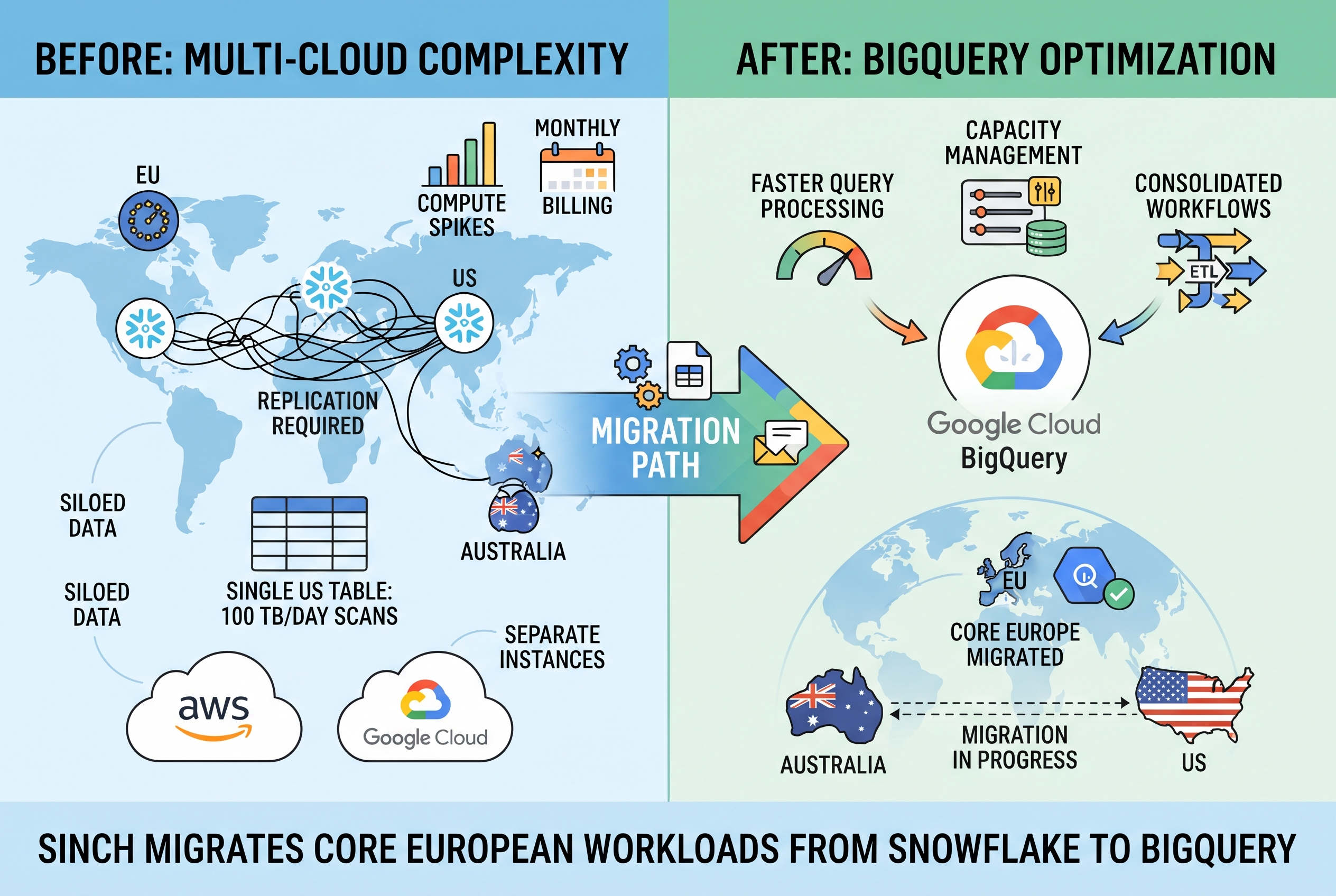
Before the project, Sinch ran separate Snowflake instances in the EU, the US and Australia on a multi-cloud footprint across AWS and Google Cloud, according to the post. Keeping them aligned required replication between regions. Monthly billing runs drove compute spikes in the US while other regions had underused capacity, Google writes, and a single US email event table could generate up to 100 TB of scans a day.
For the move, Sinch worked with Google Cloud Professional Services. What it paid for that work is not disclosed. Neither is what Sinch spent on Snowflake before or spends on BigQuery now.
The migration began with a pilot covering 20 tables and 125 GB of data, the post says. Rather than split interconnected business domains in the EU, the team moved the raw and base data layers first and stabilized core entities before repointing the downstream data marts. Sinch also consolidated 36 independent ETL workflows, the jobs that extract, transform and load data, into a single orchestrator built on Google Cloud Workflows.
Code translation was a separate task. More than 1,200 dbt models, the SQL transformation definitions that run on the warehouse, had to be converted from Snowflake's SQL dialect to BigQuery's. Google says Sinch used the BigQuery Migration Service together with custom AI translation skills, among them one named dbt-sf-to-bq-translator that runs on the BigQuery Translation API. The post credits that tooling with cutting manual refactoring effort and error rates but puts no number on either.
Some Snowflake features had no direct equivalent. SQL that relied on Snowflake-specific concurrency and table-swapping methods had to be restructured, the post says, and concurrency checks that depended on row-level locking were redesigned as serialized batch validations.
Dan Peters, senior manager for data delivery at Sinch, is quoted in Google's post: "Google Cloud's engineering expertise helped us overcome several technical challenges during our migration, particularly around optimising Spark partitioning and restructuring incremental data loads."
Data ingestion now runs on Dataproc Serverless with Apache Spark 3.5, pulling refined data from S3 and Databricks Unity Catalog into native BigQuery tables, according to Google.
On results, the post is qualitative. Its before-and-after table sets multi-hour batch runs against faster query and pipeline processing, and month-end billing spikes against capacity managed through BigQuery reservations and slot autoscaling. No query times, spending comparison or project dates appear. Google also describes data validation as "consistently outperforming legacy benchmarks" without publishing the benchmarks.
The work is also unfinished. Google's summary uses the phrase "completing the migration" even though the closing section of the same post says only the core European workloads are stabilized on BigQuery. The Australian instance, which Google labels SMB, is in progress, and US analytics is named as the next area of expansion. The US is where the post locates both the billing-run compute spikes and the 100 TB table.
For Snowflake, the post documents a named customer shifting warehouse workloads to a competitor, with two more regions planned to follow. For Google, it is a reference account for migration tooling that translates another vendor's SQL automatically. How much revenue moves between the two vendors is not disclosed.
The figures to watch for are a completion date for the US and Australian migrations and a cost comparison from Sinch itself. Google says the Australian work already uses its Antigravity skills for the Snowflake-to-BigQuery translation; it gives no end date for that region or for the US.
Leave a Reply