By news editor
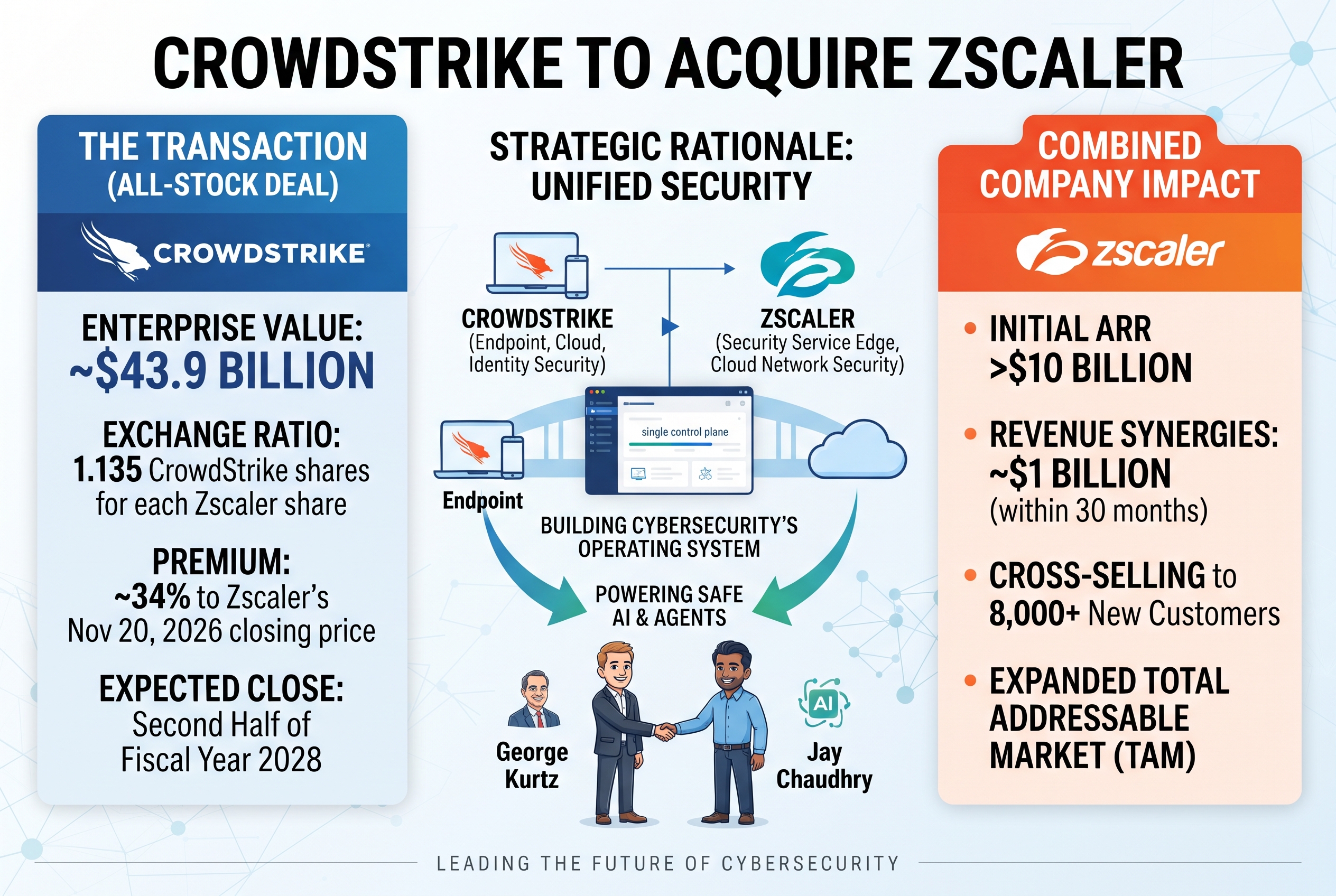
CrowdStrike has agreed to acquire Zscaler in an all-stock transaction that the two companies put at an enterprise value of approximately $43.9 billion, a deal that would take the endpoint security vendor into network security. Zscaler shareholders would receive 1.135 shares of CrowdStrike common stock for each Zscaler share, the companies say in a joint announcement on CrowdStrike's site that Zscaler published in the same terms.
The exchange ratio implies approximately $260.41 per Zscaler share, which the announcement calls a premium of approximately 34% to Zscaler's closing share price on November 20, 2026. Both numbers, like the enterprise value, are calculated on CrowdStrike's closing share price that day. No cash component is described.
After completion, existing CrowdStrike shareholders are expected to own approximately 84.1% of the combined company and Zscaler shareholders approximately 15.9%. Both boards approved the agreement unanimously.
Closing is expected in the second half of CrowdStrike's fiscal year 2028, subject to approval by Zscaler shareholders, required regulatory approvals and other customary conditions. Jay Chaudhry, Zscaler's CEO, chairman and founder, and his affiliates represent approximately 34% of Zscaler's outstanding shares and have entered into voting agreements in support of the transaction. Chaudhry is to keep leading the Zscaler business and join CrowdStrike's board after the close. Until then, the companies say, they will continue to operate independently.
What changes hands is a different layer of security from the one CrowdStrike sells today. Its Falcon platform covers endpoints, cloud workloads, identity and data. Zscaler sells a security service edge, a cloud service that sits inline between users, applications and AI agents and enforces access rules on each connection. The announcement describes network security as the largest single addressable market segment in cybersecurity.
George Kurtz, CrowdStrike's CEO and founder, frames the purchase around AI. In the announcement he says: "With Zscaler, we’re building cybersecurity’s operating system: a single control plane to deploy AI, control AI, and enable any agentic application to run safely."
The financial targets in the announcement are expectations, not reported results. At closing, the combined company is expected to begin with more than $10 billion in annual recurring revenue; Zscaler reported $3.9 billion of annual recurring revenue as of its most recently completed fiscal quarter. CrowdStrike expects approximately $1 billion in annualized run-rate revenue synergies by the end of the first 30 months after close, and $500 million in annualized run-rate cost synergies within 18 to 24 months, primarily from optimizing data center infrastructure, vendors and broader operations.
Those revenue synergies are expected to come largely from cross-selling and upselling. Approximately 8,000 Zscaler customers are not yet CrowdStrike customers, the announcement says, while the two companies already share more than 2,000 customers and 16 integrations. After closing, customers of either company would be able to add the other's products on a single Falcon Flex contract, CrowdStrike's existing commercial model. CrowdStrike also estimates the acquisition will expand its total addressable market by more than $185 billion in calendar year 2029; the announcement gives no methodology for that estimate.
For customers, one analyst points to renewal terms. Sanchit Vir Gogia, chief analyst at Greyhound Research, tells Network World that bargaining power shifts to the supplier at renewal, when it holds more of a customer's estate, and he advises CFOs and CISOs to price consolidation offers at their first full renewal and to keep one credible alternative in each layer they consolidate.
Several terms are not disclosed. The announcement names no termination fee, gives no prices for combined products and does not say how many jobs or products the cost synergies would affect.
Alongside the deal, CrowdStrike reported results for its fiscal third quarter 2027 and Zscaler for its fiscal first quarter 2027, each in a separate release. A joint conference call on the transaction replaced the CrowdStrike earnings call previously scheduled for December 1, 2026.
The next document to watch is the registration statement on Form S-4 that CrowdStrike is to file with the SEC, which will include Zscaler's proxy statement. A definitive proxy goes to Zscaler stockholders once the SEC declares that filing effective, and the shareholder vote and regulatory reviews follow from there.
Leave a Reply