By news editor
N-able has patched a critical flaw in Mail Assure, its email filtering service for managed service providers, after finding the bug while investigating a breach of the product's hosted platform. The company brought the service's dashboard and APIs back online late on Saturday, ending an outage that began on Monday of last week, The Hacker News reports, citing N-able's incident updates.
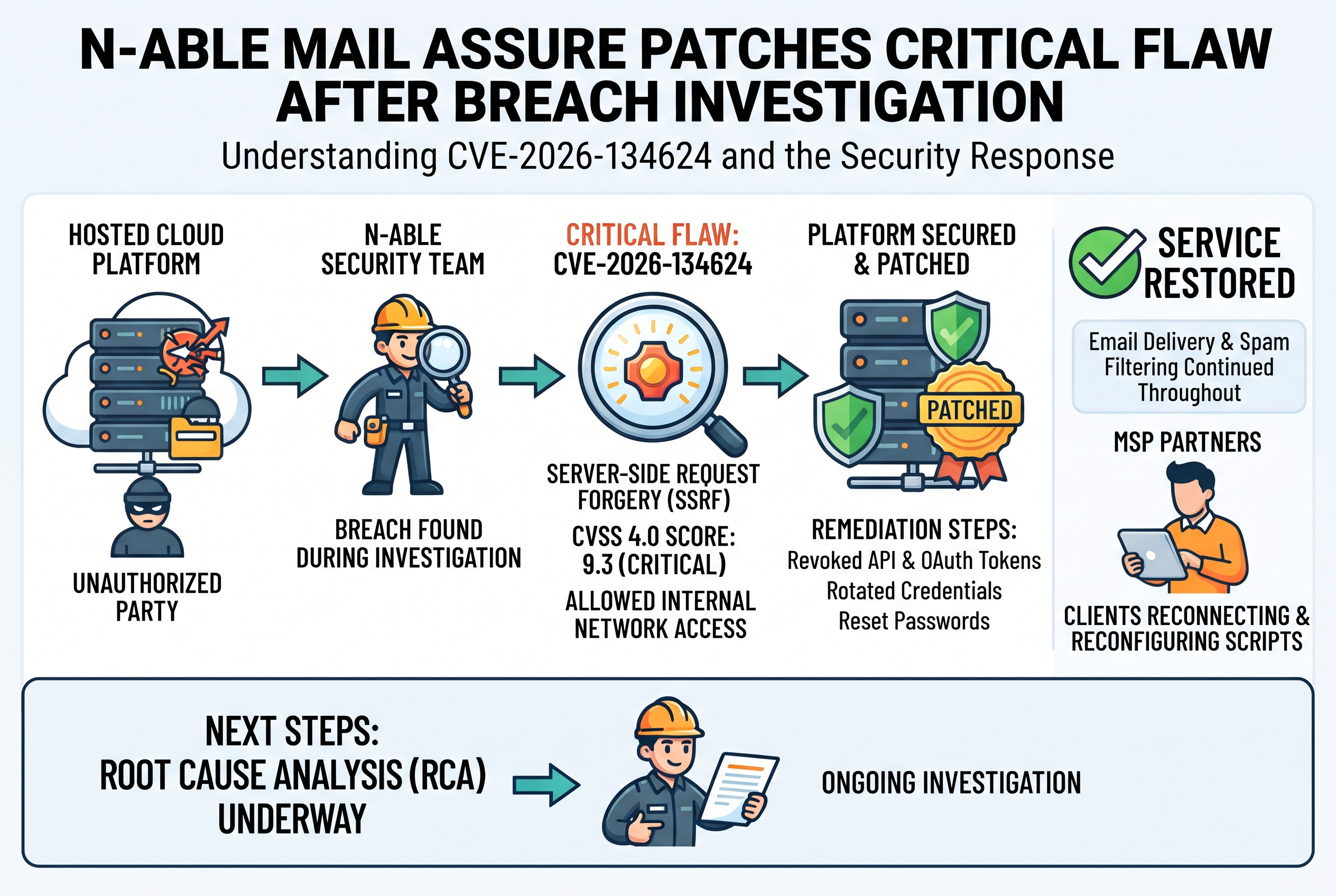
The flaw is tracked as CVE-2026-134624. N-able, which assigned the identifier itself, describes it in the CVE record published November 22 as a server-side request forgery, a class of bug that lets an attacker make a server open network connections on the attacker's behalf. The record gives it a CVSS 4.0 score of 9.3, a critical rating.
According to the record, Mail Assure builds before 20261121.1943 did not restrict the destination of a connection check the software runs for LDAP synchronization when a relay is configured. The record states: "An authenticated API user can cause the server to connect to arbitrary internal hosts and ports, determine which are reachable, and send crafted data to internal services." Its scoring vector lists high privileges as a requirement for an attack, and the record does not describe code execution.
Whether the flaw was the intruder's way in is not established. The Hacker News reports that N-able has not said so and that the investigation is still open.
Customers first heard of a service disruption, which N-able traced to platform configuration and service dependencies, according to The Hacker News. Two days later, on Wednesday, the company said the outage was a security incident in which an unauthorized party had accessed one of the Hosted Cloud servers. The dashboard and APIs stayed offline as a precaution while it investigated.
Email delivery and spam filtering kept working throughout, the company says, per the same report. In response to the intrusion, N-able took the affected server offline, rotated internal platform credentials, revoked customers' existing API tokens, invalidated OAuth tokens and reset local users' passwords.
For managed service providers on the hosted platform, the remaining work is reconnecting. Scripts and integrations that used the revoked API tokens or OAuth tokens need new credentials, and N-able has emailed each partner guidance specific to its environment, The Hacker News reports. The hosted platform is already patched, so hosted customers have nothing to install.
SpamExperts Local Cloud is a different case. It runs on customer hardware and receives software updates on a weekly schedule, the outlet writes, citing the product's update documentation, and N-able's incident statements describe the Hosted Cloud only. The Hacker News advises Local Cloud operators to confirm their servers are on build 20261121.1943.
On customer data, N-able says it has found no evidence of compromise, including of tenants' mailboxes, and no sign of exploitation beyond the one server since the fix went in, according to the report. That is the company's own statement during an open investigation, for which it has brought in an outside digital forensics and incident response team. How the attackers first got in, and whether any credentials they may have reached were taken, has not been disclosed. Neither the CVE record nor The Hacker News' account gives a number of affected partners or a cost for the outage.
The breach follows an earlier incident at another N-able hosted product. On November 9 the company took its hosted N-central remote-monitoring platform offline after a researcher published 33 unpatched flaws, The Hacker News reports. N-able says the Mail Assure breach is unrelated to that incident.
Next comes the formal root cause analysis, which N-able says is due within two weeks of its latest incident update, per The Hacker News. Two questions are open for it: how the intruder reached the server, and whether CVE-2026-134624 played any part. Separate restoration times for quarantine, logging and mailbox synchronization, which were being brought back in phases, have not been given.
Leave a Reply