By news editor
Google says AlloyDB Omni, the downloadable edition of its AlloyDB database, now integrates with large language models hosted on a company's own infrastructure, so that prompts, data and model responses stay inside that environment. The company names Gemma 4 from Google DeepMind and Qwen3.8 as examples in a Google Cloud blog post bylined to the senior software engineering manager for AlloyDB Omni.
The post is a step-by-step walkthrough. It states no price for the capability, no release status such as preview or general availability, and no customer using it.
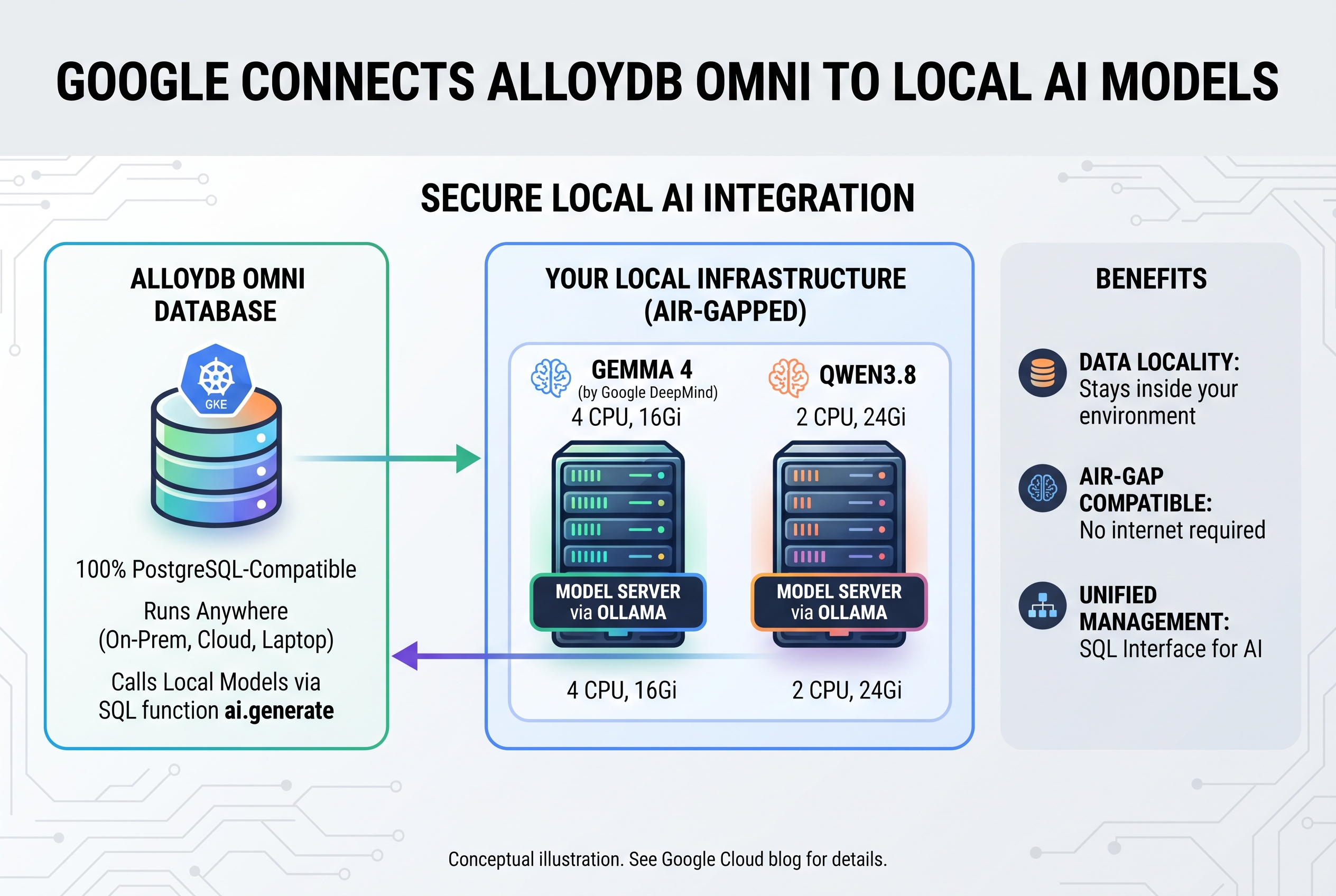
AlloyDB Omni is the edition of AlloyDB that customers download and run on their own infrastructure. The post describes it as 100% PostgreSQL-compatible and able to run in the cloud, in a data center or on a laptop. In the setup Google lays out, the database calls a local model server directly from SQL. An ordinary query invokes a built-in function, ai.generate, that passes a row's text to the model and returns the answer as a column. Google's sample query produces a one-sentence summary of each comment in a table of customer feedback.
The setup is aimed at environments that Google says were previously blocked from adopting agentic capabilities. The post names air-gapped networks, which have no connection to outside networks, and data locality requirements. It lists analyzing local logs, summarizing proprietary internal documents and running localized chatbots as uses.
On the benefit, Google writes: "Because the database and the model sit in the same local environment, your data never crosses the public internet." The post adds that local inference reduces network transit time. No latency measurement accompanies that claim.
By the post's account, the database is not limited to Google's models. It says AlloyDB Omni works with "virtually any model", whether a cloud-hosted one such as Gemini or a local one. Its walkthrough serves the model through Ollama, registers the model server's HTTP address with the database and labels the provider as custom.
The example also shows the hardware Google asks for. Its sample configuration requests 4 CPU units and 16Gi of memory for the server running Gemma 4, with a note to use 24Gi for Qwen3.8, and 2 CPU units and 4Gi for the database. No GPU appears anywhere in the configuration. The setup script also sets the database's model request timeout to 600 seconds.
Performance figures are not given. Google publishes no response times, throughput or accuracy results for either model, so the post shows what it takes to start the setup and not how it behaves under a production workload.
The demonstration itself runs on Google Kubernetes Engine, Google's managed Kubernetes service. Google says the same setup can be used on-premises "or almost anywhere", but an on-premises deployment is not shown.
Cost is also absent. The post does not say what AlloyDB Omni costs to license or whether the local-model integration carries a charge. The open models in the example run on the customer's own hardware, a cost the post does not estimate.
The details to watch for are the release that introduced local-model support and the support terms attached to it. The example uses version 1.9.0 of the AlloyDB Omni Kubernetes operator and database version 18.4.0 without saying whether either is a minimum. A named customer running the setup on its own servers would be evidence of adoption; the post offers none.
Leave a Reply