Contributed Article: By Dr. David Utzke, CEO & CTO at MyKey Technologies –
Microsoft’s November 12, 2026, global outage exposed how a dormant software defect in networking gateway servers can combine with routine traffic rerouting and reduced server capacity to trigger a worldwide cascading failure. According to Microsoft’s preliminary post-incident report, a bug introduced during a July 2026 update remained hidden for months until November maintenance and traffic failovers overwhelmed secure connection processes across a significant portion of its gateway fleet.
Cloud Infrastructure Vulnerabilities Exposed
The incident demonstrated that modern hyperscale cloud platforms remain vulnerable to systemic tsunami effects when multiple stress factors converge.
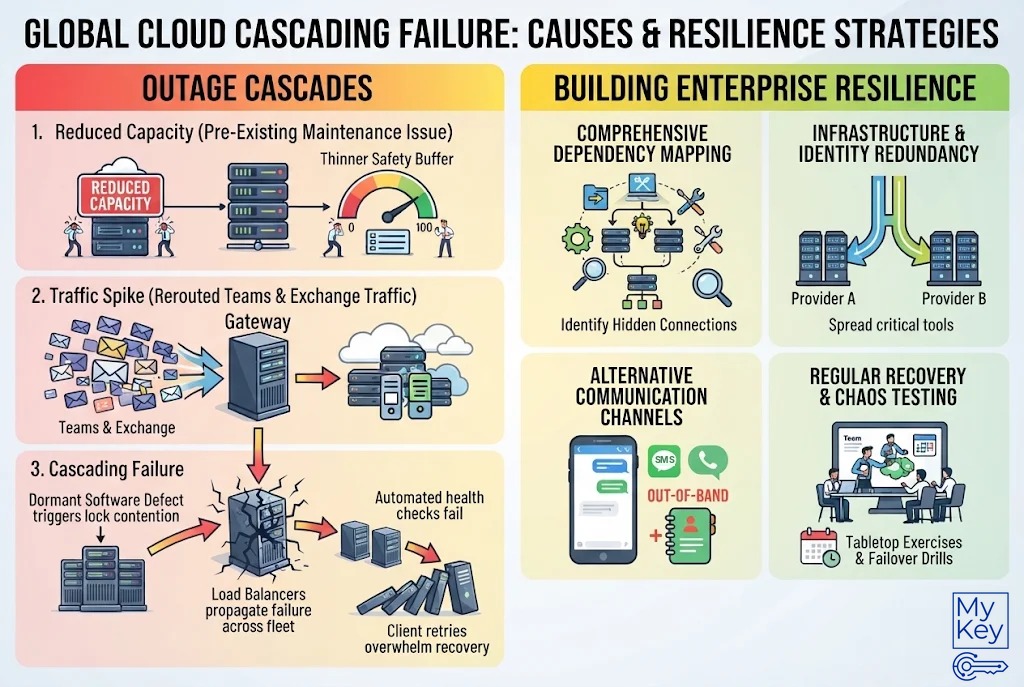
Prior to the outage, an unrelated maintenance issue had reduced Microsoft’s networking gateway server capacity. Operating with a thinner safety buffer left the remaining fleet vulnerable to sudden workload shifts that normal capacity margins would have absorbed.
Roughly 15 hours before the collapse, Microsoft rerouted Microsoft Teams traffic onto the primary networking gateways serving Exchange Online. Under this combined load, a dormant software bug triggered severe lock contention within the internal component responsible for establishing secure connections. Gateway servers choked on queued connection requests, failed automated health checks, and dropped offline.
Automated load balancers responded to failing servers by shifting traffic onto the remaining healthy gateways. Because those healthy nodes ran the same flawed code and faced instant traffic spikes, the load balancers inadvertently propagated the lock contention crash across the global fleet. During recovery, client retries created an imbalance that repeatedly crashed newly restarted servers.
Limited Provider Visibility Hinders Enterprise Response
Because Software-as-a-Service (SaaS) abstracts away underlying hardware and network routing, enterprise IT teams operate with minimal telemetry during major provider outages.
Enterprises can only observe external symptoms like timeouts and HTTP errors rather than internal gateway health. Because the failure began as intermittent mailbox disruptions in the Americas before spreading globally, organizations struggled to separate local network glitches from a systemic cloud outage; a problem compounded when Microsoft’s own Admin Center and status pages degraded under load.
Shared front-end gateways mean a bottleneck in one core service quickly bleeds into adjacent tools. Because Exchange Online serves as an architectural hub, gateway failures cascaded into Teams, SharePoint, and Microsoft 365 Copilot. Without visibility into Microsoft’s internal traffic routing, enterprise engineers could not determine whether to troubleshoot local firewalls, authentication layers, or individual applications.
External enterprises have no access to provider-side kernel logs, threat states, or deployment histories. Because the underlying gateway defect had been introduced months earlier in a July 2026 update and did not match any recent customer configuration change, enterprise teams had no way to diagnose why standard traffic was suddenly causing catastrophic failures.
When a shared routing layer saturates globally, customers cannot easily move to secondary regions or backup instances within the same cloud ecosystem. Furthermore, because the flaw was deeply embedded rather than tied to a single recent patch, quick provider rollbacks were ineffective. Enterprises without pre-configured out-of-band communication tools or multi-cloud alternatives were forced to wait while Microsoft manually managed incoming traffic to reduce connection queues.
How Outages Disrupt Security and Data Protection
This is a significant issue that many neglect to attend to. Cloud-service outages disrupt enterprise security and data protection by severing the telemetry pipelines, administrative controls, and automated policy engines that defenders rely on, even when no cyberattack is underway. To counteract these blind spots, enterprises must engineer resilience around verified dependency mapping, multi-provider redundancy, out-of-band communication channels, and regular failure simulations.
When core cloud infrastructure degrades or goes offline, defensive operations suffer immediate cascading failures across three main areas. Cloud-native Security Information and Event Management (SIEM) and Extended Detection and Response (XDR) platforms depend on uninterrupted log ingestion from identity providers, email gateways, and endpoints. When front-end gateways fail or throttle traffic, audit logs drop or queue indefinitely, creating visibility gaps that prevent analysts from distinguishing an infrastructure glitch from an active intrusion or Denial-of-Service attack.
Security Operations Centers (SOCs) rely on cloud-hosted admin portals, automated playbooks, and unified identity planes to contain threats. During an outage, analysts often lose access to identity management consoles needed to revoke compromised tokens, quarantine endpoints, or isolate accounts. Furthermore, high volumes of false-positive availability alerts flood SOC queues, causing alert fatigue and slowing down human decision-making.
Inline Data-Loss Prevention (DLP) policies inspect emails, file shares, and messaging traffic in real time before allowing sensitive data to leave the organization. If cloud-based DLP inspection engines become unreachable, systems configured to block uninspected data from passing freely create compliance and exfiltration risks. Conversely, systems configured to allow legitimate business communication are blocked, causing frustrated employees to frequently bypass controls by moving sensitive files onto unauthorized personal devices or shadow IT apps.
Strategies to Strengthen Enterprise Cloud Resilience
Enterprises can reduce their vulnerability to single-provider failures by implementing four foundational architectural and operational practices:
- Comprehensive Dependency Mapping: The process of drawing a complete “family tree” of all the company’s software, servers, and tools to see which systems rely on others to work. This reveals the hidden background connections between them so IT knows what else will break if a single tool goes offline.
- Infrastructure and Identity Redundancy: This means having backup computers and backup login systems ready to take over so a business keeps running if the main cloud provider crashes. Instead of keeping a company’s digital eggs in one basket, spread critical tools across different providers so a single outage cannot lock everyone out.
- Alternative Communication Channels: Because outages frequently disable primary email and messaging platforms simultaneously, IT and security teams need pre-established out-of-band communication tools. Maintaining secondary messaging apps, dedicated SMS alert trees, and offline emergency contact directories ensures incident commanders can coordinate restoration efforts without relying on the broken infrastructure.
- Regular Recovery and Chaos Testing: Resilience plans fail if they rely on untested assumptions about how systems degrade under stress. Enterprises should conduct regular tabletop exercises, failover drills, and controlled chaos engineering tests that simulate complete cloud-provider blackouts, verifying that teams can switch to backup tools, maintain security oversight, and restore operations within acceptable recovery time objectives.
About Dr. David Utzke:
Dr. David Utzke, the CEO and CTO at MyKey Technologies, is a Financial and Digital Asset Economist, an academically trained Distributed Ledger Architectural Engineer, AI model design and governance engineer, educator, researcher, digital forensic investigator, and author with experience in cybersecurity, cybercrime investigation, data security, heuristic and forensic analytics, cryptography, economic game theory, Extended Reality design, and quantum computing.
He can be found on LinkedIn at: https://www.linkedin.com/in/drdavidutzke/

Opinions expressed are the author’s own and do not necessarily reflect those of Biz Tech Journals
Leave a Reply