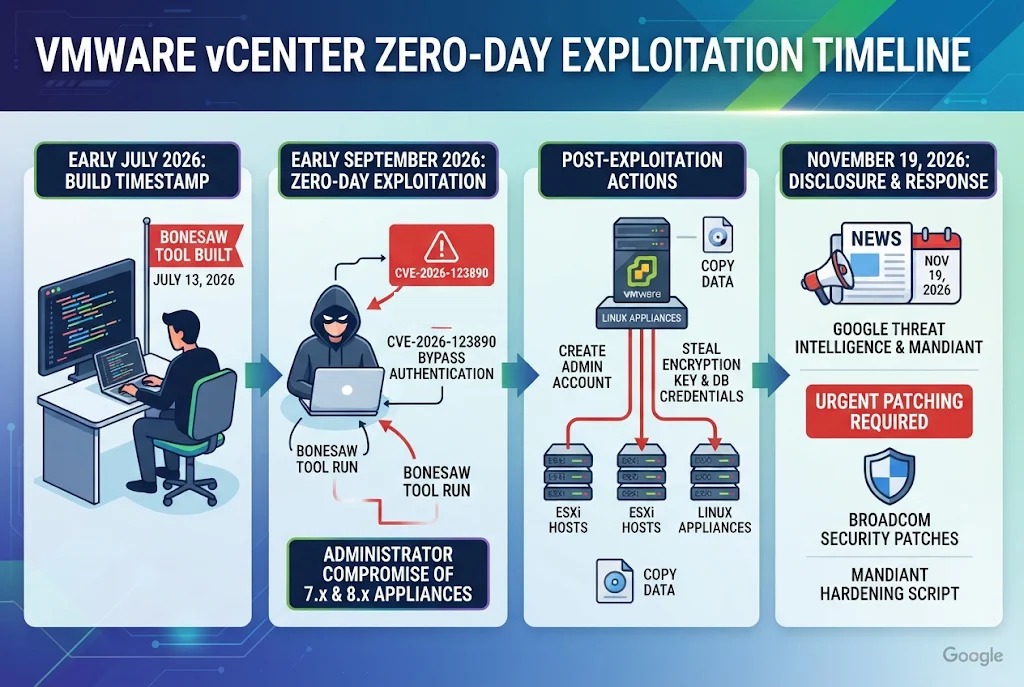
AI-generated infographic: vmware vcenter zero-day exploitation timeline. Its figures are taken from this article. Infographic: Grok.
By news editor
A suspected China-nexus espionage group broke into a VMware vCenter server in early September 2026 using a flaw that was not publicly disclosed until Nov. 19, 2026, according to Google Threat Intelligence Group and Mandiant. Google tracks the group as ARMORY CASTLE, formerly UNC5221. The vulnerability is CVE-2026-123890.
vCenter Server is the management software that administrators use to configure, control and monitor ESXi hosts, the hypervisors that run a company's virtual machines. Google says a successful attack bypasses authentication remotely and hands the intruder an administrator session, from which commands can be run and files taken. The group's exploitation tool, which Google calls BONESAW, achieves full system compromise of vCenter Server 7.x and 8.x appliances, according to the post.
For companies running vCenter, the immediate task is patching the system Google describes as the control plane for the virtualized data center. Google urges affected organizations to apply Broadcom's security patches immediately. The post gives no severity score and no fixed version numbers. It does not say how many organizations were compromised, and it names no victim.
The vCenter break-in was the second stage of a longer intrusion. On Oct. 15, 2026, the same Google teams reported that ARMORY CASTLE had exploited CVE-2026-102764, a zero-day in BeyondTrust Remote Support that has since been patched. A zero-day is a flaw attackers use before a fix exists. From the remote support appliance, the group moved to internal Linux appliances that lacked endpoint detection and response tooling, scanned the network for VMware systems and ran BONESAW against an internal vCenter server.
Once inside, the attackers created an administrator account, stole vCenter's master encryption key and database credentials, and logged in to the ESXi hosts, Google says. There they read virtual machine disk files directly and copied out a Windows directory database and registry hives. Google assesses that the data likely left the network through the compromised remote support appliance.
Five newly identified malware families and utilities turned up in the intrusion, according to the post. They include two webshells, a backdoor based on an open-source SSH server and a utility that lets the group forge login tokens, bypass multi-factor authentication and impersonate any user. A sixth tool, a backdoor that takes commands over Slack, had appeared in an earlier ARMORY CASTLE intrusion.
Google reads that tooling as a sign of funding. The post states: "The use of three separate specialized sets of malware and two zero-days in the course of a single compromise indicates that there are significant resources supporting ARMORY CASTLE operations."
Mandiant says it has evidence that the group knew of the flaw well before the September break-in. The recovered BONESAW file carries a build timestamp of July 13, 2026, which is 16 days before a separate vCenter flaw with some overlap, CVE-2026-59309, was disclosed on July 29, 2026. Logs show the tool ran in early September against a server already patched for that earlier flaw. Google cautions that build metadata can be altered before compilation.
Patching alone does not close the gap, in Google's view. The post argues: "Because vCenter serves as the centralized control plane for the virtualized data center, relying solely on reactive patching is insufficient to protect it." It says the appliance's built-in firewall cannot restrict access port by port, generates no remote logs of denied connections and leaves outbound traffic unmanaged, and it recommends a Mandiant hardening script that enforces firewall rules at the operating system level.
That advice comes from a vendor whose Google Security Operations product carries detection rules for the activity. Google itself advises rigorous testing and formal change control before such firewall rules reach production.
The next thing to watch is whether other vCenter operators find the same tools on their own systems. Google notes that BONESAW was built more than a month before it was used in this intrusion, which it takes as an indication that the tool was developed for broader operations, and it has published file names, network indicators and detection rules for defenders. The fixed version numbers, absent from Google's post, are the other detail customers need to size the patching job.
Leave a Reply