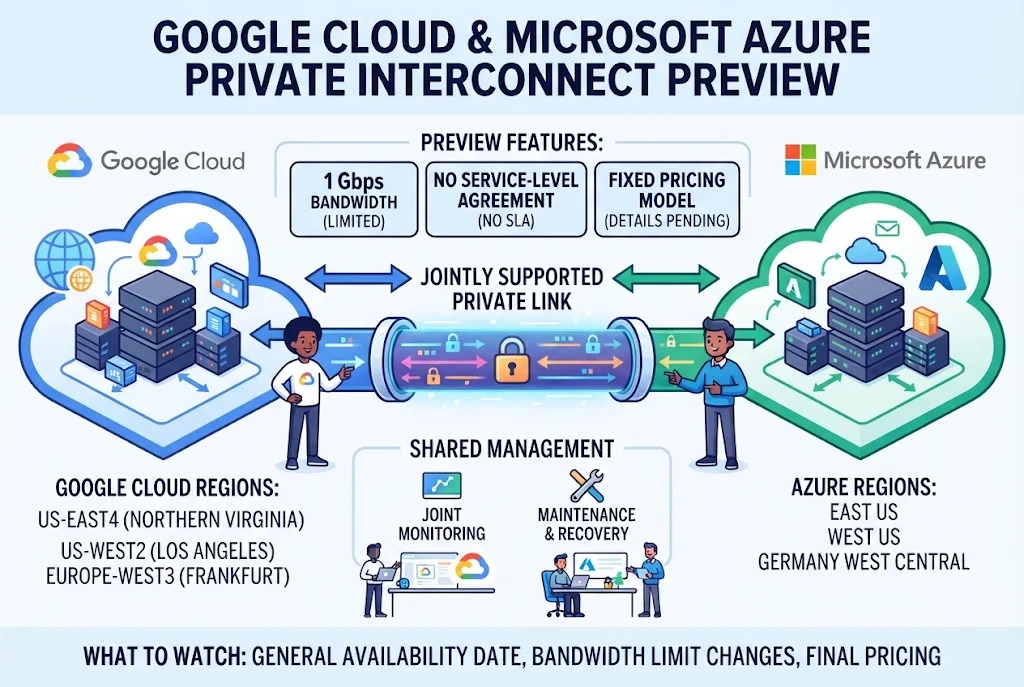
AI-generated infographic: google cloud and microsoft azure private interconnect preview. Its figures are taken from this article. Infographic: Grok.
By news editor
Google Cloud and Microsoft have opened a preview of a private network connection between their two clouds that both companies support and that customers set up through software, with no hardware to order. Google announced it as an extension of its partner Cross-Cloud Interconnect service to Microsoft Azure. Microsoft announced the same link as the public preview of Azure Multicloud Interconnect with Google Cloud.
Speed is the selling point. Connecting clouds has meant ordering physical connections from each provider, setting up networking on both sides and coordinating across teams, Google writes, and that process "could take weeks or even months." The new connection, by its account, is "set up programmatically in minutes, with no physical infrastructure to manage."
For now the service is narrow. Google lists three regions for the preview: us-east4 in Northern Virginia, us-west2 in Los Angeles and europe-west3 in Frankfurt. It says more will follow as the Azure offering moves to general availability and gives no date for that. Microsoft's availability documentation lists East US, West US and Germany West Central as the Azure regions that support Google Cloud.
That document also sets the limits a buyer should know before moving a production workload. Supported bandwidth for Google Cloud is 1 Gbps. The same table shows the Azure link to Amazon Web Services at up to 100 Gbps. Public preview connectivity carries no service-level agreement, the uptime commitment Microsoft publishes for generally available connectivity, and region availability can change during the preview.
On price, the two announcements give structure without rates. Google says customers pay "a fixed price for the connection's bandwidth" and publishes no figure in its post. Microsoft's pricing page describes a monthly price set by pricing zone, circuit bandwidth and connectivity option, with unlimited inbound and outbound data transfer included and no separate per-gigabyte Azure charge for traffic on the link.
Customers should expect a bill from each side. Microsoft's documentation states, "The participating provider can charge separately." It adds that preview pricing can differ from pricing at general availability.
Both companies describe shared operations. Google says the connection runs across physically separate locations for redundancy, that Google Cloud and Azure jointly monitor it and handle maintenance and recovery, and that traffic stays off the public internet and is encrypted between the two providers' edge routers without customer configuration. Microsoft's documentation says MACsec, an encryption standard for physical network links, is on by default.
Some work stays with the customer. According to Microsoft's FAQ, customers still manage their virtual networks and gateways on both sides, address planning, firewalls, access policies and any encryption at the workload level. Traffic entering Azure over the link needs an ExpressRoute virtual network gateway, which Microsoft lists as a prerequisite.
Two customer endorsements appear in Google's post, from executives at Nestlé and Walmart. Walmart's Gerald Bothello, group director of software engineering, is cited as saying Cross-Cloud Interconnect let the retailer simplify connectivity between cloud providers, shorten time to production and reduce overall costs. Neither statement mentions Azure, and neither gives a figure.
The preview extends a pattern of direct links between large cloud providers. Google says its partner Cross-Cloud Interconnect offerings for AWS and OCI, Oracle's cloud, are generally available, and that the service is built on an open specification for network interoperability that it published with AWS last year and that any provider can adopt. In the same post that announced the Google preview, Microsoft moved its own interconnect with AWS, introduced in preview in August, to general availability.
What to watch is the move out of preview. Neither company gives a general availability date for the Google and Azure link. Until one arrives, the open items for buyers are whether the 1 Gbps limit rises, whether a service-level agreement is attached, and what both providers charge once preview pricing ends.
Leave a Reply