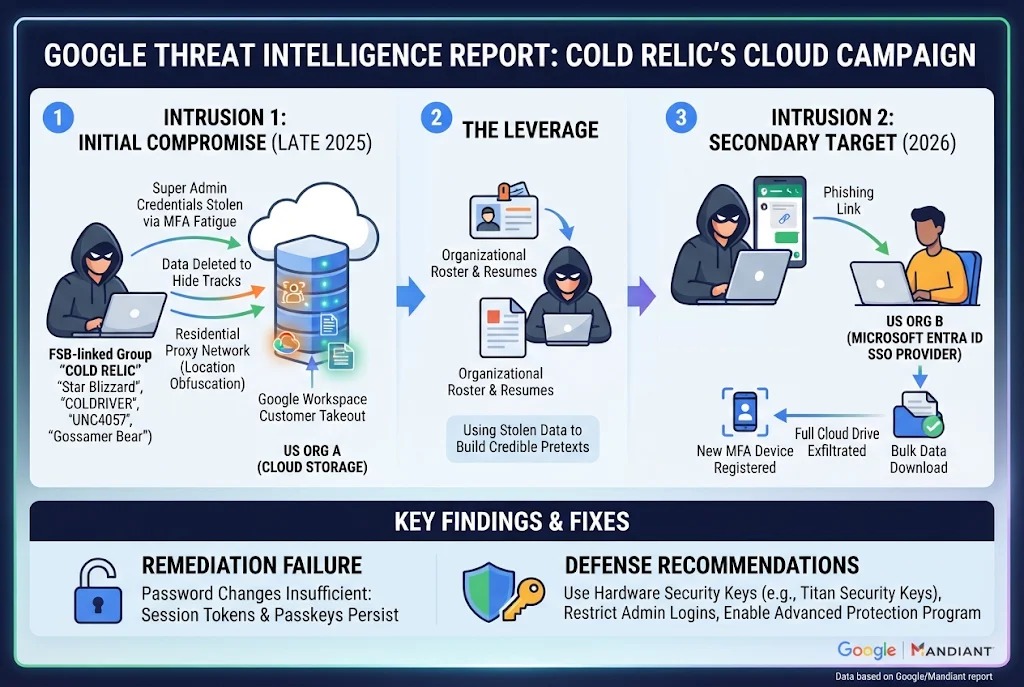
AI-generated infographic: google report on cold relic cloud intrusions. Its figures are taken from this article. Infographic: Grok.
By news editor
A Russian state-sponsored espionage group downloaded the contents of one US organization's entire cloud storage drive in late 2025, then used the staff directory and identities stolen there to compromise a second US organization in 2026, according to a report from Google Threat Intelligence Group and Mandiant. Neither victim is named, and the report gives no count of files or people affected.
Google calls the group COLD RELIC and says it has tracked and disrupted its phishing campaigns since 2015. It previously tracked the same actor as COLDRIVER and UNC4057, and the report lists Star Blizzard, Callisto and Gossamer Bear as other names for it. The US Department of Justice has assessed that the group operates within Russia's Federal Security Service, the FSB, the report says.
The authors write that the group "turns a single cloud compromise into a springboard for ongoing third party compromise and espionage." By their account, the material it looks for inside a victim includes organizational rosters, contact lists, resumes and event schedules, which it uses to build pretexts for the next target.
In the first intrusion, the attackers signed in with the stolen credentials of a Super Admin account and a multi-factor authentication fatigue attack, which sends repeated sign-in approval requests until a user accepts one. They connected through a residential proxy network located close to the victim. Google says the group picks proxies near its targets to avoid location-based alerts.
With that account, the group shared files in bulk to an email account it controlled, downloaded others directly, exported full employee lists and started a domain-wide export through Google Workspace Customer Takeout, an administrator tool that exports data for a whole tenant. It also viewed, modified and deleted Alert Center notifications to remove evidence of the break-in, the report says. Access lasted several months.
The second intrusion started in a chat. Posing as an employee of the first victim, an operator contacted a target over an encrypted messaging app and, during the conversation, shared phishing links built to steal credentials and authentication tokens for Microsoft Entra ID. The second organization used Entra ID as its single sign-on provider, the service through which one login opens other applications, for Google Workspace. After signing in, the attackers registered a new multi-factor device and bulk downloaded the files in the compromised user's cloud drive.
Two pieces of evidence tie the cases together in the report: the impersonation, and a redirect link from the second intrusion, submitted to VirusTotal in June 2026, whose parameter referenced the first victim organization.
Resetting passwords did not remove the attackers. In at least one case, the report says, a victim organization found the intrusion and reset passwords for affected accounts but did not revoke existing sessions, and COLD RELIC kept its access. Passkeys the attackers had enrolled also persisted across password and session resets. The report states that when remediating a suspected account compromise, "password changes alone are insufficient."
Recommended fixes carry a cost that the report does not price. Google advises replacing SMS, voice and push-notification approvals with hardware security keys, requiring an existing administrator or an out-of-band identity check before a new authentication device is added, restricting administrative logins from residential proxy networks, and setting data loss prevention rules across Google Drive, OneDrive and SharePoint. It adds that some intrusions were made worse because users had stored credentials in their organization's cloud storage.
Several of those recommendations point to Google's own products. The report names Titan Security Keys as an example of hardware keys, suggests enrollment in the Advanced Protection Program, and says customers of Google Security Operations get detection rules for this activity in the Mandiant Frontline Threats rule pack. No prices appear in the report.
All of these findings are Google's and Mandiant's own. The report does not identify the victims or their industries, the amount of data taken or any financial loss. It describes the group's past targets as including government officials, defense contractors and non-governmental organizations across Europe and North America.
Active operations continue, by Google's account. The report states, "COLD RELIC remains an active threat; GTIG has observed evidence of new phishing operations as recently as November 2026." After the second compromise, the messaging account used for the approach was renamed to a new persona, which Google believes was likely used to target other organizations in the same professional circles. Whether those organizations or US authorities disclose further intrusions is the next thing to watch.
Leave a Reply