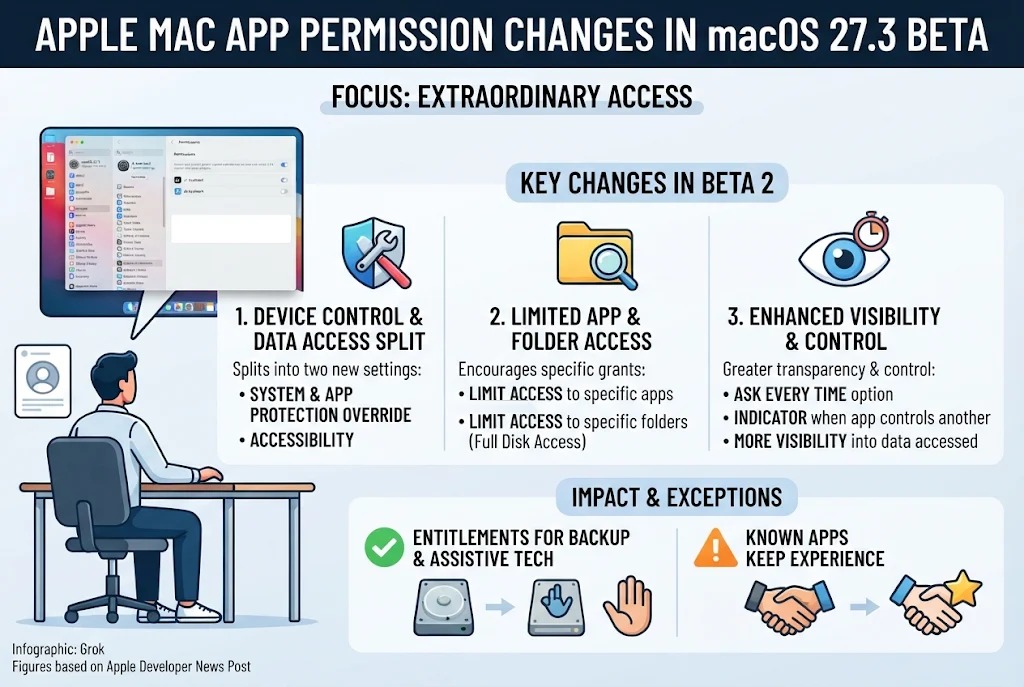
AI-generated infographic: apple mac app permission changes in macos 27.3 beta. Its figures are taken from this article. Infographic: Grok.
By news editor
Apple is changing how Mac apps obtain two permissions it describes as extraordinary access, splitting one of them into two settings and letting users confine an app to specific folders or specific other apps. The changes are in macOS 27.3 beta 2 and follow an October notice in which the company said AI agents would raise the risk of granting that access.
Both notices appear on Apple's developer news page. The new one concerns two programming interfaces, Device Control and Data Access, and Full Disk Access. Apple writes, "Before granting an app such extraordinary access, users should understand that it puts all of the data on their Mac at risk."
Under the beta, Device Control and Data Access becomes two settings, called System & App Protection Override and Accessibility. Users grant permission through a single method, selecting the requesting app from a list. Guidance in the system encourages them to grant access only to the specific apps, in the case of the override setting, or the specific folders, in the case of Full Disk Access, that their work requires.
Two further controls change what happens after setup. Users can configure an app to ask every time it needs access, and an indicator appears when a requesting app is controlling another app through the override setting. Apple also says users will get more visibility into the range of data an app receives if they grant full permissions.
For software companies, the work falls on installation and setup. The post tells developers to be prepared to adjust how they onboard users and to make sure their apps can handle having access to only a limited set of folders or apps. Users will see the new screens when approving new permission requests, and permissions they granted earlier remain in effect, according to the post.
Exceptions cover two categories. Developers of apps that use Full Disk Access for disk backup, or the new Accessibility setting to provide assistive technologies, can request entitlements, which are app-specific approvals from Apple, to deliver the same experience for new installations that they offered before macOS 27.3. The post adds, "Currently, known apps aren’t affected and will keep the same experience without an entitlement." It does not say which apps count as known, and it names no entitlement for any other category of app.
The link to AI comes from the earlier notice. In that October post, Apple said Full Disk Access largely sidesteps the controls that protect users' private data so that backup apps can function, and that some developers were using it in ways that could expose files, mail, messages and browsing history without users' full knowledge. It named no developers. The company then wrote, "As AI agents become increasingly capable and autonomous, the risks associated with this level of access will grow substantially."
Nothing in the November post mentions AI. The Hacker News, reporting the change, describes the controls as covering apps that use AI agents and ties them to the October notice.
For developers whose Mac apps request this access, the practical change arrives at first run. A new user may grant only some folders or some apps, or require a prompt each time, and the app is expected to keep working. Existing users keep the grants they already made, the post says.
Several details are not disclosed. Apple gives no date for the general release of macOS 27.3, no criteria for the entitlements and no count of apps or developers affected. The October post said additional controls would ensure that users can grant this level of access only with very explicit action. The November post does not say whether more controls will follow.
Entitlement details are the next thing to watch. Apple says only that they will be available soon, and those rules would determine which apps keep their current setup experience when macOS 27.3 ships.
Leave a Reply