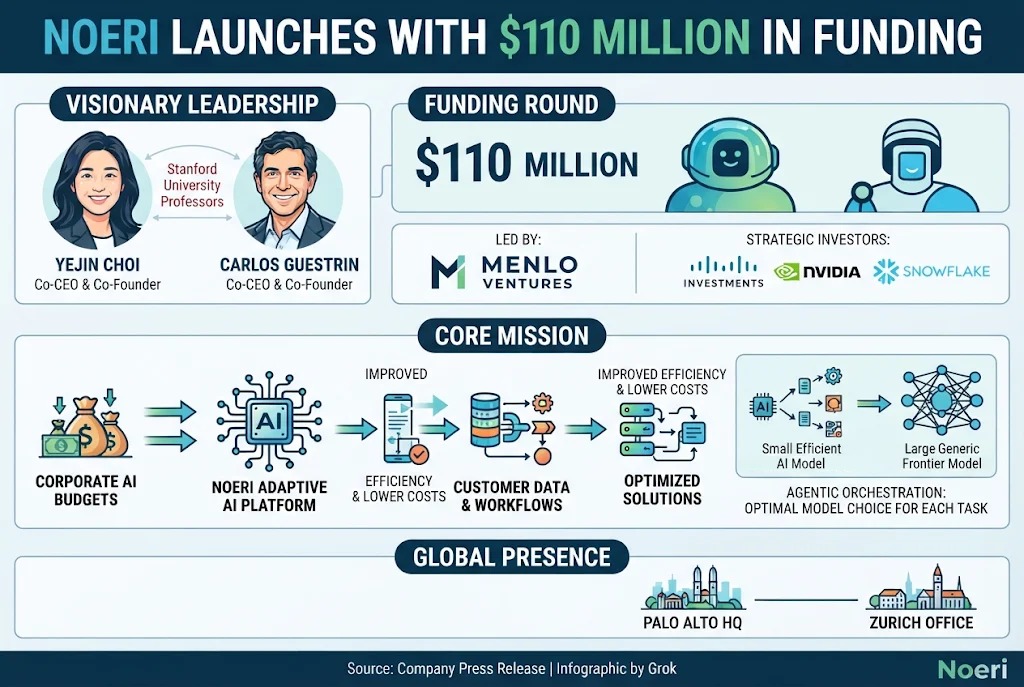
AI-generated infographic: noeri launch funding round. Its figures are taken from this article. Infographic: Grok.
By news editor
Noeri, an AI lab founded in 2026 by two Stanford computer science professors, has launched with $110 million in funding led by Menlo Ventures, with Cisco Investments, Nvidia and Snowflake joining as strategic investors.
The company announced the round in a Business Wire release, read via Yahoo Finance's full-text republication. Madrona Venture Group, Kindred Ventures, Wing Venture Capital and NEA also took part. The release does not name the stage of the round, gives no valuation and does not say how much each investor put in.
Yejin Choi and Carlos Guestrin, the founders, serve as co-CEOs. Guestrin co-founded Turi, a machine learning platform that Apple acquired in 2016, and then led Apple's central machine learning and AI organization, according to the release. Choi is a MacArthur Fellow who was previously a professor at the University of Washington and a senior director at the Allen Institute for AI. The lab is based in Palo Alto and has an office in Zurich.
What the money backs is a pitch aimed at corporate AI budgets. For a specific job, the release says, a company usually either pays more for the most capable model or accepts weaker results from a cheaper one. Noeri says its system studies a customer's own data and workflows, then changes the software around a task, the choice of model for each step and, where it pays off, the models themselves.
Every change the system proposes comes with an explanation and goes to a person for approval, according to the release. The system works with both closed models and open-weight ones, meaning models whose trained parameters are published. Customers keep ownership of their data and of the workflows and models they develop, subject to applicable third-party model licenses, the release says.
The founders argue for that ownership in an essay on Noeri's website. Choi and Guestrin write: "Today, using the most capable AI usually means sending your data to someone else’s servers and renting an intelligence you cannot inspect, move or keep." The essay says the expertise to build AI models now sits with a small group of specialists at a few well-funded frontier labs.
For evidence, the release points to the founders' academic research. It says Choi's work on agentic orchestration showed that a small model directing a team of other models and tools can outperform frontier models at a fraction of the cost. It gives no benchmark results for Noeri's own product. Noeri's home page says results are judged inside each deployment: "Quality and cost are measured on your own traffic and metrics, not a public benchmark, so the improvement is visible."
No customers are named. The release says Noeri is working with strategic partners across industries, including some of its investors, without identifying them. It lists no prices and no date on which the product becomes generally available.
Menlo Ventures partner Venky Ganesan says in the release that most new AI labs ask the market to wait years for a breakthrough, and that the firm moved quickly to lead the round because the founders are doing research and putting it to work inside companies at the same time.
Beyond enterprise workflows, the release pitches the system for scientific work. It says Noeri's AI can propose hypotheses, run experiments and learn from the outcomes, on problems that range from new molecules and proteins to complex technical systems. No research partner is named.
How the $110 million will be spent is not broken down. The release says the company is hiring researchers and engineers in Palo Alto and Zurich.
The next thing to watch is a first named customer and a result measured on that customer's own workload, the standard Noeri's home page sets for itself. A disclosed price would show whether the offer undercuts the most capable models that the release says companies now pay more to use.
Leave a Reply