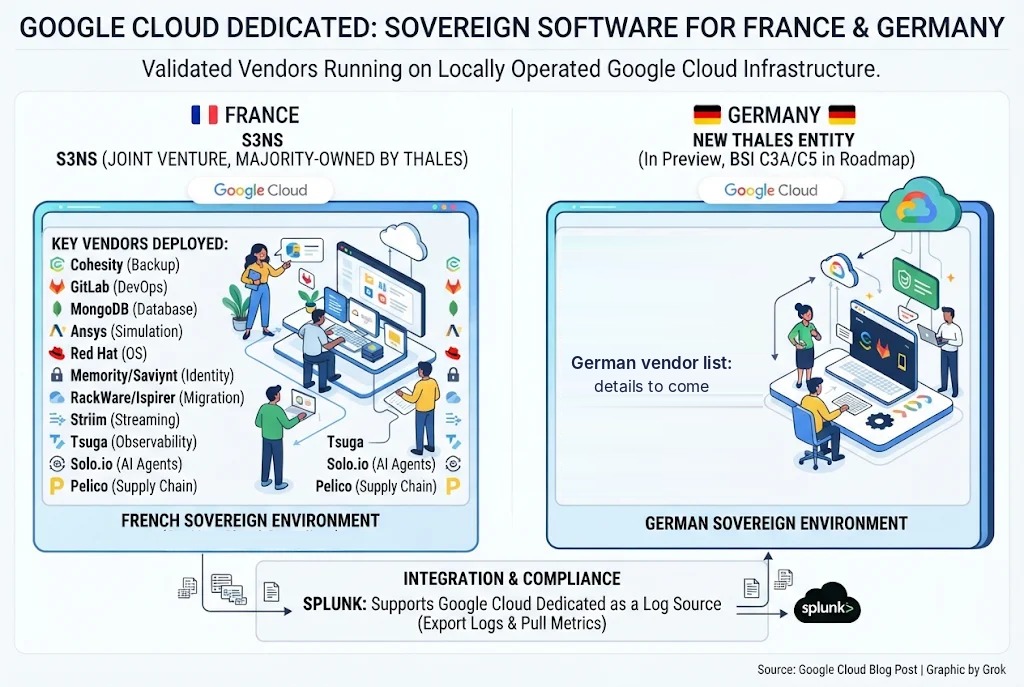
AI-generated infographic: software vendors on google cloud dedicated in france and germany. Its figures are taken from this article. Infographic: Grok.
By news editor
Google Cloud has named 14 software vendors, among them Cohesity, GitLab, MongoDB, Red Hat and Splunk, whose products it says run on or connect to Google Cloud Dedicated, the version of its cloud that local partners operate for French and German organizations with data sovereignty requirements.
The list appears in a Google Cloud blog post written by the service's product lead and a product manager. They describe Google Cloud Dedicated as offering the architecture, security and programming interfaces of Google Cloud inside locally governed environments managed by independent domestic operators.
In France that operator is S3NS, which the post describes as a joint venture majority-owned and managed by Thales. For Germany, the post refers to a newly formed entity that will also be owned and managed by Thales and is currently in preview. It gives no date for general availability there.
Buyers in view are organizations in financial services, healthcare, critical infrastructure and the public sector that must meet national standards, including SecNumCloud in France and BSI C3A in Germany.
Software, not infrastructure, is what Google says has held those buyers back. The post states: "When highly regulated European institutions consider moving to a sovereign cloud, the infrastructure itself is rarely the primary roadblock. The real bottleneck is software." It says strict sovereignty has historically meant rewriting applications, swapping standard tools for untested alternatives or shelving projects because the needed vendors could not operate in the environment.
Most of the 14 entries are products described as deployed inside the partner-operated boundary. They cover backup and recovery from Cohesity, software delivery from GitLab, engineering simulation from Ansys, identity management from Memority and Saviynt, and migration tools from RackWare and Ispirer. Data streaming from Striim, Red Hat Enterprise Linux and OpenShift, observability from Tsuga, MongoDB Enterprise Advanced, an AI agent runtime from Solo.io and supply chain software from Pelico complete that group.
Splunk's entry is an integration instead. According to the post, Splunk now supports Google Cloud Dedicated as a log source, so customers can export logs from those environments into Splunk Enterprise, and Splunk Observability Cloud can pull metrics from them.
The pitch to customers is that no rewrite is needed. Because Google Cloud Dedicated keeps the same architecture and interfaces as Google Cloud, the post says, validated software runs in the partner-operated environments without custom re-platforming. Google does not describe the validation process or say how long it takes a vendor.
Operational control sits with the local partner under this model. The post says infrastructure operations, software quarantine procedures and day-to-day administrative access are managed directly by the European partners, with remote technical escalations subject to escorted access that the partner supervises.
Commercial terms are not in the post. It lists no prices for the service or for the software, and it gives no count of customers. The one deployment it cites is unnamed: Pelico's setup on S3NS is described as proven for a global aerospace and defense group. A second example, UPS Capital's use of Striim's streaming technology, is presented as a capability European operators can now deploy inside their own boundary.
French organizations are told to obtain validated software and manage deployment through S3NS. German organizations are directed to a local partner team to review architecture patterns and compliance roadmaps for BSI C5 and C3A. The post does not say whether the German service has been certified against those standards.
The German entity's move from preview to general availability is the next step to watch, and Google has not dated it. Published prices, or a named customer running one of the 14 vendors' products inside S3NS, would show how much regulated work is moving onto the service.
Leave a Reply