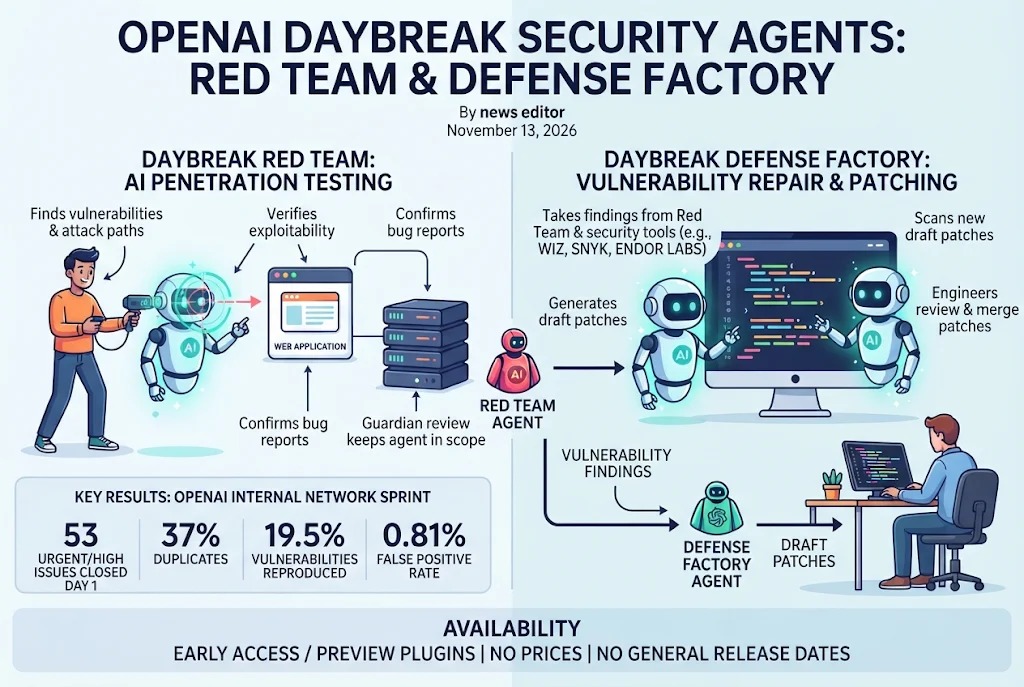
AI-generated infographic: openai daybreak security agents. Its figures are taken from this article. Infographic: Grok.
By news editor
OpenAI has introduced two security products built on AI agents: Daybreak Red Team, which runs penetration tests against web applications, and Daybreak Defense Factory, which investigates vulnerability findings and drafts patches. SecurityWeek reports that the company announced both at its Cyber at the Frontier event on November 12.
Both arrive in limited form. OpenAI's Red Team page labels the product early access and asks companies to register interest. The Defense Factory page directs buyers to contact sales, and SecurityWeek says the product is offered through a preview plugin in ChatGPT for workspaces that have Daybreak access. Neither page lists a price, a customer or a date for general release.
Daybreak is the name of OpenAI's cybersecurity program, and entry is gated. On its Daybreak page the company says it verifies applicants and reviews how they plan to use its models before approving access. One tier, Daybreak Blue, covers defensive work. Another, Daybreak Red, covers authorized red teaming, the practice of attacking a company's own systems to find weaknesses, along with penetration testing and exploit validation. The same page lists the two new products beside a Daybreak plugin and a Codex Security command-line tool and software development kit.
Red Team is described on its page as AI penetration testing for web applications. Its agents use source code and application context to investigate attack paths and confirm vulnerabilities, the page says, test findings that arrive from code scanners, bug bounty submissions and disclosure reports, and check whether a patch stops the exploit. Scope is enforced with isolated environments and what OpenAI calls Guardian review, a control the page does not describe further. The customer sets which applications and endpoints the agents can reach.
Defense Factory handles the repair work, taking findings from a company's existing security tools and from Red Team. OpenAI's page describes the division of labor this way: "Agents trace vulnerabilities through your code and develop patches. Engineers review and test proposed patches before merge." Engineers can add context and adjust a patch with Codex, OpenAI's coding agent, and the product can scan new commits or run recurring checks, the page says. SecurityWeek reports that the product can import vulnerability data from Wiz, Snyk and Endor Labs, scan connected GitHub repositories and create draft pull requests, and that patches are not deployed automatically. OpenAI's page frames this as putting a company's existing security tools to work on fixes.
The supporting figures come from OpenAI's own network. On a separate page about an internal operation it also calls a Defense Factory, the company says a security sprint involving more than 250 people closed 53 urgent or high-priority issues on its first day. It says 37% of findings turned out to be duplicates, 19.5% of findings were reproduced at runtime, and the false-positive rate after that validation step was 0.81%.
Those numbers describe OpenAI's own systems, with OpenAI as the only source. The page does not give the total number of findings, the period the sprint covered or any outside review, and it lists a technical blog post as coming soon. It says teams at Cloudflare, Ramp and Google are exploring the same approach, a statement about the method and not about customers of the two products.
A price, a general availability date and the promised technical post are the next things to watch. Results from a customer's network, if one publishes them, would be the first test of the figures outside OpenAI.
Leave a Reply