Contributed Article: By Peter Ayedun, Co-founder and CEO, TruGrid –
For IT teams responsible for remote access, the past several months have delivered an uncomfortable reminder: maintaining security is not always as simple as installing the latest patch.
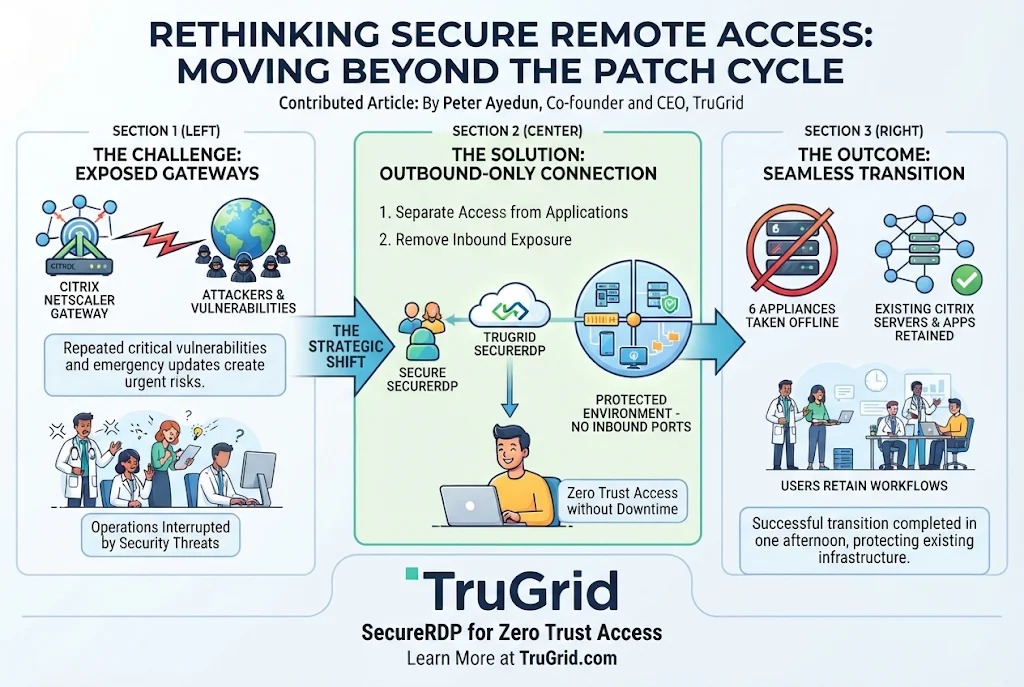
Citrix NetScaler administrators have faced a steady stream of critical vulnerabilities, emergency updates, and security advisories. The latest bulletin, covering 28 additional vulnerabilities, has renewed questions about the risks associated with internet-facing remote-access infrastructure. For organizations that depend on Citrix to keep employees, clinicians, and business partners connected, the challenge is particularly difficult. They need to respond to security threats without interrupting the applications and workflows their organizations depend on.
Patching remains essential. But when a particular access architecture repeatedly creates urgent security concerns, organizations should consider a broader question: Does the gateway need to remain exposed to the internet at all?
One Citrix partner decided to answer that question differently.
On October 7, IntelliSuite Technologies, a hosting provider and Citrix partner serving primarily healthcare clients, made the decision to remove six NetScaler appliances from internet exposure. In a single afternoon, the company moved 29 client sites to an outbound-only connection model.
The important detail is what did not change: the Citrix servers and applications remained in place. Clients did not have to rebuild their existing Windows environments, and users retained the desktops and applications they were accustomed to accessing.
The project demonstrated that organizations can rethink the path users take to reach their systems without necessarily replacing the systems themselves.
Separate the applications from the access architecture
Remote access is often treated as a single technology decision. An organization deploys a gateway, configures connectivity, and maintains that infrastructure as part of its security operations.
Over time, however, the gateway can become a critical point of exposure. It must remain accessible to legitimate remote users, which also means it may be reachable by attackers. Each newly disclosed vulnerability creates another cycle of assessment, patching, testing, and communication.
A more useful starting point is to separate the applications an organization needs to protect from the infrastructure used to provide access to them.
IntelliSuite did not need to abandon Citrix to change its approach. Its existing servers and applications could remain where they were. The change involved how remote users connected to those resources.
This distinction matters for organizations that have invested heavily in established infrastructure. Replacing an entire application environment can be expensive, disruptive, and unnecessary when the immediate problem is the way that environment is exposed.
Make the security change without making it a business disruption
The concern with any remote-access change is straightforward: users must still be able to work.
For healthcare organizations, that requirement is especially important. Clinicians and administrative teams depend on reliable access to systems that support daily operations. A security improvement that creates widespread downtime is unlikely to be an acceptable solution.
IntelliSuite’s transition involved moving 29 client sites while keeping its existing Citrix environment intact. The objective was to change the access path, not force clients into a wholesale technology replacement.
This is where an outbound-only connection model can be valuable. Rather than requiring an organization to leave inbound access ports open for remote connectivity, the connection is initiated outward from the protected environment. TruGrid SecureRDP uses this approach to provide Zero Trust access to Windows desktops and applications, with built-in MFA and no inbound firewall ports opened.
The right implementation still requires planning. IT teams need to understand their network architecture, identity requirements, application dependencies, user groups, and fallback procedures before making a change. They also need to test the experience from the end user’s perspective.
Security architecture should be evaluated not only by how it protects infrastructure, but also by whether people can continue doing their jobs.
Treat the transition as an operational decision
One lesson from IntelliSuite’s experience is that a remote-access redesign does not have to become a lengthy infrastructure project.
The company completed its transition in one afternoon. That should not be interpreted as a universal implementation timeline; every environment has different dependencies and requirements. It does, however, challenge the assumption that changing remote-access architecture always requires rebuilding the systems behind it.
A practical assessment should address several questions:
- Which internet-facing components are essential, and which can be removed from the access path?
- Can existing servers and applications remain in place?
- How will identity verification and multifactor authentication be handled?
- What will users experience during the transition?
- Has the organization established a tested fallback and recovery plan?
- How will security and IT teams validate the new connection model?
These questions help move the conversation beyond the immediate urgency of the latest vulnerability.
Look beyond the next patch
Organizations should continue applying vendor security updates and following official advisories. Nothing about changing an access architecture removes the responsibility to patch systems or maintain a disciplined vulnerability-management process.
But repeated emergency updates should also prompt a review of the underlying design.
The goal is not to declare one technology universally unsafe or suggest that every organization should make the same change. It is to recognize that internet exposure is an architectural choice, and organizations should periodically question whether that choice remains necessary.
IntelliSuite’s decision offers a useful example: six appliances taken offline, 29 client sites transitioned, and existing Citrix servers and applications retained.
For IT leaders, the larger lesson is that protecting remote access does not always require replacing the environment employees rely on. Sometimes the more effective step is to change how people reach it.
The next security advisory will arrive. Organizations can prepare by patching promptly—but they should also ask whether their remote-access architecture is creating risks they no longer need to accept.

About the Author: Peter Ayedun is the co-founder and CEO of TruGrid, a cybersecurity software company that provides Zero Trust access to Windows desktops and applications. TruGrid helps organizations replace traditional VPNs, Citrix, and exposed remote-access gateways without rebuilding their existing Windows environments. More than 3,000 organizations in over 160 countries use TruGrid.
Opinions expressed are the author’s own and do not necessarily reflect those of Biz Tech Journals
Leave a Reply