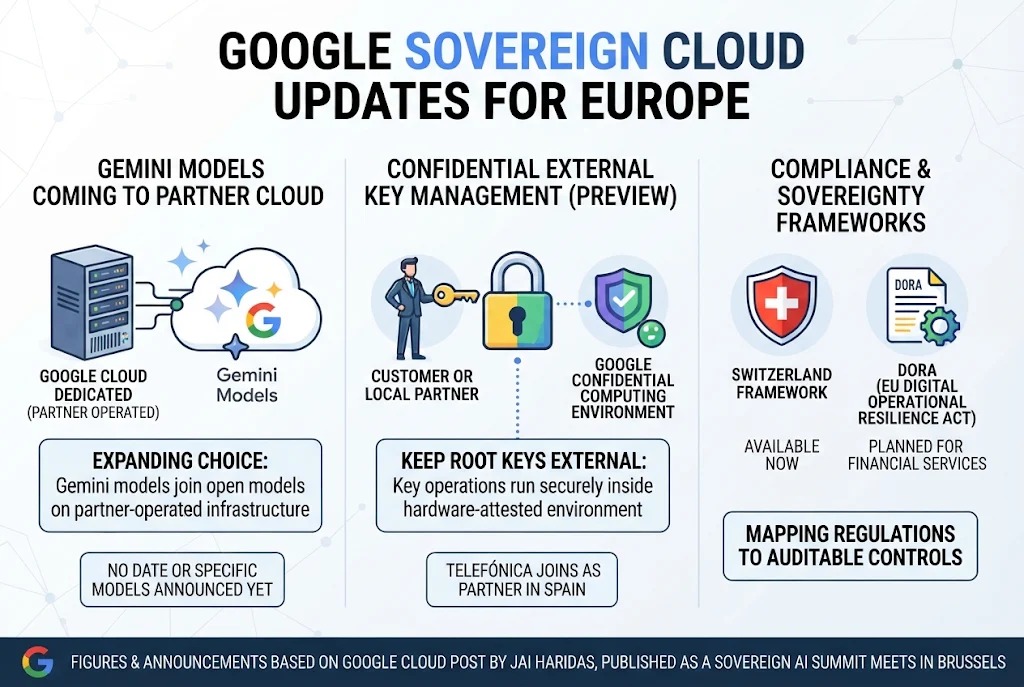
AI-generated infographic: google sovereign cloud updates for europe. Its figures are taken from this article. Infographic: Grok.
By news editor
Google Cloud says its Gemini models are coming to Google Cloud Dedicated, the version of its cloud that an independent local partner operates on isolated infrastructure. Customers there have so far been offered open models or models of their own. The company gives no date, does not say which Gemini models will be offered and lists no price.
The announcement comes in a Google Cloud blog post by Jai Haridas, vice president and general manager for regulated and sovereign cloud, published as a Sovereign AI Summit meets in Brussels. Haridas writes, "Gemini models are coming to Google Cloud Dedicated, our partner-operated cloud, expanding model choice beyond the open models already available in the model garden."
Three tiers make up what the company calls Sovereign Cloud from Google. Google Cloud Data Boundary applies data residency, access and encryption controls on the public cloud. Google Cloud Dedicated is run by a local partner. Google Distributed Cloud runs in a customer's own data center, either connected or fully air-gapped, meaning cut off from outside networks.
Select Gemini models are already available on the public cloud with a commitment to process customer data in-region, including within the EU, and with Google Distributed Cloud, according to the post. The partner-operated tier was the one without them.
In France, S3NS runs a cloud called PREMI3NS that is built on Google Cloud Dedicated. The post says S3NS has made managed model serving and inference generally available there, with open models from providers such as Mistral and Google or models that customers bring themselves. It adds that PREMI3NS has achieved SecNumCloud 3.2 qualification from ANSSI, France's national cybersecurity agency, and that Google is extending Google Cloud Dedicated to Germany with Thales, currently in preview.
Encryption keys are the second part of the announcement. Customers who hold their keys outside Google Cloud can deny access to their data, but every key request then travels to an external system, which the post says can add latency and availability risk. A service called Confidential External Key Management, in preview, is designed to keep root keys with the customer or a chosen local partner while key operations run inside a hardware-attested Confidential Computing environment. Telefónica joins as a key-holding partner in Spain, also in preview.
For compliance teams, Google is introducing Data Boundary frameworks that map local and regional regulatory requirements to enforced, auditable controls. A framework for Switzerland is available now. One for the EU's Digital Operational Resilience Act, known as DORA, is planned for financial services organizations, with no date given.
Continuity terms are spelled out for the partner-operated tier. According to the post, the local partner controls the environment, can block software updates in exceptional circumstances and can keep operating for up to 12 months if its connection to Google is severed.
Haridas also restates a commitment the company made in February. Should a national government order Google to suspend or terminate cloud operations provided from any country, the post says, "we will seek to limit, modify, or object to any such order using all available legal avenues." That is a pledge to contest such an order. The post does not say what would follow if a challenge failed.
Software availability and startups round out the list. More than a dozen software vendors have validated their products on Google Cloud Dedicated, the post says, and a new Google for Startups Accelerator for sovereign AI offers startups in regulated sectors an equity-free program with support from Google engineers, mentorship and access to local cloud providers.
Much of the announcement is not yet generally available. The key service, the Telefónica partnership and the German extension are in preview, the DORA framework is planned, and Gemini on Google Cloud Dedicated has no date. No customer is named in the post, and it carries no prices.
The post opens with four questions it says European organizations ask, the first being, "Will choosing more control mean settling for less capable AI?" For the partner-operated tier, the answer depends on which Gemini models arrive and when. Those two details, along with the German service leaving preview and the DORA framework's release, are the next things to watch.
Leave a Reply