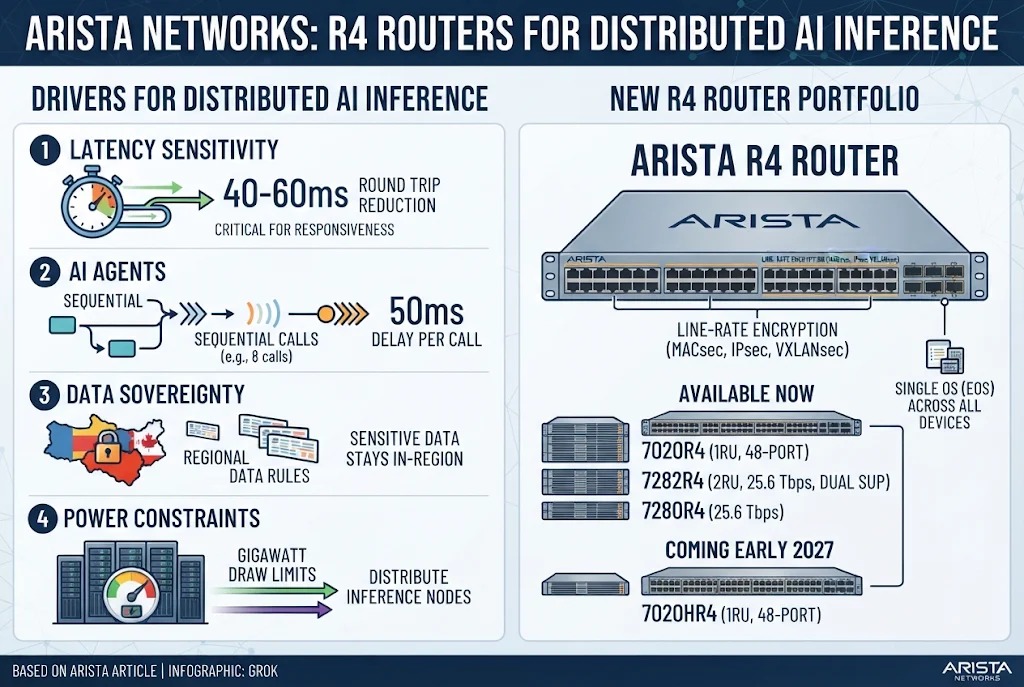
AI-generated infographic: arista r4 router additions for distributed ai inference. Its figures are taken from this article. Infographic: Grok.
By news editor
Arista Networks has added four routers to its R4 line, built to carry AI inference traffic between data centers, regional hubs and edge sites instead of inside one large cluster. The company announced the expanded portfolio under its Etherlink name, and Network World reports that three of the four models are available now, with the fourth, the 7020HR4, due in early 2027.
Inference is the work of running a trained model to answer requests. In a blog post published with the launch, Arista's Tyson Lamoreaux and Brendan Gibbs argue that the first phase of AI building concentrated compute in centralized clusters and that inference now has to move closer to the people using it. They write, "Training can tolerate being tucked away near remote power grids, while inferencing cannot."
Four pressures drive that move, by the post's account. The first is latency: shaving 40 to 60 milliseconds off a round trip across a wide-area network, it says, can decide whether an interface feels responsive. The second is AI agents, where a request that needs eight sequential calls picks up a 50 millisecond network delay on each one. The third is data rules that bar sensitive prompts and customer data from crossing national borders.
Power is the fourth. The post states, "The sheer electrical draw of gigawatt-scale data centers has hit severe utility limits." Spreading inference nodes across metro edges, colocation centers and regional hubs, it argues, frees up available power capacity and relieves congestion on core network backbones.
Those are a vendor's assertions. The post cites no utility data, no measurements from a live network and no deployments. Its latency figures are illustrations, not test results.
On the hardware, Network World reports that the 7020HR4 and 7020R4 are 48-port routers one rack unit high, aimed at edge sites, distributed inference, data center leaf positions and service provider access. The 7282R4 and 7280R4 offer up to 25.6 Tbps of non-blocking bandwidth with 100, 400 and 800 Gigabit Ethernet ports. The 7282R4, two rack units high, adds dual supervisor engines, which give the router a redundant control plane.
Encryption is the first feature the post lists. The R4 platforms build line-rate encryption into every port, it says, including the MACsec, IPsec and VXLANsec methods, so that prompt data, customer credentials and model weights stay protected over public networks and shared fiber. Deep packet buffers are included to absorb the traffic spikes that come with unpredictable user demand.
Software is the other half of the pitch. All of the routers run EOS, Arista's network operating system, and the authors say a single operating system across AI clusters, backbones, data centers and routing edges lets security fixes reach every device without separate qualification for each product line. Security updates can often be applied without a reboot, they add. The post contrasts this with "legacy vendors" that it says maintain several operating systems, and it names none of them.
Costs are not disclosed. Neither Arista's post nor Network World's report gives a price for any of the four models, and neither names a customer. The post presents the shift of inference toward colocation and regional sites as under way, without deployment counts to show how far it has gone.
The 7020HR4's arrival in early 2027 is the next dated step. Before then, the items to watch are list prices, a first named customer for the new models, and any operator figures that would test Arista's claim that inference is moving out of the largest campuses.
Leave a Reply