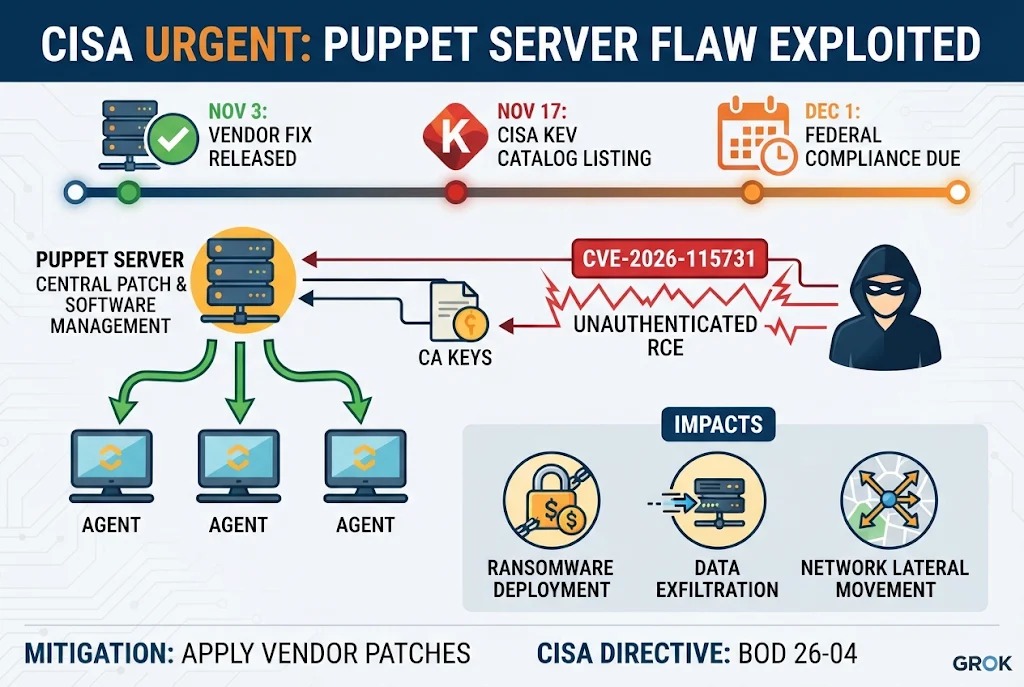
AI-generated infographic: cisa exploited-vulnerability listing for a puppet server flaw. Its figures are taken from this article. Infographic: Grok.
By news editor
The US Cybersecurity and Infrastructure Security Agency has added a critical flaw in Perforce's Puppet Enterprise to its Known Exploited Vulnerabilities catalog, the agency's list of vulnerabilities that have been exploited in the wild. The entry carries a date added of November 17, 2026 and a due date of December 1, 2026. Its required action is to apply mitigations in accordance with vendor instructions under Binding Operational Directive 26-04, which is compulsory for Federal Civilian Executive Branch agencies.
Companies use Puppet to provision software and patch servers from a central point. Security firm Neodyme, which found the flaw, describes the product as widely used in big companies and built around a server from which enrolled machines, called agents, pull their software and configuration.
Tracked as CVE-2026-115731, the flaw sits in the server code that processes reports. According to CISA's entry, it lets a client holding any agent certificate signed by the deployment's certificate authority execute arbitrary code on the Puppet server as its service user. That certificate requirement does not always keep outsiders away. CISA writes, "If the certificate authority automatically signs requests without strong verification, an unauthenticated network attacker can obtain a valid certificate and exploit the vulnerability."
Two severity scores appear in the National Vulnerability Database record, both rated critical. One is 9.4 on the 10-point CVSS 4.0 scale, credited to the vendor's security contact. The other is 9.9 under CVSS 3.1, credited to the database itself.
Affected releases in that record are Puppet Enterprise 2023.8.0 up to 2023.8.13, 2025.0.0 up to 2025.12.1, and 2026.0.0. Versions 2023.8.13, 2025.12.1 and 2026.0.1 are listed as unaffected. The record also marks Puppet 8 releases before 8.22.2 and Puppet 9 releases before 9.1.3 as vulnerable.
Neodyme says it found the bug, along with a second one, while preparing for a red team engagement, a simulated attack carried out for a client. It reported both to Perforce and to OpenVox, a community-maintained open source fork of Puppet, and says fixes and public advisories from both were released on November 3, 2026. By the firm's account the vulnerable code dates back to 2021. Its researchers used AI-based analysis to find the bugs, the post says, and that analysis needed strict steering.
How many servers an outsider can reach depends on automatic certificate signing, the setting CISA's entry warns about. Neodyme asserts that "most large companies have autosign enabled" for provisioning tools that enroll new hosts. The post gives no survey or count behind that statement, and neither CISA nor the database record says how many Puppet servers are exposed.
Damage varies with how a server is set up, Neodyme writes, but one consequence does not. In the firm's words, "Independent of the configuration, an attacker with RCE on a Puppet server can grab the CA signing keys and impersonate other hosts." RCE is remote code execution, and the CA is the certificate authority that vouches for each machine's identity. Neodyme names ransomware deployment, mass data exfiltration and movement to other parts of a network as worst cases, while adding that "an environment hardened according to the best practices will mitigate direct impact significantly."
A companion flaw, CVE-2026-115732, allows impersonation of other hosts in what Neodyme calls a non-default but commonly used configuration. CISA's entry covers only CVE-2026-115731. Users of the open source fork are affected as well: The Hacker News reports fixes in OpenVox Server 9.2.0 and 8.18.0 and OpenVox Agent 9.3.0 and 8.32.0.
What the attacks look like is not public. CISA's entry names no victims, gives no count of incidents and marks use in ransomware campaigns as unknown. The Hacker News reports that no details are available on how the flaw is being used in the wild. None of CISA, the database record or Neodyme gives a number of affected customers or an estimate of what an intrusion costs.
For federal agencies, December 1, 2026 is the date to watch. For companies running Puppet, the open items are whether CISA or Perforce publishes detail on the attacks, such as signs that a server was reached, and whether CVE-2026-115732 joins the catalog.
Leave a Reply