AI-generated illustration of a stack of spreadsheets beside a desk calculator and gold coins. It is not a picture of anything in this story. Illustration: Grok.
By news editor
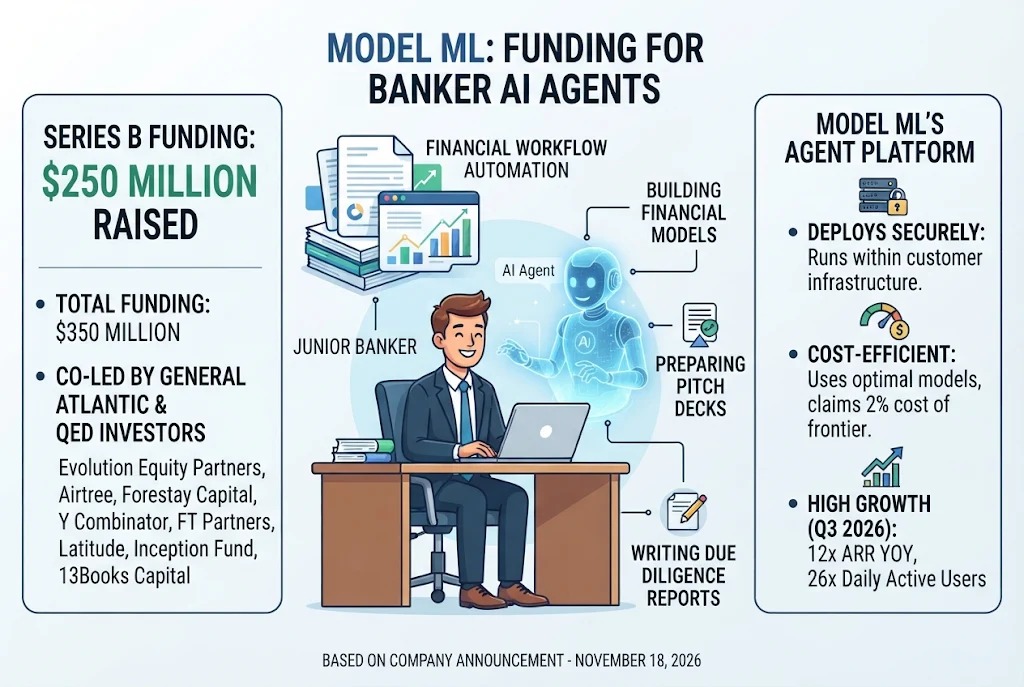
Model ML, a London-headquartered startup that sells AI agents to investment banks, consulting firms and asset managers, has raised $250 million in Series B funding at a $1.5 billion valuation, the company announced. General Atlantic and QED Investors co-led the round. The announcement does not say whether the valuation is counted before or after the new money.
Evolution Equity Partners, Airtree, Forestay Capital, Y Combinator, FT Partners, Latitude, Inception Fund and 13Books Capital also took part, according to the release, which General Atlantic published in the same form. By the company's count, the round brings total funding raised to $350 million.
That total is not fully itemized. The release names one earlier round, a $75 million Series A led by FT Partners in November 2025. The two rounds add up to $325 million, and the source of the remaining $25 million is not described.
Growth is reported only as multiples. In the third quarter of 2026, Model ML says, its annual recurring revenue grew 12x year on year and daily active users increased 26x. Annual recurring revenue is the yearly value of subscription contracts. Neither multiple comes with a base: the release gives no revenue in dollars, no user count and no customer names.
What the company sells is an agent assigned to an individual banker, consultant or investor that runs on the employer's systems and data. The release's example is news breaking on a company a banker covers. The agent, Model ML says, judges whether the development matters and prepares the analysis in the firm's own formats.
TechCrunch describes the work being automated as tasks traditionally done by junior bankers and consultants, including building financial models, preparing pitch decks and writing due diligence reports. It reports that the agents connect to clients' tools, including Excel and PowerPoint.
Chaz Englander, co-founder and chief executive, puts the goal this way in the release: "We’re building a personal AI agent for every banker, consultant and investor, working 24/7 inside the systems their firm already trusts."
On cost, Model ML makes a claim the release does not document. It says it is not tied to any single AI provider and routes each task to the model that scores best on quality, speed and cost, with a growing share going to its own fine-tuned open source models. On the workloads those models handle, the company says, they run at 2% of the cost of frontier models and are in most cases five times faster. No benchmark, task list or named comparison model accompanies the figures.
Competition comes from AI model developers and from other startups. TechCrunch notes that Anthropic and OpenAI have built tools for financial professionals, and it names Hebbia and Rogo as other startups automating routine work for bankers and consultants. Rogo raised $160 million at a $2 billion valuation in April, TechCrunch reports.
For buyers concerned with data handling, the release lists the controls. Model ML says it often deploys within a customer's own infrastructure so that data does not leave the customer's environment, that customer data is never used to train AI models, and that it is ISO/IEC 27001:2022 certified and SOC 2 Type II audited.
Investors describe adoption without naming an adopter. Nigel Morris, co-founder and managing partner of QED Investors, says in the release: "Eighteen months ago, Model ML was emerging from stealth. Today, its product is deeply embedded inside some of the world’s largest institutions." No bank, consulting firm or asset manager is identified as a customer.
Brothers Chaz and Arnie Englander founded the company. TechCrunch reports that they earlier co-founded Fat Llama, a peer-to-peer rental marketplace acquired by Swedish rival Hygglo for $41.5 million in 2022.
The new money will go to research and engineering teams in London and New York, the company says. It also lists offices opened this year in Paris, Madrid, Tokyo, Singapore and Dubai.
So far the company has not put dollars to its recurring revenue, named a customer or published the test behind the 2% cost figure. Whether it discloses any of the three as it spends the round is the thing to watch.
Leave a Reply