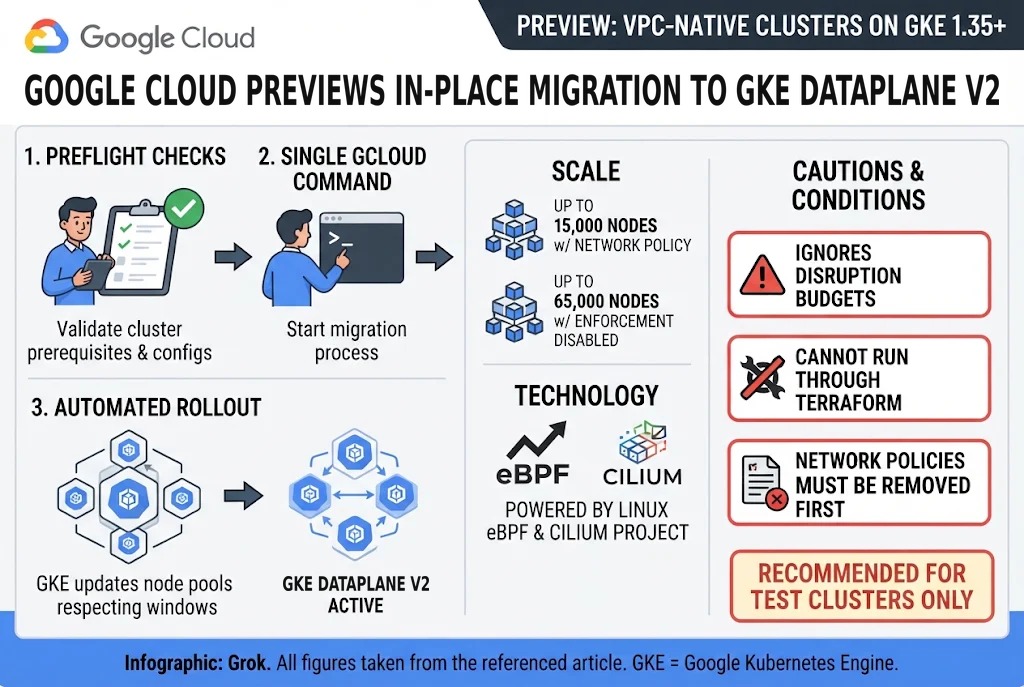
AI-generated infographic: gke dataplane v2 in-place migration preview. Its figures are taken from this article. Infographic: Grok.
By news editor
Google Cloud has opened a preview of in-place migration to GKE Dataplane V2, letting customers switch the networking layer of an existing Kubernetes cluster instead of building a second cluster and moving workloads to it by hand. The announcement limits the feature to eligible VPC-native clusters running GKE 1.35 or later.
GKE is Google Kubernetes Engine, the company's managed service for running containerized applications. The dataplane is the part of a cluster that moves network traffic between workloads. GKE Dataplane V2 is built on eBPF, a Linux kernel technology, and on the open-source Cilium project, and it replaces the iptables routing and kube-proxy components of the older design.
Migration has been the obstacle. In the post, the company says customers report that "migrating production clusters carrying stateful workloads and established IP allocations has been challenging, often requiring a disruptive parallel cluster setup." It gives no figure for what those parallel migrations cost or how long they take.
Scale is the reason Google offers for moving. The company says GKE Dataplane V2 supports clusters of up to 15,000 nodes with network policy enforcement, and up to 65,000 nodes with enforcement disabled, a configuration that requires recreating clusters. It is also the networking layer for GPU and Cloud TPU clusters on GKE, which ties the migration to AI workloads. No benchmark or named customer accompanies those figures.
Three stages make up the process, according to the post: preflight checks, a single Google Cloud CLI command to start, and an automated rollout in which GKE updates node pools while respecting the customer's maintenance windows, exclusions and upgrade strategies.
The fine print sits in Google's migration guide, which adds conditions the blog post does not mention. The cluster must run version 1.35.3-gke.1155000 or later, and customers using Cloud Service Mesh or open source Istio need Istio 1.23 or later. Existing network policies have to be removed first, because GKE recreates nodes during the move and sudden enforcement could cause what the guide calls unintended network disruption. Terraform cannot be used to run the migration. Cluster-wide networking configurations are locked from the start of the migration until it completes.
Production teams get a specific warning. The guide states: "The migration ignores your cluster disruption budget." It does not quantify the workload disruption to expect and refers readers to a separate planning document.
Capacity is another condition. GKE creates new nodes before deleting old ones, using the customer's surge or blue-green upgrade strategy, and the guide says a node pool migration fails with a stockout error if the Google Cloud zone lacks the resources to provision those nodes. GKE then retries automatically.
Rollback to the older dataplane is available at any point before the finalization phase is complete, the guide says, and GKE finalizes automatically once every node pool has migrated. Neither document describes a way back after that. Routes-based clusters are not supported, and clusters with Calico network policy enabled cannot migrate directly.
As a preview, the feature falls under Google's pre-general-availability terms. The guide says such features are available as is and might have limited support, and the blog post recommends testing migrations on non-production or test clusters first. Google has not given a date for general availability or named a customer that has completed a migration.
The next thing to watch is that general availability date, and whether the restrictions on Terraform, Calico and routes-based clusters are lifted before it arrives. Until then, the company's own guidance keeps the feature on test clusters.
Leave a Reply