By news editor
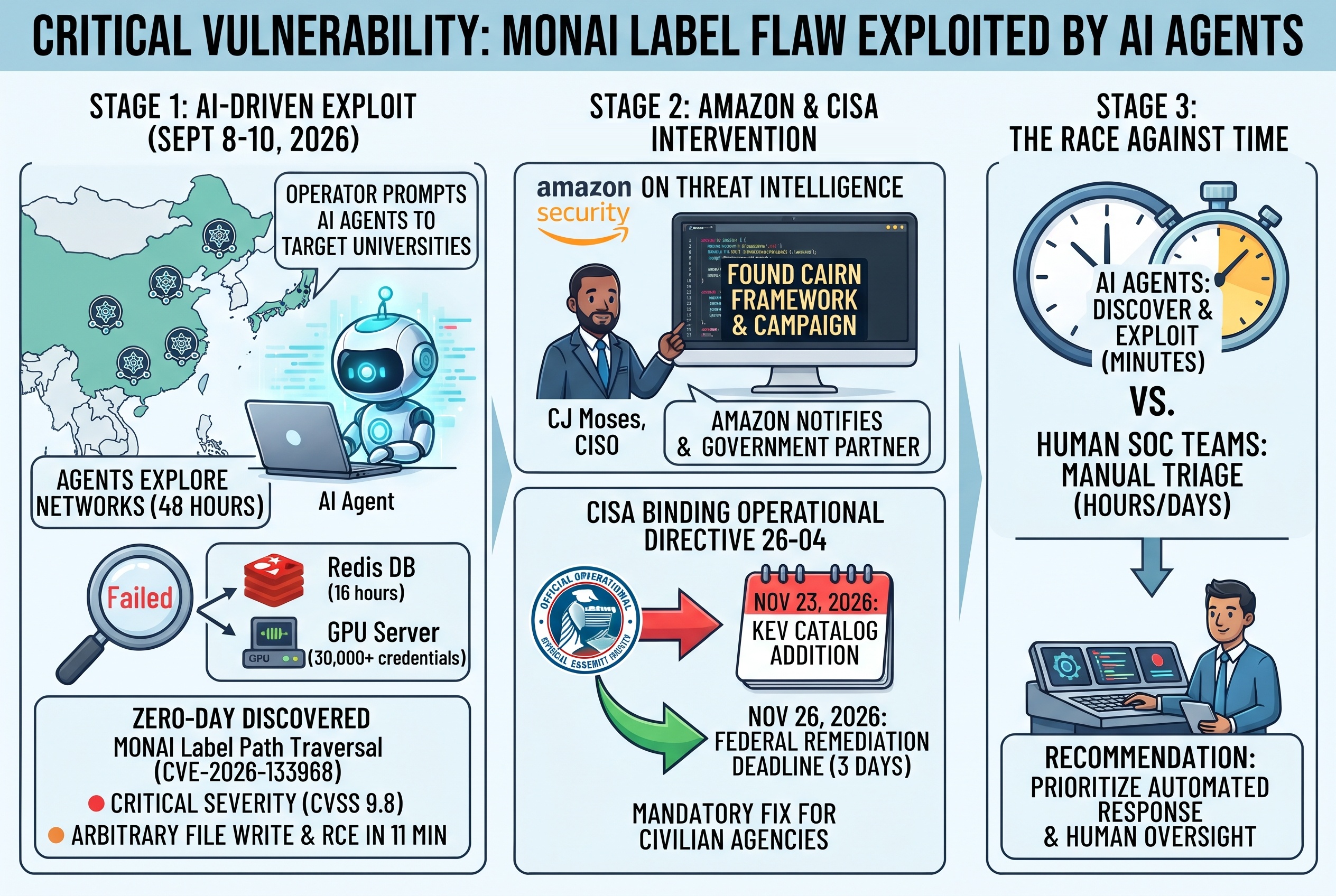
Federal civilian agencies have until November 26, 2026 to fix a critical flaw in MONAI Label, an open-source medical imaging AI application, after the Cybersecurity and Infrastructure Security Agency added it to its Known Exploited Vulnerabilities catalog on November 23. Amazon says the flaw was found and first exploited by AI agents that an attacker had pointed at a list of university networks.
The agency's alert lists the MONAI Label bug, CVE-2026-133968, alongside CVE-2026-134624, a server-side request forgery flaw in N-able's Mail Assure (SpamExperts) product, and says both were added on evidence of active exploitation. CISA's catalog data feed sets the same November 26 due date for each.
That first entry, The Hacker News reports, is the zero-day, a flaw with no fix available when it is first used, described in a post by CJ Moses, chief information security officer of Amazon Integrated Security. Amazon's post does not name the software, describing it only as an open-source medical imaging AI application. The MONAI Label project's security advisory says the issue was originally reported by a GitHub account named aws-sec-vdp.
According to Moses, Amazon Threat Intelligence found a server on September 10, 2026 running Cairn, an open-source autonomous AI penetration-testing framework, with no authentication, which left the operator's prompts and the AI output visible to anyone on the internet. The records showed a campaign of about 48 hours, beginning September 8, against IP addresses associated with universities in East Asia outside mainland China. The operator supplied target addresses and a goal of obtaining shell access, meaning the ability to run commands on a machine. The agents planned and adjusted their own steps from there.
Two operations failed. Agents spent roughly 16 hours and 148 sequential actions trying to take over a Redis database at one university, and in a separate operation tested more than 30,000 credential combinations against a university GPU server and other systems on that university's network. Against the medical imaging application the outcome was different. Moses writes: "In about 11 minutes, the agents went from mapping the application’s API to arbitrarily writing files on the server."
The project's advisory describes a path traversal flaw, a bug that lets a caller write files outside the folder the software is meant to use, in MONAI Label's datastore upload endpoints. It says an arbitrary file write can lead to remote code execution and that authentication is disabled by default, so in the default configuration any network client that can reach the server can exploit it. Versions 0.8.5 and earlier are affected and 0.8.6 is listed as patched. The advisory rates the issue critical. The Hacker News gives it a CVSS score of 9.8.
After the discovery, Amazon says, it notified the project's maintainers, who released a fix. The affected organizations were not AWS customers, so AWS worked with a government partner to notify them. Amazon assesses with moderate confidence that the operator is a Chinese-nexus threat actor, citing the Simplified Chinese prompts, China Standard Time timestamps and the choice of targets.
How many organizations run MONAI Label on reachable servers is not disclosed by CISA, Amazon or the project. For those that do, the advisory's interim steps are to enable authentication, keep the server off untrusted networks and run it as an unprivileged user. CISA's Binding Operational Directive 26-04 applies only to federal civilian agencies, which in this case must remediate within three days and carry out a forensic triage to assess whether the system is compromised. The agency encourages all other organizations to prioritize fixes for catalog entries.
Moses frames the problem for security teams as one of response time. He writes: "An agent that discovers and exploits a zero-day in minutes completes its activity faster than many security operations centers can manually triage an alert." His recommendation is to prioritize high-confidence detections that trigger automated response, with humans overseeing outcomes instead of reviewing every action. Gambit Security, as described in Amazon's post, has documented a separate, financially motivated actor using Cairn to target online retailers.
On the second listing, a spokesperson for N-able told The Hacker News that exploitation was confined to a single N-able hosted server and that monitoring since remediation has found no further malicious activity.
The federal due date of November 26 is the next fixed point. After it, the open items are whether CISA, Amazon or the MONAI project puts a number on exposed or compromised MONAI Label servers, and whether further campaigns built on Cairn are reported.
Leave a Reply