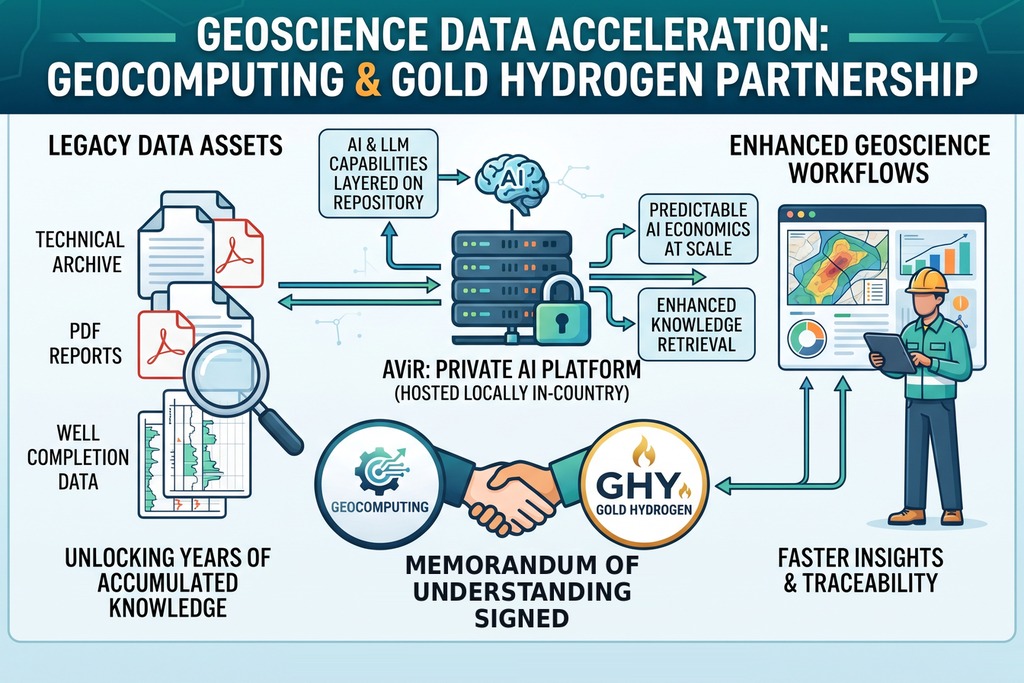
GeoComputing Group, the Houston-based IT consultancy for oil, gas, energy and geoscience companies, has signed a memorandum of understanding with Gold Hydrogen Limited (ASX: GHY) to evaluate AViR, its private data and AI platform, for Gold Hydrogen’s technical teams. The agreement sets a framework for testing whether locally hosted language models can turn an explorer’s technical archive into something geoscientists can question directly, and it gives both companies an evaluation period before any larger commitment.
The work centers on Gold Hydrogen’s SharePoint-based technical information repository. Under the MoU, the companies will assess upgrading that repository and layering large language model and agentic AI capabilities on top of it. The stated objective is to make geological and technical information, including legacy PDFs, well completion reports and well logs, easier to search, retrieve, trace and analyze. For an exploration company, those documents hold years of accumulated knowledge, and the ability to trace an answer back to its source file matters as much as the answer itself.
Gold Hydrogen, a natural hydrogen and helium explorer, sees the platform as a way to process complex geoscience data faster. “To advance natural hydrogen and helium exploration in Australia, we are partnering with GeoComputing to build a localized LLM and multi-agent AI platform,” said Billy Hadi Subrata, chief technology officer of Gold Hydrogen. He added that the MoU gives the company an evaluation period to see how these capabilities may enhance any potential project or service it develops, and that the team is eager to see how AViR will unlock new insights.
AViR builds on GeoComputing’s RiVA cloud platform. RiVA supplies the performance that demanding petroleum workflows require by placing high-performance computing close to the data it depends on. AViR extends that environment with locally hosted language models designed for private, in-country operation, so technical teams keep control over their environment while putting their knowledge to work. That architecture speaks directly to a concern common across the energy sector, where subsurface data is among the most valuable and sensitive assets a company holds.
GeoComputing points to three advantages AViR delivers to energy operators: enhanced knowledge retrieval, AI placed closer to critical exploration and production workloads, and predictable AI economics at scale. The cost point is notable. Operators weighing public AI services often face usage-based pricing that is hard to forecast, while a private deployment sitting beside the data offers a more stable budget line as usage grows.
“Having advantages of AI-based knowledge retrieval as part of a private, local deployment model can significantly enhance the exploration of naturally occurring hydrogen and helium,” said John Creevan, CEO of GeoComputing. He said the MoU is a chance to showcase AViR by giving Gold Hydrogen’s technical team tools that improve productivity while containing costs, and that GeoComputing hopes the engagement becomes a springboard for future success.
Gold Hydrogen engages in the discovery, exploration and development of natural hydrogen and helium gas in Australia. Its flagship Ramsay project, in which it holds a 100 percent interest, covers roughly 75,000 square kilometers across the Yorke Peninsula and Kangaroo Island in South Australia. The company was incorporated in 2021 and is based in Brisbane.
GeoComputing, founded in 2004, offers bespoke solution design and architecture, project management, infrastructure services, application support and data management. Its RiVA platform combines core components from leading vendors into a single computing environment customized for petro-technical workflows, backed by follow-the-sun support from subject-matter experts in infrastructure, data, geoscience applications and workflows around the clock.
The agreement is an evaluation rather than a deployment, and details on scope and timing of any follow-on project are still to come. Still, it shows how private, in-country AI is moving into the daily work of subsurface teams. For a young explorer building a picture of a new resource class, faster access to its own data could shorten the path from archived report to drilling decision, and for GeoComputing, a working relationship with a hydrogen and helium specialist extends AViR’s reach beyond traditional oil and gas into the newer energy frontier.
Leave a Reply