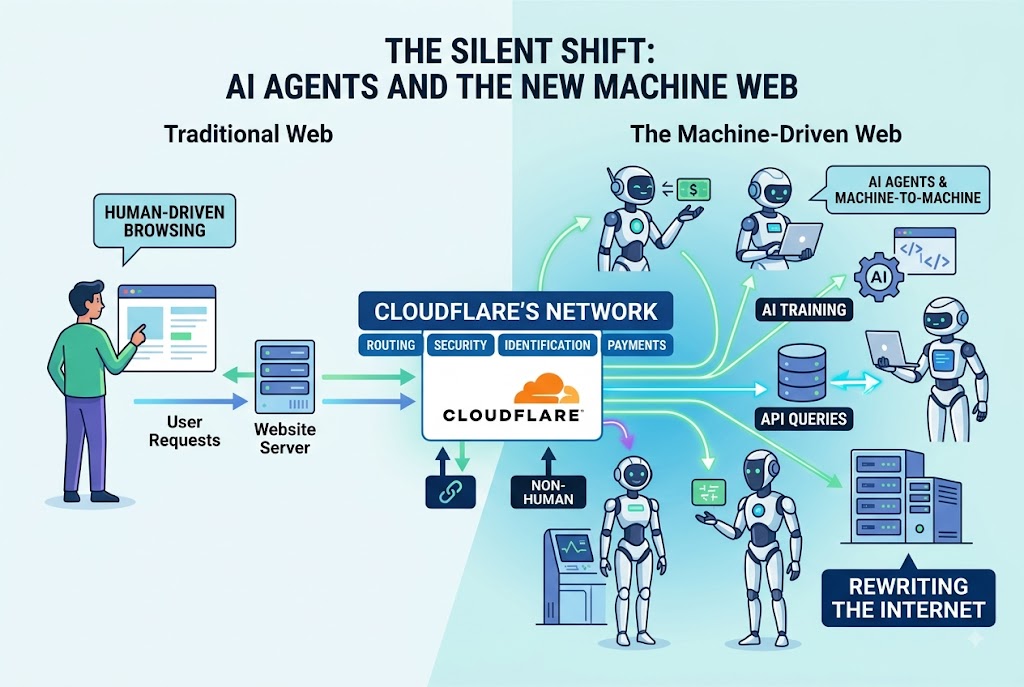
For decades, the internet operated on a simple premise. Human users opened browsers, visited websites, clicked links, and made purchases. Today, that foundational dynamic is shifting toward automated software interactions. Autonomous AI agents now crawl web pages, query APIs, pull data, and execute transactions without direct human intervention.
This surge in machine-to-machine traffic is reshaping digital infrastructure. Handling automated traffic demands dedicated tools for security, identity verification, traffic routing, and payments. Cloudflare, long known for content delivery and cybersecurity, finds itself positioned at the core of this transition. Handling traffic for over twenty percent of the web, the company is evolving into a central toll collector for autonomous online activity.
Recent network analytics highlight how quickly this change is taking place. Non-human activity now accounts for more than half of internet traffic. In June 2026, AI training crawlers made up 52% of crawler requests, a massive increase from 22% in spring 2025. An additional 36% of crawler traffic stems from mixed-use crawlers combining search, training, and agent tasks.
Financial results mirror this structural evolution. Cloudflare reported second-quarter revenue growth of 36% year over year to $696.1 million, while large customers paying more than $100,000 annually grew to 4,698. The company also raised its full-year revenue outlook to between $2.864 billion and $2.87 billion.
“As the web shifts to AI answer engines and agent-driven commerce, we are seeing a fundamental rewrite of the Internet for machine-to-machine traffic,” CEO Matthew Prince said. “Cloudflare sits at the center of this paradigm shift.”
Rather than simply hosting web services, infrastructure providers now manage an ecosystem where software constantly interacts with software. As AI agents increasingly manage web tasks on behalf of users, the backbone of the internet is being rebuilt for a machine-dominated web.
Leave a Reply