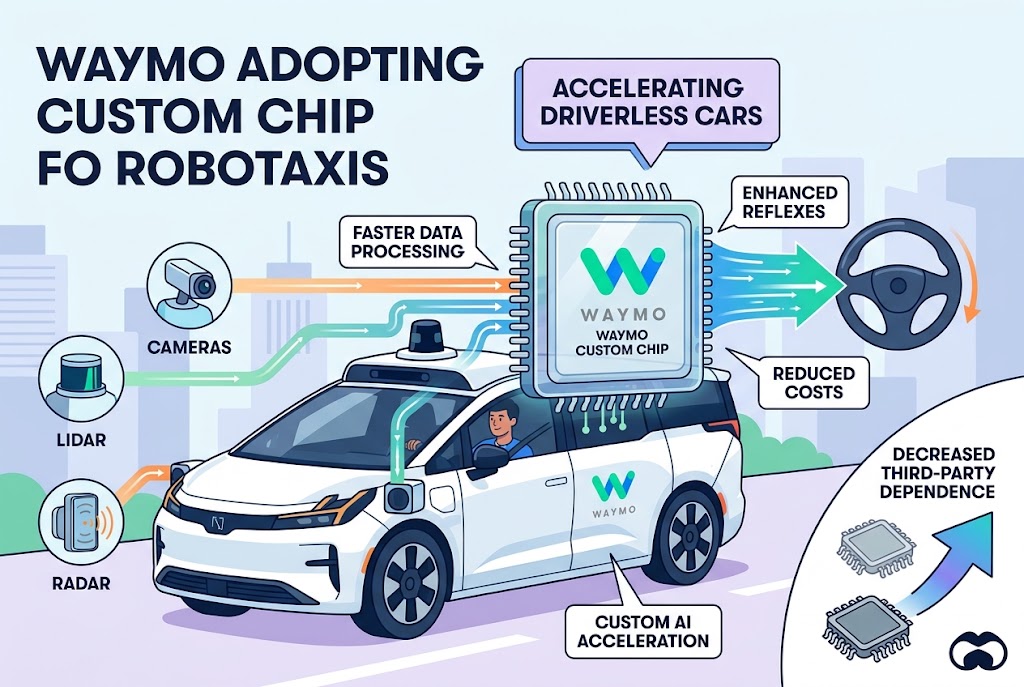
Autonomous vehicle leader Waymo is taking a major step toward independence by designing custom silicon for its growing fleet. The company, owned by Alphabet Inc., has developed a new application-specific integrated circuit to power its driverless vehicles, marking a significant strategic pivot in how it handles hardware engineering.
For years, the self-driving industry has relied heavily on off-the-shelf processing units from established tech giants. Historically, “Waymo has historically relied on products from companies including Nvidia and Advanced Micro Devices Inc., integrating them into computers of its own design.” By shifting toward purpose-built chips, the business aims to cut computing overhead while optimizing performance specifically for its proprietary software architecture.
The newly created ASIC processor is already integrated into production models. According to company statements, “The ASIC chip — short for application-specific integrated circuit — is in production in Waymo’s latest robotaxi generation, the company said Thursday.” Waymo executives believe that using its custom silicon will directly translate to faster, response times on busy streets, noting that “using its own chip, alongside others and with sensors the company designed itself, will improve its robotaxis’ reflexes and navigational skills in complex urban environments.”
The engineering specifications places the new hardware among the most capable in the automotive market. Built using Taiwan Semiconductor Manufacturing Co.’s 5-nanometer process node, the custom silicon delivers remarkable processing density. “Waymo said its chip is capable of more than 1,000 TOPS, short for trillions of operations per second.” This level of performance puts its in-house engineering, directly on par with top hardware platforms supplied by Nvidia.
Beyond raw power, the customized architecture allows the autonomous drive system to rapidly ingest massive streams of visual, radar, and lidar information. “With a specialized chip, Waymo said it can now more quickly process sensor data and run AI models that help robotaxis understand and respond to surroundings.”
This hardware revolution aligns with a broader push across parent company Google to engineer tailored hardware solutions and keep computing expenses grounded. While earlier vehicle generations relied on retrofitted commercial SUVs, Waymo’s latest deployment features dedicated vehicles manufactured by Zeekr, an automotive brand owned by Geely Automobile Holdings. These vehicles, fitted with the internal processors, reflect a transition toward purpose-built driverless transport that could lower long-term service costs and deliver a smoother ride experience for passengers.
Leave a Reply