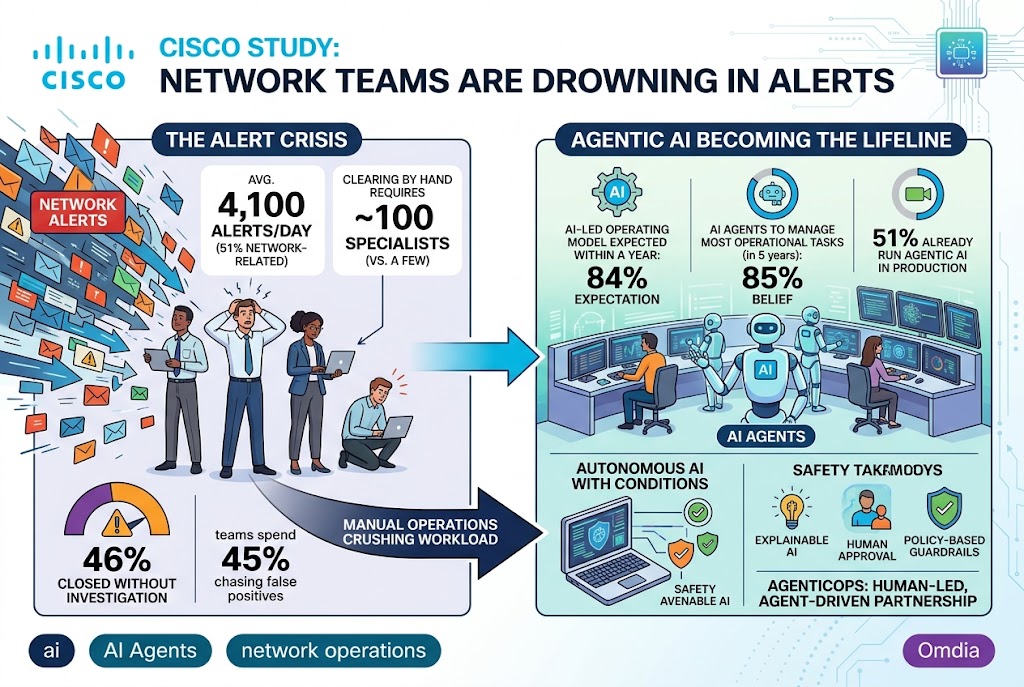
Enterprise network operations teams can no longer hire their way out of the workload crushing them, and most have already decided that autonomous AI agents are the answer. That is the central finding of a new study from Cisco, conducted with research firm Omdia, which surveyed more than 1,000 IT and network operations leaders at organizations with 500 or more employees across North America, Western Europe and Asia-Pacific.
The numbers point to an industry that has moved past the question of whether to adopt agentic AI. Three quarters of respondents (75%) have already deployed AI for network operations, and 51% run agentic AI systems that take action in production today. Looking ahead, 84% expect to reach a fully AI-led operating model within the next twelve months, and 85% believe AI agents will autonomously manage most operational tasks within five years.
The Math Behind the Alert Crisis
The report makes its case with simple arithmetic. The average organization fields about 4,100 alerts and events per day, and 51% of them, roughly 2,100, are network related. A single practitioner can clear about 21 alerts a day. Clearing the daily network backlog by hand would require a team of roughly 100 specialists.

Unsurprisingly, most of that volume goes untouched. According to the study, 46% of network alerts are closed without investigation, and teams spend 45% of their investigation time chasing false positives. Two thirds of leaders (67%) say alert volumes keep their teams from doing critical work.
The pace of change adds to the pressure. Some 59% of organizations change their production networks daily or more often, 29% make multiple changes per day, and 57% say their current change processes cannot keep up with the speed the business requires.
Fragmented Tools, Slow Fixes
Complexity is compounding the problem. Of those surveyed, 92% report that performance issues span multiple domains, and the average organization relies on about 10 separate tools to get end-to-end visibility. When things break, resolution is slow: the median incident takes 12.5 hours to resolve, while the mean stretches to 88 hours, pulled up by long-tail outages. Nearly half (46%) say incidents typically take more than a day to fix, and one in ten say they typically take longer than a week.
AI itself is part of the strain. Two thirds (67%) say the generative AI boom has significantly increased network complexity, and 70% say AI adoption has increased NetOps workloads. Cisco’s analysis of aggregated Meraki campus and branch telemetry found per-client direct-to-AI traffic jumped 54%, and that an agent performing a task can generate up to 450% more total traffic than a human doing the same work. The report projects AI traffic will continue to double roughly every six months. Meanwhile, 95% of respondents say their existing, non-agentic tools fall significantly short.
Autonomy, With Conditions
The more striking finding is how comfortable operations leaders have become with handing AI the controls. Eight in ten (80%) say they are comfortable with AI taking a high or fully autonomous role in NetOps today. Broken down, 56% want AI to act with a human approving each action, 24% support fully autonomous operation with no human approval, and only 20% prefer no or limited autonomy.

That comfort comes with firm conditions. Just 1% of respondents would trust AI with no guardrails at all. The rest expect a full set of controls as a baseline: explainable AI actions, human approval, policy-based operating limits, emergency override mechanisms, role-based access control and immutable audit trails. Some 69% require detailed explainability for agent-driven actions, and 86% say a single integrated platform is the most effective path forward.
Across 15 NetOps processes tracked in the study, planned use of agentic AI roughly doubles within 24 months. Remediation actions, for example, rise from 18% of organizations today to 36%, while performance optimization and policy compliance monitoring both climb to 35%.

The Boardroom Gap
The biggest obstacle may be internal. The study found NetOps practitioners are roughly twice as likely as line-of-business executives to recognize the shift toward what Cisco calls AgenticOps, a human-led, agent-driven operating model in which people and AI agents work as partners. Many business leaders still view AI primarily as AIOps, a tool that surfaces insights for humans to act on.
Respondents also named the familiar barriers: data security and privacy (38%), implementation and integration complexity (34%), risk and compliance (30%) and budget concerns (29%). Standing still carries its own risks, however. Leaders expect that failing to automate will lead to security gaps or increased enterprise risk (64%), more frequent or severe service degradations (62%) and more failed AI initiatives (53%).
Early Results and What Comes Next
For organizations that have moved furthest, the report points to measurable payoffs. Practitioners at the most AI-mature organizations using AgenticOps are close to 30% more productive than those at the least mature, and those organizations are 3.2 times more likely to have full end-to-end visibility.
Cisco’s recommendations follow from the data. It urges IT leaders to shift budget from headcount growth toward autonomy architecture and move skilled engineers off the alert frontline and into network design and optimization. It also advises translating operational realities, such as 4,100 daily alerts and multi-day outages, into business risk language executives understand, and building a trust-first governance framework, with explainability as a non-negotiable requirement for every vendor, before scaling.
The report frames the next twelve months as decisive. The study does come from a vendor with a stake in AI-driven networking; Cisco competes directly with HPE Juniper, Arista and others to sell the platforms that will run these agents. Still, the underlying message is hard to dismiss: with alert volumes outpacing human capacity and AI traffic multiplying, the question for most enterprises is no longer whether agents will run the network, but how quickly they can put the guardrails in place to let them.
Leave a Reply