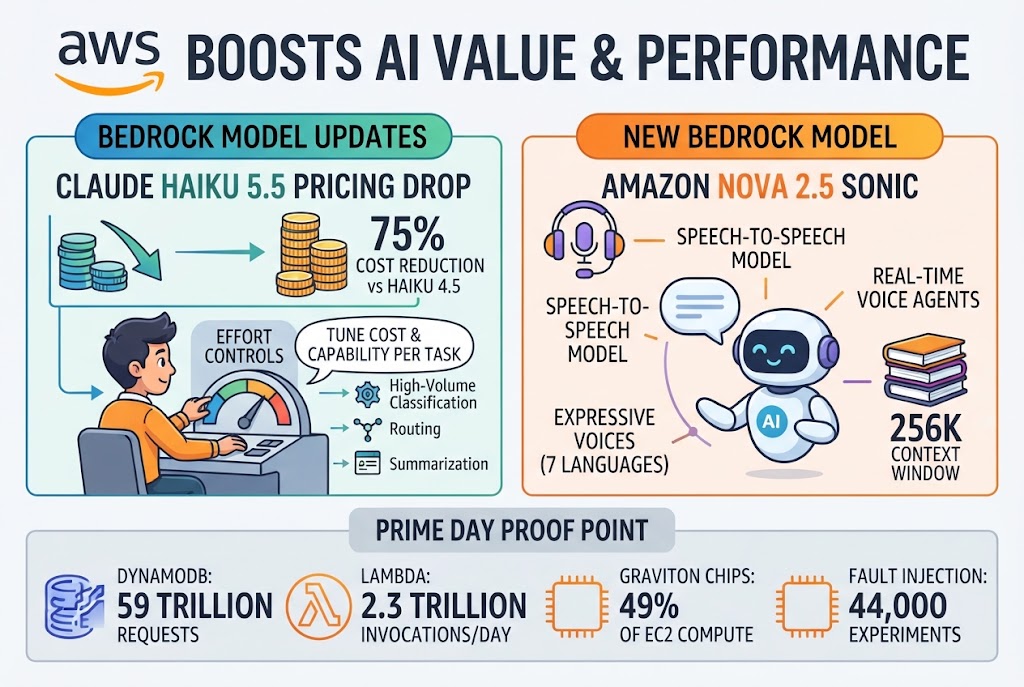
Amazon Web Services used its October 13 weekly roundup to make two points at once: its infrastructure handled Amazon’s Prime Day without strain, and it is cutting the price of running AI models. Claude Haiku 5.5 is now available on Amazon Bedrock at roughly 75% lower cost than Haiku 4.5 for most tasks, and AWS released a new speech-to-speech model, Amazon Nova 2.5 Sonic, for real-time voice agents.
For enterprise buyers, the pricing is the headline. Cheaper inference lowers the cost of putting AI into high-volume workflows, and AWS is positioning Bedrock as the place to buy it.
Claude Haiku 5.5 on Bedrock
AWS says Claude Haiku 5.5 costs about 75% less than Haiku 4.5 for most tasks. It is the first Haiku model with effort controls, which let customers tune cost and capability for each task instead of paying for the same level of reasoning on every request. A customer routing simple classification and a hard analysis through the same model can now dial each separately.
The offering also shows how AWS packages third-party models. A lower price on the smallest Claude model widens the range of workloads where it makes economic sense, such as high-volume classification, routing and summarization.
Nova 2.5 Sonic targets voice agents
Amazon Nova 2.5 Sonic is a speech-to-speech model for real-time voice agents. AWS says it improves reasoning, instruction following and tool calling, cuts latency, offers expressive voices in seven languages and supports a 256K context window. Those are vendor claims that customers will need to test against their own call-center and assistant use cases.
The release shows AWS building its own models alongside the third-party ones it sells, a strategy that gives it more control over price and performance for specific tasks.
Security and data features
Several smaller launches target operations teams. GuardDuty RDS Protection now detects data exfiltration and destruction on Aurora PostgreSQL and RDS for PostgreSQL by analyzing queries, and it needs no agents or configuration changes. Lambda with self-managed Kafka now supports OAuth, so consumers can authenticate through identity providers such as Cognito or Okta. Amazon Redshift added Apache Iceberg materialized views, stored in S3 and registered in the Glue Data Catalog, that can be queried from engines including Athena, Spark, Trino and Snowflake.
AWS also released Strands Box, an open source sandbox for AI agents in developer preview under the Apache 2.0 license. Policy controls are written in a language called Dogwood, and credentials stay outside the agent’s environment. AWS Continuum, in public preview, brings penetration testing into CI/CD pipelines.
Prime Day as a proof point
The roundup also reported infrastructure figures from Prime Day, which ran in June. DynamoDB handled more than 59 trillion requests over four days, peaking at 192 million requests per second. Lambda ran more than 2.3 trillion invocations per day. EBS peaked above 24.8 trillion I/O operations and moved more than an exabyte of data daily. ECS on Fargate averaged 158.3 million tasks per day, up 47.7% from a year earlier, and Graviton chips powered up to 49% of the EC2 compute Amazon.com used.
AWS said it ran more than 44,000 fault injection experiments ahead of the event, over six times the 2025 count. The numbers come from AWS itself, but they offer a rare look at the scale of a production workload.
The competitive read
The price cut matters most. Microsoft Azure and Google Cloud also sell access to frontier models, and each competes on price and on how easily models fit into existing systems. A 75% reduction on a widely used model, paired with effort controls, puts pressure on those rivals to match on small-model pricing.
Amazon’s own chips matter here too. Graviton’s share of Prime Day compute shows how far Amazon has moved workloads onto silicon it designs.
What to watch
AWS re:Invent runs November 30 to December 4 in Las Vegas, with reserved seating and the session catalog already open. Before then, customers should test Haiku 5.5’s quality against the price drop, check whether effort controls deliver savings in practice, and see whether competitors respond. The October roundup shows a cloud provider competing on cost at the model layer while it shows off its infrastructure at the hardware layer.
For enterprise teams, the practical step is to run a pilot that compares Haiku 5.5 with the model currently in use on a real workload, track cost per task and quality, and decide where the cheaper option is good enough. Savings of the size AWS describes only matter if quality holds on the tasks a company cares about. Teams that use Bedrock should also review the new GuardDuty and Lambda features, since identity and monitoring gaps are often where cloud projects slow down.
Leave a Reply