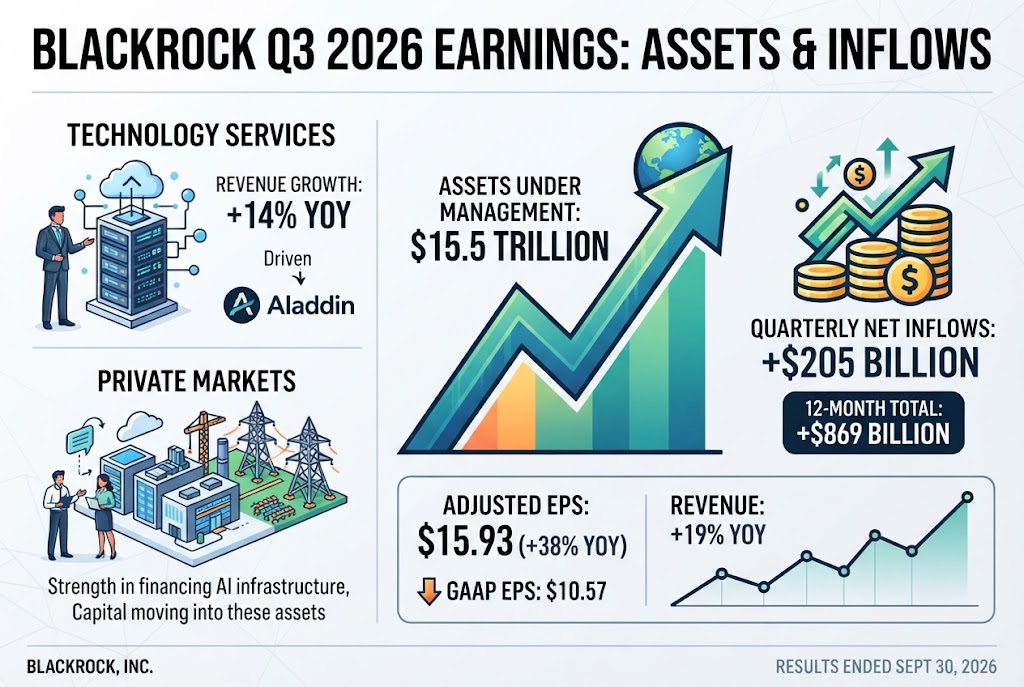
BlackRock reported third-quarter results on October 14 that show the world’s largest asset manager growing on nearly every measure: assets under management reached $15.5 trillion, net inflows totaled $205 billion for the quarter, and adjusted earnings per share rose 38% from a year earlier. The numbers give investors a view of where money is flowing as AI infrastructure spending reshapes capital markets.
The quarter ended September 30, 2026. The firm’s results also showed strength in technology services and in private markets, two businesses that matter to the AI buildout.
Inflows and fee growth
Net inflows of $205 billion for the quarter brought the trailing twelve-month total to $869 billion. Organic base fee growth was 11% annualized in the quarter and 10% over twelve months, a sign that new money is coming into higher-fee products and not only into low-cost index funds.
Revenue rose 19% from a year earlier. GAAP operating income also rose 19%, and operating income as adjusted climbed 27%.
Earnings per share
Diluted earnings per share were $10.57 on a GAAP basis, up 25% year over year, and $15.93 as adjusted, up 38%. The adjusted figure also reflects higher nonoperating income. BlackRock said a noncash change in the fair value of contingent consideration from prior acquisitions affected its GAAP results, and it excludes that item from adjusted figures.
The firm repurchased $550 million of its shares in the quarter.
What the inflow numbers imply
The scale is easier to see in ratios. Quarterly net inflows of $205 billion equal about 1.3% of the $15.5 trillion in assets under management, and the twelve-month total of $869 billion is roughly 5.6% of the same base. Those are the author’s calculations from BlackRock’s reported figures, and they show a business adding assets at a mid-single-digit annual pace on top of market gains.
The gap between GAAP and adjusted earnings is also worth noting. Adjusted diluted EPS of $15.93 is $5.36 above the GAAP figure of $10.57. BlackRock named the noncash change in contingent consideration from prior acquisitions as one item affecting GAAP results, and investors who compare the two measures should read the release’s reconciliation for the full list.
Technology and private markets
Technology services and subscription revenue grew 14% from a year earlier, driven by Aladdin and multi-product solutions. Aladdin is BlackRock’s investment management and risk platform, and it makes the company as much a software provider as an asset manager.
Private markets were cited as a source of strength in the quarter’s inflows. The release did not break out infrastructure or AI as separate drivers. Even so, private-market strength fits the broader story of institutional capital moving into the assets that finance data centers, power and networks.
Fink’s data center warning
The results came out on the same day Chief Executive Larry Fink spoke to CNBC. He warned that “if we have a moratorium of some sort in this country, we will be in a recession,” arguing that much of the economy is tied to AI infrastructure spending. BlackRock shares rose about 1% in late-morning trading after the earnings release.
The earnings release itself contains no quote from Fink, so the link between the two events is context rather than a statement in the results. Still, a firm managing $15.5 trillion has a large stake in whether AI infrastructure projects proceed, and its comments carry weight with policymakers.
How BlackRock compares
BlackRock’s scale sets it apart from rivals. The $205 billion of quarterly net inflows and the $869 billion over twelve months show that clients continue to add to its platforms. Competitors in asset management and in alternatives, such as Blackstone, compete for the same institutional mandates.
The 14% growth in technology services is a separate advantage. Aladdin gives BlackRock recurring revenue that is less tied to market levels than asset-based fees are. That mix is harder for traditional managers to copy.
What to watch
Investors will look for three things in coming quarters. The first is whether organic base fee growth holds near 10%. The second is how much of the private-markets inflow turns into infrastructure and data center commitments. The third is whether policy moves, such as local restrictions on data centers, affect the pipeline of deals that BlackRock and its peers are financing. The quarter shows a firm in strong shape, but its growth now rides in part on a buildout that faces rising resistance.
Readers who want the full picture should read the complete earnings materials and the call transcript, and compare the quarter’s inflow mix against prior periods to see whether private markets are gaining share.
Leave a Reply